

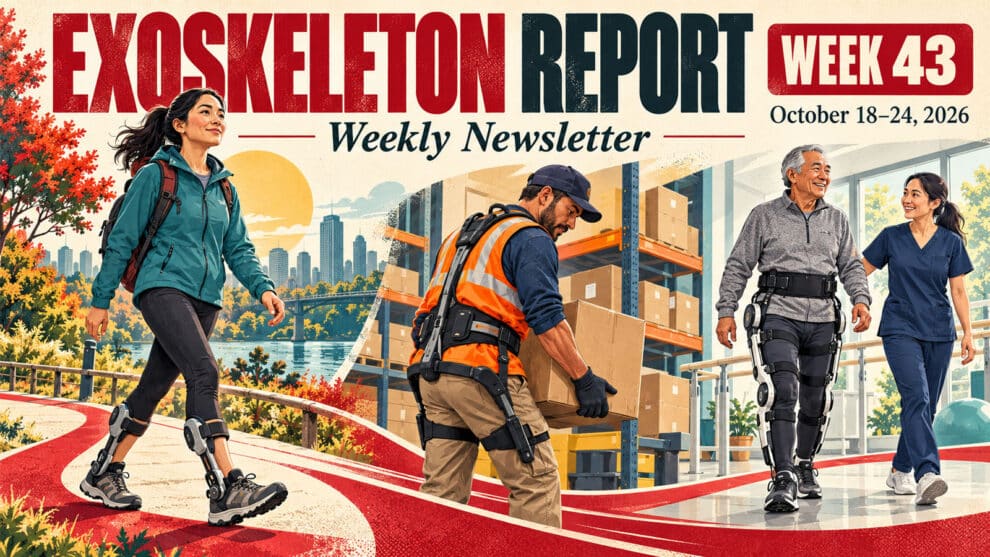
Welcome to the digital archive of the Exoskeleton Report weekly newsletter. We live in a chaotic world, but interesting things happen in the world of physical human enablement that may go unnoticed. This is my way to remind the community that good things are still happening all over the world!
Exoskeleton Report Newsletter Week 43
October 18 to October 24, 2026
Consumer
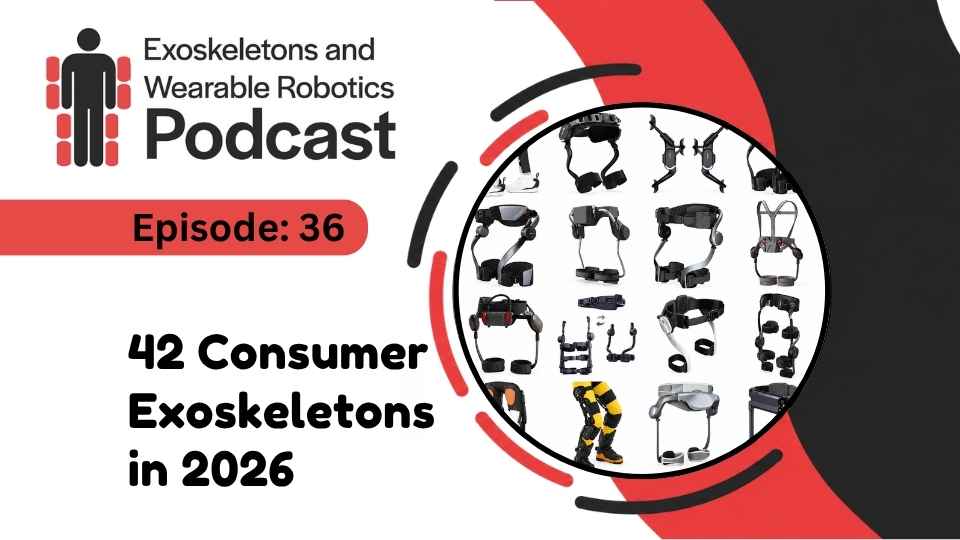
42 Consumer Exoskeletons in 2026
So, on the podcast we have talked about what consumer exoskeletons are for, what are some of the hurdles to their adoption, we had an episode where Dr. Sugar puts multiple devices to the test, we had an episode on storage and maintenance and I have posted videos of my grandmother using them… but what are the consumer exoskeletons? This is not an exhaustive list, plus things appear to be changing daily, but I wanted to take a stab at it and list the consumer exoskeletons that we know about, what have we seen or gotten to try in person, and what can we infer from the marketing material for the rest. We tried to go quickly as this was a lot of websites and devices to bring up! Get all the links to video and audio versions on Exoskeleton Report.
CĀPABL Launches Consumer Exoskeleton Website
Physical therapist Cody Jacox has launched CĀPABL, a website aimed at helping individuals, families, and healthcare professionals discover and compare consumer exoskeletons. The site brings together product specifications, available reviews, and information on opportunities to try devices, with plans to develop a clinician network and structured product evaluations.
Dephy Veterans Day Sidekick Giveaway
Dephy is giving away six Sidekick exoskeleton systems to veterans this Veterans Day, recognizing the service members who helped test and shape its early technology. The giveaway aims to help veterans stay active and connected to their communities. Nominate yourself or a veteran you know by November 2, with recipients announced November 11. Details, eligibility, and nominations →
MIT-developed exoskeleton shoes learn your stride and push off your heel with each step – YouTube – WCCO – CBS Minnesota
Industrial
Five-Month Warehouse Trial Adds Evidence on Back Exosuits
Longer-term randomized studies of exoskeletons in actual workplaces remain relatively uncommon, making this new paper in Ergonomics a valuable contribution. Researchers enrolled 97 workers across six logistics warehouses to evaluate Verve Motion’s SafeLift powered back exosuit over approximately five months, tracking discomfort, effort, device use, and usability during everyday work.
The results were mixed. The main randomized comparison found no statistically significant reduction in back discomfort, although overall body discomfort improved. An exploratory analysis found that workers classified as moderate users experienced fewer episodes of worsening back discomfort and reported approximately 20% less back effort during early follow-ups compared with their starting levels. However, these workers also began with less discomfort and more favorable impressions of the device, limiting how confidently the differences can be attributed to the exosuit.
ExR’s Perspective: This study adds useful evidence about what happens when exosuits enter everyday warehouse operations. It offers encouraging findings, while leaving injury prevention unproven. It also documents practical obstacles: task suitability, heat, and access to storage and charging affected use. Evaluating workplace exoskeletons requires understanding both what the technology can do and whether workers can comfortably and consistently use it.
Read the study: Moderate exosuit use reduces the incidence of back discomfort in logistic warehouse workers: a randomised controlled trial with an exploratory dose-stratified analysis
Japan adds non-powered assist suits to an equipment subsidy program
Japan has added non-electric assist suits to its catalog-based subsidy program for labor-saving equipment, opening another funding route for occupational exoskeletons. Eligible small and medium-sized businesses purchasing registered products can receive subsidies covering up to 50% of qualifying costs, with per-application ceilings ranging from ¥5 million to ¥15 million (approximately US$31,900 to $95,600) depending on workforce size and qualifying wage increases. The Assist Suit Association oversees product review for this category, which includes devices using springs, rubber, pneumatic reaction forces, or non-powered load redistribution. Its anti-resale measures include publishing recipient companies and equipment serial numbers, checking continued use every four months, and requiring difficult-to-remove identification stickers that leave visible evidence of removal. Unauthorized resales would trigger public disclosure and notification to the subsidy administration. The initiative pairs financial support for adoption with measures intended to keep subsidized equipment in use. Read the association’s announcement.
Medical
Immediate effect of gait training using the hybrid assistive limb in patients in the acute phase of stroke: a prospective pilot study
A small Japanese pilot study published October 23 in Frontiers in Neurorobotics explored whether CYBERDYNE’s Hybrid Assistive Limb (HAL) exoskeleton could improve walking immediately after rehabilitation sessions early after a stroke. Researchers at Tokushima University Hospital followed four patients, analyzing 31 HAL-assisted and 20 conventional training sessions. Walking speed and step length improved significantly immediately after HAL training, although the adjusted comparison did not establish a statistically significant advantage over conventional training. An exploratory analysis suggested greater benefits during sessions when patients initially walked more slowly. These preliminary findings support further investigation, but the small, nonrandomized study cannot establish whether the immediate improvements translate into lasting recovery. Read the study, found via Bioengineer.org.
Technology
China Focuses on Developing Robots for an Aging Society / KBS 10/22/2026
ExR’s Perspective: when the use comes before the device: robot showers, massagers and exoskeletons can all fall together in the same tech group.
Awards
Georgia Tech Awarded $1.5 Million to Help Older Adults Find Assistive Technology
Georgia Tech researchers have received a three-year, $1.5 million federal grant to expand ACCESS for Aging Well with Assistive Technology 2.0, a platform designed to help older adults find tools that support independent living. Led by Nathan Moon, the project will combine an existing aging-resource website and assistive technology catalog, using AI, expert input, and state program data to guide assessments and recommendations. Community discussions and product reviews will help refine suggestions, while partnerships with senior centers, rehabilitation centers, and aging agencies will help connect people with available resources. The goal: make suitable assistive technology easier to find and access for people who want to remain in their homes and communities.
“For every $1 spent on assistive technology, people save $9,” Moon said. “Assisted living is terribly expensive. We will never replace assisted living or nursing homes, but we do want to give people the choice to age successfully in their communities of choice.” – Principal research scientist Nathan Moon
#ExoJobs
- Fully Funded PhD Position – Wearable Robotics | Fall 2027 – Kennesaw State University
- Assistant or Associate Professor of Kinesiology and Health – IOWA State
- 9 Open Positions at Edgerun Technologies
- Trexo is recruiting licensed U.S. PTs and OTs
- Multiple Positions at WIRobotics (exos and humanoid robotics)
- 15 Positions Open at Angel Robotics
- 7 Positions Open at SKIP
- 7 Positions Open at hTRIUS
Do you have an open position you would like posted here?
Email: Hello@ExoskeletonReport.com
Special Thanks To!
Please welcome EASE as our newest corporate-level sponsor!!
Heartfelt thanks to our paid Patreon subscribers:
- Corporate Tier: Humotech, Auxivo, HeroWear, Digity, Hypershell, Proteso, Crimson Dynamics, RoboGolfPro, Skelex, Logosol, EASE
- V.I.P: Volker Bartenbach, Rita Vazquez-Torres, MinMar, George Georgiev, Hapo
- Main Tier: SupperEssence, Karl Zelik, George Woodland, Stefano Toxiri, Sebastien Stassin, Diego Arbea, Cody Jacox
Support ExR by Becoming a Patreon Member
If Exoskeleton Report helps you stay current on wearable robotics, please become a paid Patreon member today. Join the readers and sponsors already backing ExR and help keep this independent, high-signal newsletter free to read and growing.
Advertising & Consulting Now Available
Please Support the Exoskeleton Report on Patreon
Some links on the Exoskeleton Report are affiliate links, which means we may earn a commission if you purchase through them. This helps support our work and keeps the site running.


Add Comment