

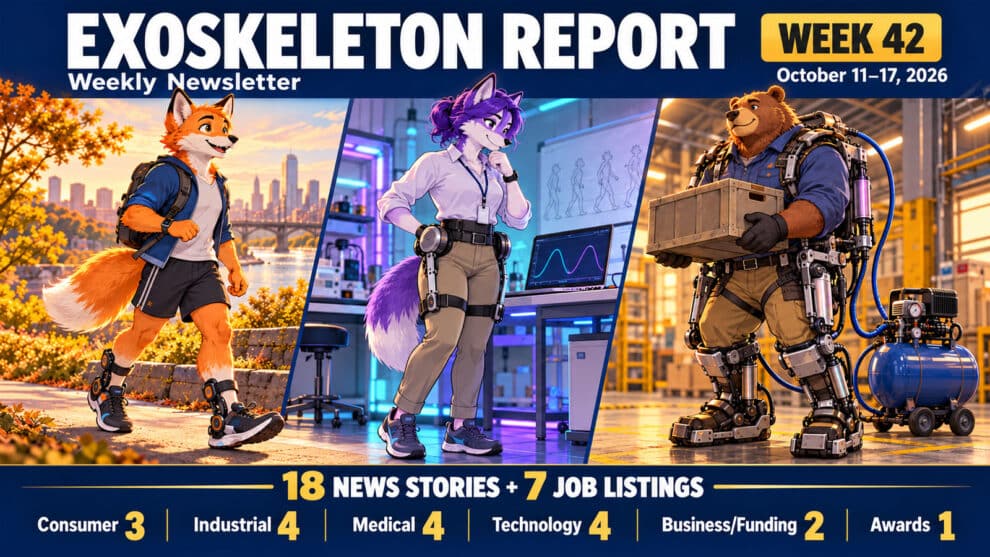
Welcome to the exoskeleton and wearable robotics news for Week 42: October 11, 2026 – October 17, 2026. While the world remains chaotic, here are 18 relevant news items and achievements from last week alone! As usual, subscribe to the email newsletter for the best results and timely delivery.
Exoskeleton Report Newsletter Week 42
October 11–17, 2026
Consumer
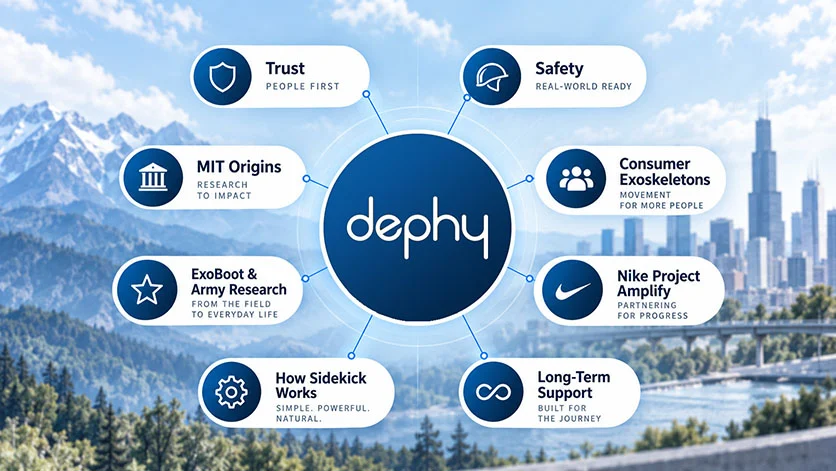
Why the Ankle? Interview with Dephy CEO Luke Mooney on the Sidekick and the Future of Consumer Exoskeletons
ExR’s Perspective: I had the pleasure of doing a written interview with Dephy’s co-founder about powered ankle assistance, the Sidekick, the consumer exoskeleton market, research, and trust… read more on Exoskeleton Report
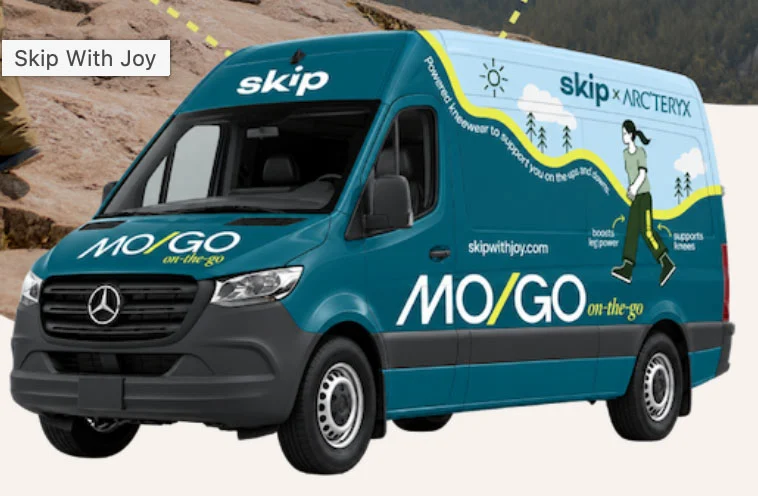
Skip’s MO/GO Demo Van Is Ready to Hit the Road
Skip has unveiled a customized MO/GO demonstration van and is asking its community to help plan the route. In its latest email update, the company invites interested users to share their nearest city so it can identify potential stops. Skip also welcomes inquiries from groups interested in hosting demonstrations. Want the van to visit your area? Share your location with Skip.
ExR’s Perspective: Access to hands-on demonstrations matters. A traveling demo program could give more people the opportunity to assess an exoskeleton’s fit, comfort, and assistance before committing to a purchase.
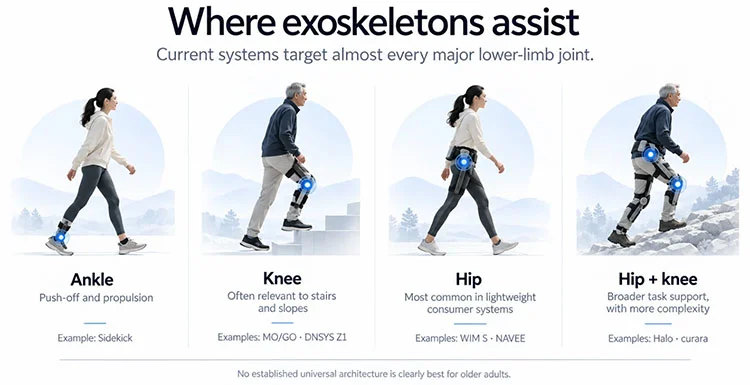
Exoskeletons for Older Adults in 2026: What Can You Actually Buy, Rent or Trial?
Exoskeleton Index’s new guide to exoskeletons for older adults explores available devices, research findings and limitations, and options to buy, rent, or trial. It also examines cost, fitting, and accessibility, and whether users will keep wearing these devices over time.
ExR’s Perspective: This is precisely the kind of resource I would like to see more of, and create more of ourselves. Catalogs, directories, and maps establish the foundation: who makes what, and where it can be found. The next step is to bring that information together into accessible guides that help readers understand the choices, evidence, and unanswered questions.
I especially appreciated the clear graphics, careful treatment of study limitations, and attention to distribution, cost, and accessibility, topics becoming increasingly important as exoskeletons reach more people. Thank you to Exoskeleton Index for including my contributions and linking readers to ExR. We welcome further collaboration: turning scattered information into useful, digestible knowledge is one of the ways we can help move the field forward.
Read the full guide at Exoskeleton Index.
Industrial
LYB and exoIQ collaborate on material solutions for industrial wearable exoskeletons
LyondellBasell (LYB) is collaborating with exoIQ on materials for its B900 active back exoskeleton. LYB supplies glass fiber-reinforced polyamide for structural strength, polypropylene for lightweight components with impact resistance, and masterbatch solutions for consistent color and appearance. The collaboration addresses the need to balance strength, durability, and low weight across different components of an industrial exoskeleton.
Bobby: Would other companies developing exoskeletons be able to purchase the same polymer for their exoskeletons from you?
“Yes, other companies developing exoskeletons would be able to purchase the same polymers that exoIQ purchased for the B900.
The LYB team worked with exoIQ to develop complementary solutions for different B900 components to meet requirements for strength, durability, lightweight performance, and design.” – LYB, Corporate Communications
You can find the full press release on https://www.lyondellbasell.com/en/who-we-are/updates-events/…
SUITX by Ottobock Expands Exoskeleton Distribution Through Würth’s European Store Network
Industrial exoskeletons are becoming available where tradespeople already shop for tools and supplies. SUITX by Ottobock is expanding its partnership with Würth, one of Europe’s major B2B distributors of industrial and construction supplies, to make exoskeletons accessible through its extensive network of physical trade stores. More than 90 Würth branches in Germany already offer exoskeleton solutions, with plans to exceed 100 by the end of 2026 and expand to 240 locations in France by March 2027. The partnership allows construction companies and skilled tradespeople to receive in-person advice and try exoskeletons before purchasing, potentially overcoming a significant barrier to wider adoption.
Sources: Ottobock Official Announcement | AD HOC News
EksoWorks/EVO went to DynaWear Tech – acquisition follow-up.
A ChronoScale filing contains important information on the Ekso Bionics sale: on September 30, the industrial EksoWorks business, including EVO, was sold to DynaWear Tech, while the remaining rehabilitation business went to Wandercraft’s subsidiary. Filing.
The industrial team is continuing the business under this new DynaWear Tech company. “DynaWear will continue to manufacture and distribute Ekso EVO and to support Ekso ZeroG.” Ekso’s updated EVO page.
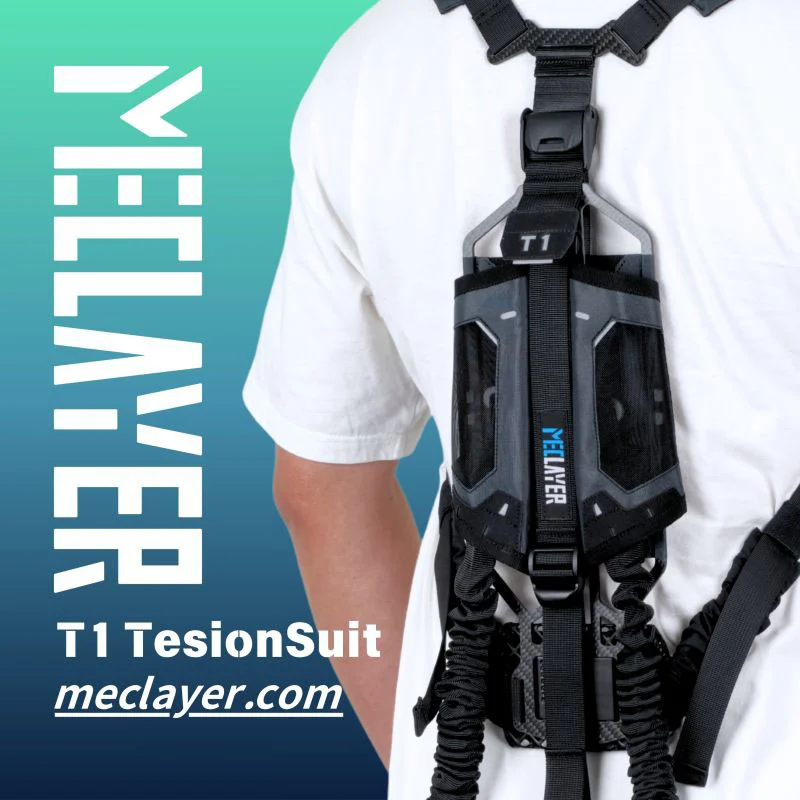
MecLayer previews the T1 TensionSuit
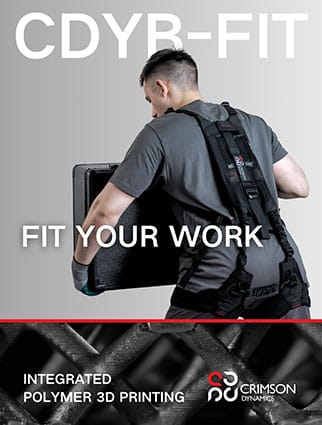
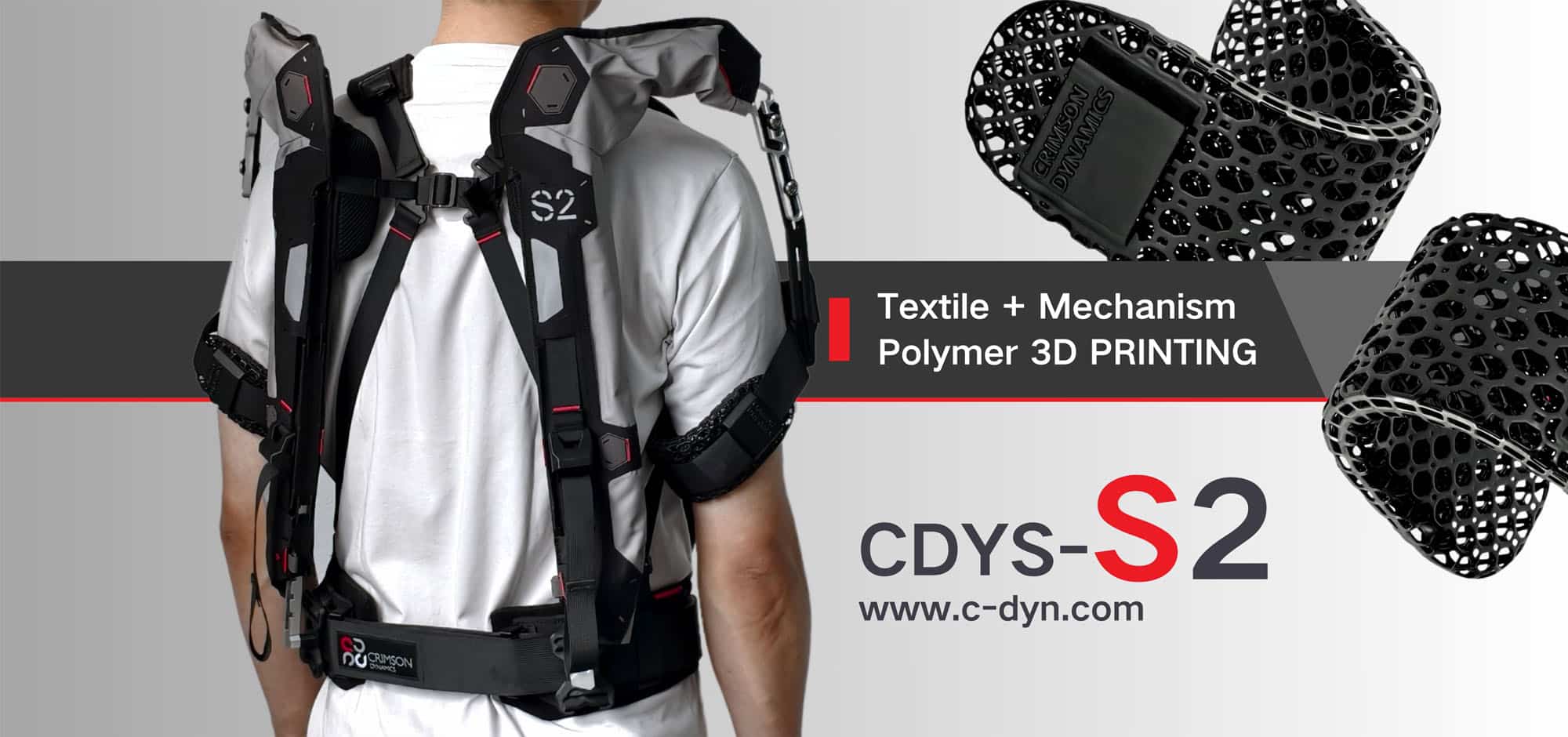
MecLayer, a new brand from Crimson Dynamics, has previewed the T1 TensionSuit, a passive back-support exosuit intended for everyday tasks and industrial work. It is designed to weigh less than 0.6 kg and uses elastic elements to assist with bending and returning upright. A mechanical “Swing Differential Mechanism” automatically switches between walking and assistance modes, without manual activation. The T1 is currently listed as “coming soon.”
Learn more about the T1 on MecLayer.com.
Medical
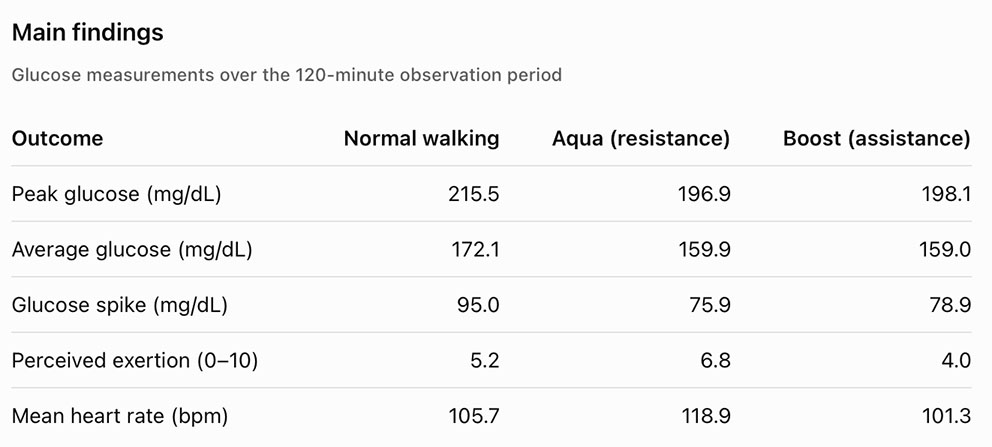
Samsung Bot-Fit Exoskeleton Shows Potential to Improve Blood Sugar Control
A new study published in BMC Endocrine Disorders evaluated Samsung’s Bot-Fit powered hip exoskeleton in 14 adults with type 2 diabetes during 30-minute walks following food consumption. Both the resistance (Aqua) and assistance (Boost) modes significantly reduced post-meal glucose exposure compared with walking without an exoskeleton, by approximately 25% and 22%, respectively. Surprisingly, the assistive Boost mode achieved comparable glucose-lowering benefits while reducing perceived exertion, whereas the resistive Aqua mode increased cardiovascular demand. The findings suggest a potential new application for wearable robotics in supporting metabolic health, although larger, longer-term studies are needed.
Source: Read the full research paper – BMC Endocrine Disorders (2026)
AI & Robotics Reshaping Rehabilitation with Professor Robert Riener
Fourier Rehab – YouTube – Featuring Professor Robert Riener, we explore how rehabilitation robotics can enhance clinical practice while keeping therapists and patients at the center of recovery.
NIH Researchers Develop Open-Source Software for Exoskeleton Control and Clinical Research
Researchers at the National Institutes of Health (NIH) have introduced BRACE, an open-source Python software framework designed to simplify the development and testing of rehabilitation robotics, including powered exoskeletons. Demonstrated using a lower-limb exoskeleton with powered knee actuators, the system allows researchers to switch between control strategies for activities such as walking and squatting, adjust assistance parameters in real time, and simulate controller behavior using previously collected data. The goal is to let researchers focus on trials and experiments and less on robotics with the intent to accelerate research into exoskeleton-assisted rehabilitation for individuals with cerebral palsy and other gait disorders, while supporting future development of controllers for more complex movements, including stairs, ramps, and obstacle negotiation.
Source: Biomedical Robotics Architecture for Clinical Experimentation (BRACE) – SoftwareX, October 2026
Open-source code: GitHub – BRACE
ReWalk Study Examines Up to 45 Months of Home Use
An Italian study highlighted by Lifeward assessed seven people with chronic paraplegia after using the ReWalk 6.0 exoskeleton at home for 20–45 months, with a median of 33 months. Six participants averaged more than 3,000 steps per month, no falls or exoskeleton-related fractures were reported, and all seven reported improvements in quality of life and mental health. Limited caregiver availability substantially reduced use for one participant, highlighting a practical barrier to sustained adoption. The small, cross-sectional study offers encouraging evidence about long-term use outside rehabilitation clinics, although it cannot establish that the device caused the reported health improvements.
Technology
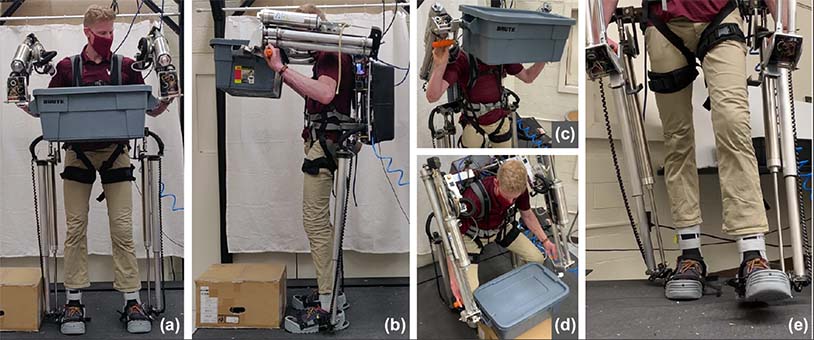
An underactuated heavy lift and carry exoskeleton
The paper features the HeavyLC Exo, which can lift and carry 36 kg total using six pneumatic actuators across a full-body structure with 20 degrees of freedom. The leg design also includes a novel unidirectional spring at the hip that generates torque during leg adduction. It achieves substantial assistance with relatively few actuators; the prototype weighs 67.4 kg, requires an external air compressor, and leaves significant stabilization demands on the wearer.
ExR’s Perspective: Who said that pneumatic exoskeletons were dead (oh yeah, I did). I guess I was wrong.
Full paper: https://www.cambridge.org/core/journals/wearable-technologie…
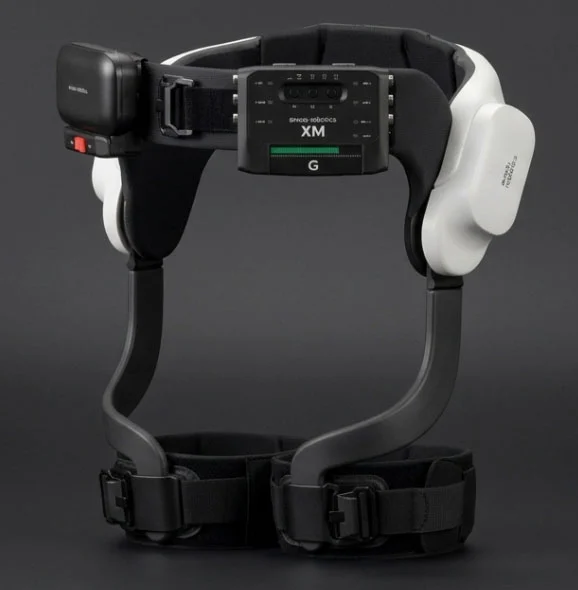
Angel Robotics Introduces phai-x1 Hip Exoskeleton for Research
Angel Robotics has introduced phai-x1, a programmable hip-assistance exoskeleton intended to help researchers develop and test wearable-robot control algorithms. Announced in late September, it builds on the company’s existing ANGEL SUIT H10 hardware and expands its research offerings beyond the components and control-experiment equipment previously offered through ANGEL KIT. The platform allows independent control of the left and right hip joints, while its XM10 expansion module runs researchers’ custom control algorithms at 1 kHz – 1,000 updates per second. This gives laboratories a complete wearable system on which to experiment with assistance strategies, reducing the hardware-development work needed to start a project.
Researchers can connect additional sensors to capture body motion, muscle activity, and ground-reaction forces alongside the robot’s operation. These capabilities support work in gait analysis, movement-intention estimation, personalized assistance, and human–robot interaction. Angel Robotics says participants at August’s IFAC Wearable Robot Challenge 2026 (3–5 students and researchers were given two days after approximately two hours of training) used the same kit. The wearable platform sits alongside the company’s phact actuators and phorce control engine in its broader Physical AI platform, extending its wearable-robot technology into tools for research and development.
Fewer Sensors, Similar Results for Exoskeleton Movement Recognition
A study published in Frontiers in Mechanical Engineering explored how motion sensors and a combined LSTM–CNN neural network could help lower-limb exoskeleton AI software recognize the wearer’s activity from motion sensors. Researchers reported approximately 94% accuracy on participants excluded from model training. Using four sensors instead of six reduced accuracy by less than one percentage point, suggesting an opportunity to simplify sensing hardware. Testing was done only on recognition, but not on mode switching.
Read the study – Frontiersin.org.
DilatArm: An Accessible, Low-cost Passive Exoskeleton using Dilatant Fluid for Viscosity Feedback – Tremor Suppression Mode and More – Embodied Dynamics Lab – YouTube
Business / Funding
Hurotics Raises ₩25 Billion (US$18.7 Million) in Series A Funding
South Korean wearable robotics company Hurotics has raised ₩25 billion (approximately US$18.7 million) in a Series A round led by Atinum Investment, with participation from strategic investors including Daewoong, Naver, and Lotte. The funding will support international regulatory approvals and distribution for its H-Medi rehabilitation exosuit, alongside development and mass production of H-Care for everyday walking assistance. H-Medi is already being used at several Korean hospitals and was supplied to the University of Illinois Chicago for stroke rehabilitation research and physical therapist training. The investment supports Hurotics’ expansion from clinical rehabilitation into daily mobility assistance.
E-bike maker Velotric plans consumer exoskeleton expansion following $29.9 million funding round
Velotric has announced plans to enter the consumer exoskeleton market after raising RMB 200 million (approximately US$29.9 million) in Series C funding. Its planned wearable robots will focus on recreational hiking, prioritizing wearing comfort and helping everyday users extend their outdoor activities. The financing also supports golf carts, technology development, and global operations. Velotric reports more than 1,600 independent bicycle dealers across North America, potentially providing a substantial retail and service network for future exoskeletons. The announcement does not disclose an exoskeleton model, specifications, pricing, or launch date.
Awards
Hypershell X Ultra S Named to TIME’s Best Inventions of 2026
TIME has included the Hypershell X Ultra S in its annual Best Inventions list, bringing consumer exoskeletons further into the mainstream spotlight. Published October 15, the entry highlights its HyperIntuition control algorithm, designed to anticipate users’ movements and provide smoother assistance during hiking, running, and cycling. The device is one of 300 inventions recognized in this year’s unranked selection. Exoskeletons have appeared on TIME’s list before, including Enhanced Robotics’ Sportsmate 5 in 2022 and Arc’teryx and Skip’s MO/GO in 2024.
ExoJobs
- Assistant or Associate Professor of Kinesiology and Health – IOWA State
- 8 Open Positions at Edgerun Technologies
- Trexo is recruiting licensed U.S. PTs and OTs
- Multiple Positions at WIRobotics (exos and humanoid robotics)
- 14 Positions Open at Angel Robotics
- 7 Positions Open at SKIP
- 7 Positions Open at hTRIUS
Special Thanks
Please welcome EASE as our newest corporate-level sponsor!!
Heartfelt thanks to our paid Patreon subscribers:
Corporate Tier: Humotech, Auxivo, HeroWear, Digity, Hypershell, Proteso, Crimson Dynamics, RoboGolfPro, Skelex, Logosol, EASE
V.I.P: Volker Bartenbach, Rita Vazquez-Torres, MinMar, George Georgiev, Hapo
Main Tier: SupperEssence, Karl Zelik, George Woodland, Stefano Toxiri, Sebastien Stassin, Diego Arbea, Cody Jacox
Support ExR by Becoming a Patreon Member
If Exoskeleton Report helps you stay current on wearable robotics, please become a paid Patreon member today. Join the readers and sponsors already backing ExR and help keep this independent, high-signal newsletter free to read and growing.


Add Comment