


The biggest news of last week: exoskeleton technology received favorable coverage in a well-analyzed report on Swiss TV. This is, and much more, of the wearable robotics news from last week:
Exoskeleton Report Newsletter Week 39
September 20–26, 2026
Walking with Springs, Part 2: Over Two Decades of Wearable Robotics with Dr. Tom Sugar
I had no idea that Tom has worked on so many systems and projects. Motorized backpacks, gravity-compensation exoskeleton, wearable jet pack, wearable robots for running, pushing, climbing… No wonder we had to split it into two episodes! As usual, you can find links to the audio version + transcript summary and relevant links for Episode 35 on the Exoskeleton Report.
Consumer
Hypershell launches a directory of stores and experience hosts that can demo their exoskeletons
Hypershell’s “Try-On Nearby” page lets visitors search for retail locations and individual Experience Hosts where they can explore its exoskeletons before buying. The directory currently displays 171 stores and 28 hosts. Explore Try-On Nearby
The Next Robotics Frontier — ASME
ASME’s “The Next Robotics Frontier” profiles Skip founder Kathryn Zealand alongside the founders of Andromeda and Tatum Robotics, exploring how personal experiences shaped technologies addressing mobility, loneliness, and communication barriers. The Skip section discusses MO/GO’s development around independence, hands-free movement, and user acceptance. Read the ASME article
Exoskeleton vs Mt Whitney: Can the DNSYS Z1 Live Up To The Hype?
“Well there is no better place to test the DNSYS Z1 than on the Mt. Whitney trail . With 23 miles and almost 7,000FT of vertical gain, we are about to find out if an exoskeleton really can assist with endurance and bad knees.” – YouTube -LiveHardxLoveHard
Medical
Eve by Wandercraft | US Exoskeleton Launch Event | Full Replay
Watch the full broadcast on YouTube – Includes a panel with Dr. Karen Nolan, how medical exoskeleton research builds upon decades of advocacy work for people with disabilities and much more! Research needs to be translated into documents for advocacy groups so they can get the word out.
Awards
Hiroshi Kobayashi wins the ninth Tateisi Prize Achievement Award for promoting harmony between humans and machines
Innophys founder and Tokyo University of Science professor Hiroshi Kobayashi has been named the recipient of the ninth Tateisi Prize’s Achievement Award for bringing the Muscle Suit into mass production and worldwide use. Presented by the Tateisi Science and Technology Foundation, the prize recognizes achievements that promote “harmony between humans and machines,” highlighting Kobayashi’s work to support lifelong independence, reduce physical strain, and address the challenges of aging populations and labor shortages. Announcement
Business
Chinese exoskeleton maker explores US market
Exoskeleton market growth in China is reported to have increased more than fourfold in the first half of 2026, while producers eye the U.S. and other international markets. A four-minute video accompanies the article: CGTN 2026
The 1.6 billion-yuan exoskeleton market is red-hot: hospitals are making huge profits, yet the best-selling product is the thousand-yuan “hiking pants”
In a separate business article, 36KR breaks down the Chinese exoskeleton industry as one still dominated financially by medical exoskeleton sales, when measured by total revenue rather than number of units.
Technology
Design and Finite Element Analysis of a PEEK-Based Pediatric Hip Exoskeleton for Gait Rehabilitation in Children with Cerebral Palsy
A simulation only study compared four PEEK hip-joint designs for a proposed pediatric rehabilitation exoskeleton, identifying a trade-off between lower stress and reduced deflection. ExR’s Perspective: having worked with PEEK for many years I have also wondered about its usability for exo construction. I am happy to see that others are taking a look at the question. Paper available on MDPI.
Hiking with a Motor: Exoskeletons Take Over Daily Life | Einstein | SRF Wissen
Presented in German, with closed captions available through auto-translate. Watch on YouTube — SRF Wissen
Swiss public broadcaster SRF explores exoskeletons for recreation, aging, and work in this 36-minute episode of its science programme, Einstein. Presenter Tobias Müller tests a Hypershell while climbing stairs and cycling, with ETH Zurich researchers measuring its effects on physical effort and movement. The programme also follows an 85-year-old woman with knee osteoarthritis as she attempts a group hike with assistance.
The coverage then turns to occupational exoskeletons in automotive workshops, logistics, and waste handling, examining their potential to support workers – and whether assistance might also bring expectations of greater productivity. These stories connect around one question: what can exoskeletons offer in everyday life? Presented in German, the episode combines personal experiences, workplace reporting, and scientific testing to explore both benefits and practical limitations.
New AURA Lab Connects Exoskeleton Research from Rehabilitation to Space
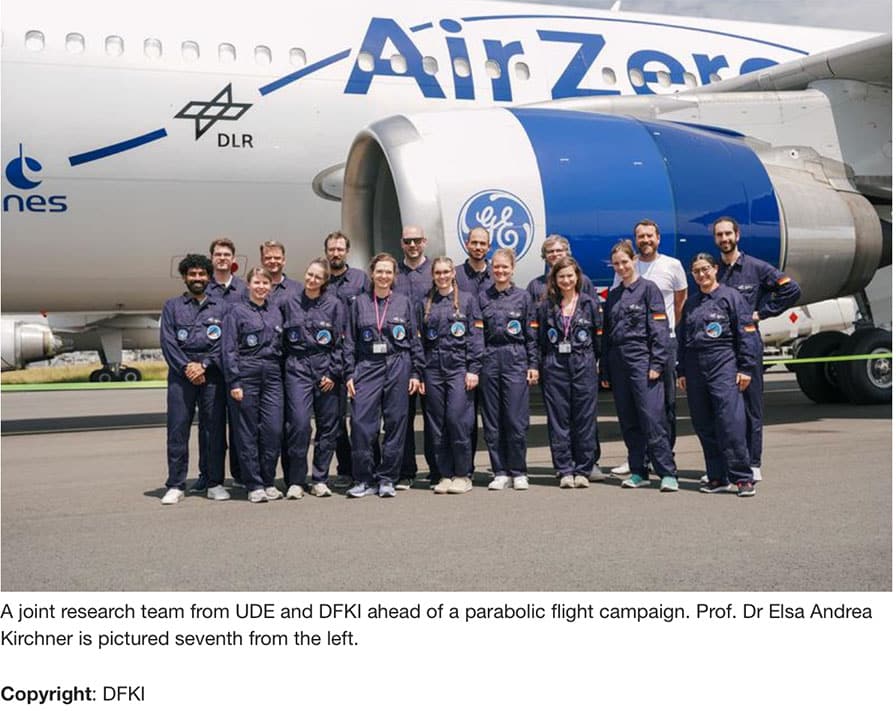
The University of Duisburg-Essen and the German Research Center for Artificial Intelligence (DFKI) are establishing the AURA Lab, an AI and robotics hub with a strong exoskeleton focus. Led by Professor Elsa Andrea Kirchner, it gives their collaboration, underway since 2021, a permanent base and brings in additional research groups. Highlighted applications include:
- Stroke rehabilitation: Exoskeletons that adapt assistance to individual users to help them relearn movements.
- Astronaut training — MikroBeM: An exoskeleton counterbalances the arm’s weight to simulate microgravity on Earth. Parabolic flights test whether that training improves movement in actual weightlessness; the fourth campaign took place in September.
- Robot teleoperation — ExoAssist: Since July, researchers have been developing a full-body exoskeleton that could allow astronauts to control remote robots through their movements for tasks in orbit or on the Moon.
#ExoJobs
- Trexo is recruiting licensed U.S. PTs and OTs
- Six positions open at ABLE Human Motion – Spain
- Multiple Positions at WIRobotics (exos and humanoid robotics)
- 15 Positions Open at Angel Robotics
- 12 Positions Open at SKIP
- 6 Positions Open at hTRIUS
Do you have an open position you would like posted here? Email Hello@ExoskeletonReport.com
Special Thanks
Heartfelt thanks to our paid Patreon subscribers:
- Corporate Tier: Humotech, Auxivo, HeroWear, Digity, Hypershell, Proteso, Crimson Dynamics, RoboGolfPro, Skelex, Logosol
- V.I.P: Volker Bartenbach, Rita Vazquez-Torres, MinMar, George Georgiev, Hapo
- Main Tier: SupperEssence, Karl Zelik, George Woodland, Stefano Toxiri, Sebastien Stassin, Diego Arbea, Cody Jacox
Support ExR by Becoming a Patreon Member
If Exoskeleton Report helps you stay current on wearable robotics, please become a paid Patreon member today. Join the readers and sponsors already backing ExR and help keep this independent, high-signal newsletter free to read and growing.
Strategic Partners
By: Borislav “Bobby” Marinov | Borislav.Marinov@ExoskeletonReport.com
Advertising & Consulting Now Available
Some links on the Exoskeleton Report are affiliate links, which means we may earn a commission if you purchase through them. This helps support our work and keeps the site running.


Add Comment