

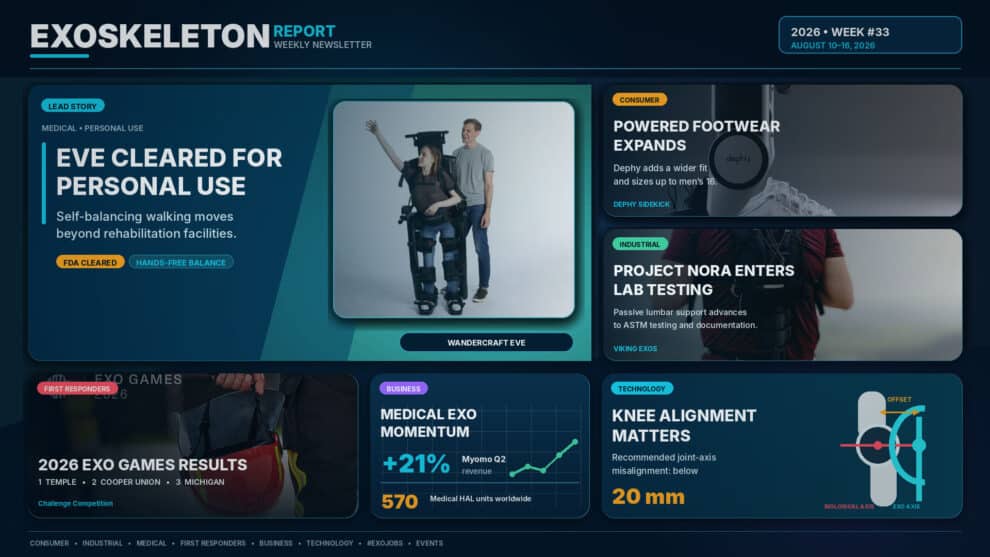
The march of the exoskeleton and wearable robotics industry carries on. This week, a new FDA approval for a personal-use exoskeleton, more evidence on the tight requirements for augmenting the knee, encouragement for business data, a podcast once again emphasizing the need for usability, jobs, events, and so much more!
Visual Archive:
Text-Only Archive: Week 33: August 10 – 16, 2026
Kathryn Zealand Is Building “Predictive Text for Walking” at Skip
Kathryn Zealand, founder and CEO of Skip, and Jessica Bath, DPT, PhD, assistant professor of physical therapy at UCSF, join Brian Heater for a special episode of Automated about wearable robotics, Parkinson’s disease, freezing of gait, and the future of human mobility. – YouTube – Automated Podcast and Skip
Dephy Expands the Sidekick Footwear Line, Broadening Access to the World’s Only Ankle-Powered Walking Technology
Dephy has added a second footwear option designed for standard-to-wide feet, extending the available size range from women’s 4 through men’s 16. The wider model adds softer cushioning, reduced arch support and easier entry while retaining the carbon ground-reaction plate and quick-attach interface that transfer adaptive push-off assistance from the powered ankle units to the ground. – PRNewswire
Reudyn launches robotic exoskeleton to help people walk and run further and faster
Reudyn – a newly established Shenzhen consumer wearable-robotics brand backed by established micromobility manufacturer Shenzhen LEQI Intelligent Technology. Its first product, the Hip X26 hip-assist exoskeleton, is announced for September 2026, but specifications and pricing have not yet been released. – FitTechGlobal
2026 H2 Consumer Exoskeleton NEWS — Hip, Knee & Integrated Models, New Releases YouTube – RIDER Techjoy
“This video takes an in-depth look at the latest developments in the consumer exoskeleton market, covering three major areas: **hip, knee, and ankle exoskeletons**. We take a look at brands including HYPERSHELL, VIGX, ASCENTIZ, VASTNAUT, DNSYS, YROBOT, Haier, Fubao Technology, WIMRobotics, DEPHY, and more, as well as new products that may be launched in the second half of 2026.”
ExR’s Perspective: Yet another wonderful video outlining the differences and capabilities of conusmer exoskeletons. Remember to use YouTube subtitles in English. The structure is similar to my CES 2026 video… just keeping track of the consumer exos alone is starting to get challenging (a good problem to have).
Viking Exos Moves Project NORA Into Laboratory Work
Viking Exos says its passive, battery-free Project NORA lumbar-support exoskeleton has progressed from outdoor field trials into laboratory testing and documentation using ASTM F3358 and F3427. The company has also opened access to a technical white paper describing the design and initial alpine and backcountry deployments – Viking Exos
FDA Clearance for Eve, Wandercraft’s Personal Use Self-Balancing Walking Exoskeleton – link
Effects of lower limb exoskeleton-assisted rehabilitation training on ischemic stroke patients with ICU-acquired weakness
An accepted Scientific Reports study examined lower-limb exoskeleton rehabilitation in 72 stable inpatient-rehabilitation patients with ischemic stroke and ICU-acquired weakness, a diffuse loss of strength associated with critical illness and prolonged ICU care. Both groups received the same total 80 hours of rehabilitation over eight weeks, but the experimental group replaced part of its conventional physical therapy with progressively intensified training using the UG220 exoskeleton from Chengtian Technology. Compared with conventional rehabilitation alone, the exoskeleton group finished with higher overall muscle-strength and lower-limb Fugl-Meyer scores, larger quadriceps and gastrocnemius cross-sectional areas, and more symmetrical muscle activation measured by surface EMG; osteocalcin and alkaline phosphatase also increased, while creatine kinase did not differ significantly. The findings suggest that exoskeleton training may accelerate short-term neuromuscular and musculoskeletal recovery in this selected population, although the single-center, retrospectively registered study did not assess long-term retention, independent walking, activities of daily living, or community mobility.
CYBERDYNE Narrows Loss and Introduces Updated Medical HAL
CYBERDYNE reported revenue of ¥1.027 billion for the quarter ended June 30, 2026, up 2.7% year over year, while its operating loss narrowed sharply from ¥100 million to ¥17 million. Growth came partly from product rentals in the Asia-Pacific region and treatment services in the United States, with 570 Medical HAL Lower Limb units now operating worldwide. The company also began Japanese rental sales of an updated Medical HAL model designed to accommodate users approximately 150–190 cm tall, with an overseas rollout planned; net profit reached ¥374 million, although investment-valuation and foreign-exchange gains contributed substantially. CYBERDYNE
Myomo raises guidance following 21% quarterly growth
Myomo reported second-quarter 2026 revenue of $11.7 million, up 21% year over year, and raised its full-year revenue guidance to $45–47 million. It also said 53% of quarterly revenue came through its MyoConnect referral network and other recurring sales channels. https://myomo.com/myomo-reports-second-quarter-2026-financia…
Official 2026 Exo Games Results Posted on the ET CoE Website
Temple University won the Challenge Competition, followed by The Cooper Union and the University of Michigan; Cooper Union won the presentation award, Vrije Universiteit Brussel won poster and design, and Michigan won both the Team Description Paper and Teams’ Choice awards. This is a clean, timely newsletter story, especially because the August 3–6 competition focused on emergency-response exoskeletons and ASTM F48 test methods. – ET CoE
Study on the Influence of Rotation Axis Misalignment of the Exoskeleton Knee Joint on Human Knee Joint Torque
A new study in Sensors quantifies how knee-joint misalignment can create substantial unwanted loading in a rigid lower-limb exoskeleton. Jiang and colleagues developed an OpenSim human–exoskeleton model that represented both strap compliance and soft-tissue deformation, shifted the exoskeleton’s knee axis forward, rearward, upward and downward, and compared the predicted effects with torque and muscle-activity measurements from eight healthy volunteers. The response was strongly direction-dependent: in simulations, a 50 mm rearward offset increased peak knee-flexion torque by 211.2%, while a 50 mm upward offset increased peak extension torque by 38.9%. Even at a 20 mm offset, maximum torque differences reached 54.65%, and the study’s relative assistance-efficiency metric declined by as much as 5.13%. The authors recommend keeping knee-axis misalignment below 20 mm, reinforcing that joint geometry, careful fitting and resistance to device slippage are central performance and safety considerations rather than merely matters of comfort. – Sensors
Plus jobs, events and much more in the original e-mail version. Make sure to subscribe and special thanks to all of our Patreon members!


Add Comment