

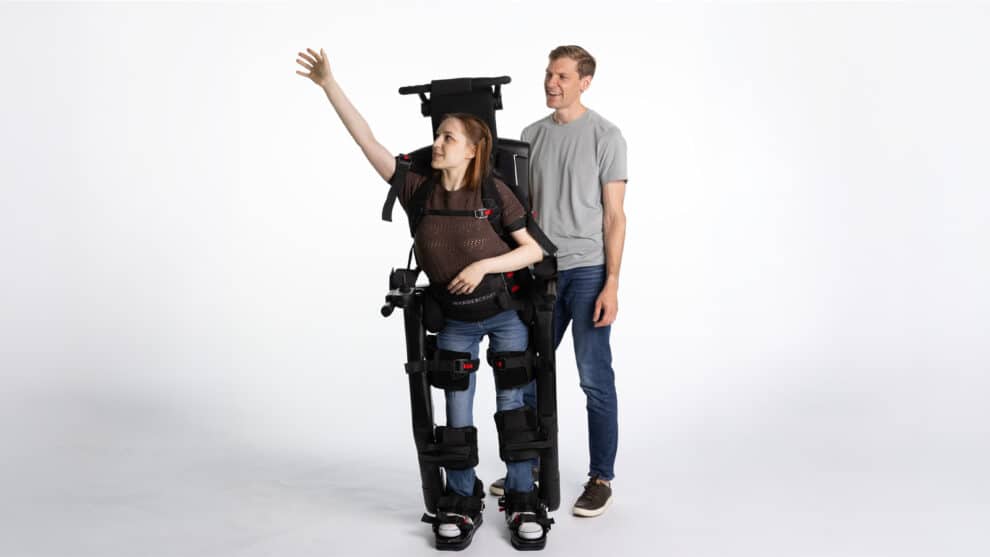
The U.S. Food and Drug Administration (FDA) has cleared Wandercraft’s Eve for personal use, bringing Wandercraft’s hands-free balancing technology beyond rehabilitation facilities and into prescribed personal use for eligible adults with spinal cord injuries. The device is intended to give eligible wheelchair users living with spinal cord injuries additional opportunities to stand, walk, and perform everyday activities while upright. A U.S. commercial launch is planned for September 17, 2026.
According to Wandercraft, Eve may be used by eligible adults with spinal cord injuries at any level, provided that the user can operate the device’s remote control. That is an unusually broad description compared with the injury-level limitations historically associated with many personal exoskeletons, although “at any level” should not be interpreted to mean that every person with a spinal cord injury will qualify. Individual users must still undergo a clinical assessment, fitting, and training process.
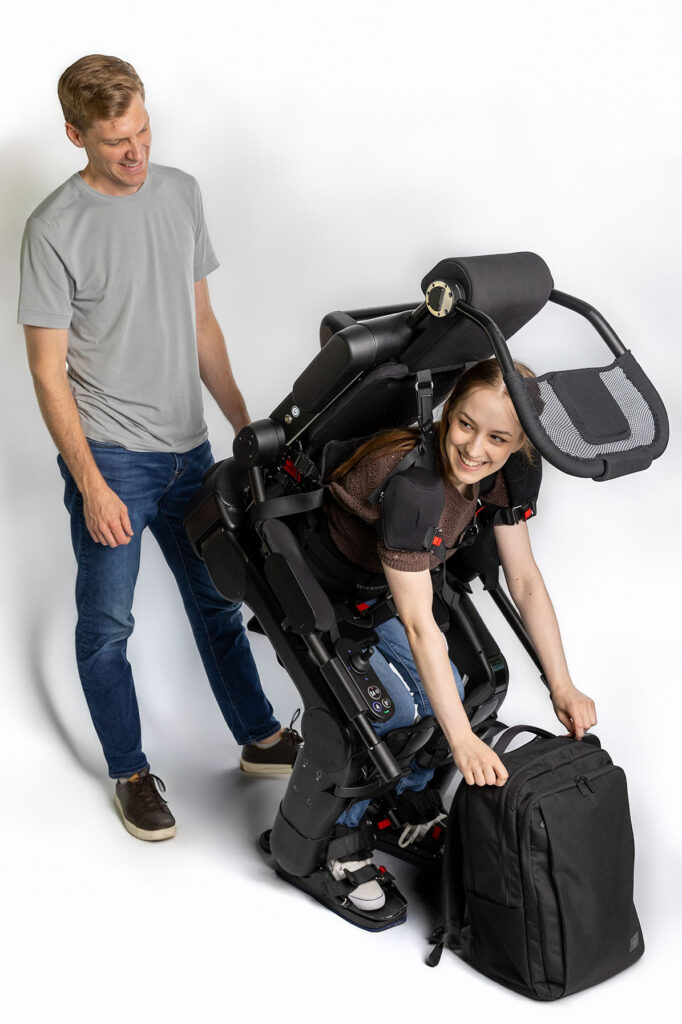
Eve uses active self-balancing technology, allowing the user to stand and walk without continuously depending on crutches or a walker for balance. This also leaves the user’s hands available for activities such as reaching, carrying objects, preparing food, turning, bending, and interacting with the surrounding environment.
The clearance announced on August 11 is nevertheless specific and limited. Eve is intended for use on level indoor surfaces and level outdoor areas immediately adjacent to a building, such as patios and terraces. Use must take place under the supervision of a specially trained companion.
Wandercraft also explicitly describes Eve as a complement to the wheelchair, not a replacement for it. That distinction matters. The system is intended to create additional opportunities for upright mobility and participation rather than to serve as the user’s sole means of transportation.
More Than a Decade in the Making
I first met Wandercraft co-founder Jean-Louis Constanza at the now-distant WearRAcon 2017. Full of excitement and energy, he sought me out to confirm that I was the person behind the Exoskeleton Report. We had only a few minutes between presentations, so he quickly outlined what I thought at the time was an outlandish vision: accessible, mass-produced exoskeletons that could supplement wheelchair use and help people with lower-body paralysis stand again. Almost a decade later, that vision is one step closer to reality.
Wandercraft’s original breakthrough was Atalante, later commercialized as Atalante X: a dynamically self-balancing exoskeleton designed for rehabilitation facilities. Unlike most medical exoskeletons, it did not require crutches or a walker to maintain balance. Wandercraft now reports that Atalante X is being used in more than 150 rehabilitation and research centers worldwide. Eve carries that same general self-balancing concept beyond the clinic and toward personal ownership.
Prescription, Training, and Commercial Launch
 Wandercraft plans to commercially launch Eve in the United States on September 17, 2026, with an unveiling at the Cure healthcare innovation campus in New York City in partnership with the United Spinal Association. Viewers can register to watch the livestream on Sept. 17 at 6 p.m. ET here: https://share.hsforms.com/2iWRkru7sTcmpTGdO6_Lo1Q5aapy
Eve will be a prescribed medical device. Prospective users must complete:
- A clinical assessment
- An individualized fitting
- Training with a companion
- Five two-hour training sessions, potentially completed within one week
The training program covers transfers, remote-control operation, level-surface walking, movement through tight spaces, activities of daily living, and safety and emergency procedures.
Wandercraft is also assembling the service infrastructure required to move Eve from clearance to actual home use. Walk US will support evaluations and training; National Seating & Mobility will serve as the exclusive complex rehabilitation technology distribution partner; Good Shepherd Rehabilitation will support access in Pennsylvania’s Lehigh Valley; and USVetServ will distribute Eve and Atalante X to Department of Veterans Affairs facilities.
This network may prove just as important as the hardware. Personal exoskeleton adoption depends on assessment, training, reimbursement, fitting, repair, and long-term service, not simply whether a device has received regulatory clearance.
The Medicare Question
Medicare created a more viable reimbursement pathway for qualifying personal exoskeletons in 2024 by treating certain systems as braces and permitting lump-sum payment through the Durable Medical Equipment, Prosthetics, Orthotics, and Supplies program. Wandercraft anticipates that Eve could become eligible for Medicare reimbursement under the established K1007 pathway within 60 to 90 days. Its access team will assist users and clinicians with claims, coverage requirements, financing, and private-payer options. FDA clearance does not automatically produce Medicare coverage for every user. Wandercraft is projecting eligibility for the pathway, while individual coverage will still depend on documentation, medical necessity, and payer decisions.
Clinical Testing for Personal Use
The clearance was supported by a three-site clinical trial conducted through the James J. Peters Department of Veterans Affairs Medical Center in the Bronx, Kessler Foundation in New Jersey, and Walk in New York.
The program examined safety, function, training, usability, and whether users and companions could integrate Eve into activities representative of personal use. Wandercraft says participants completed functional and task-based assessments and met key walking and usability endpoints.
Read the original full press release on the Wandercraft website. All images courtesy of Wandercraft



Add Comment