

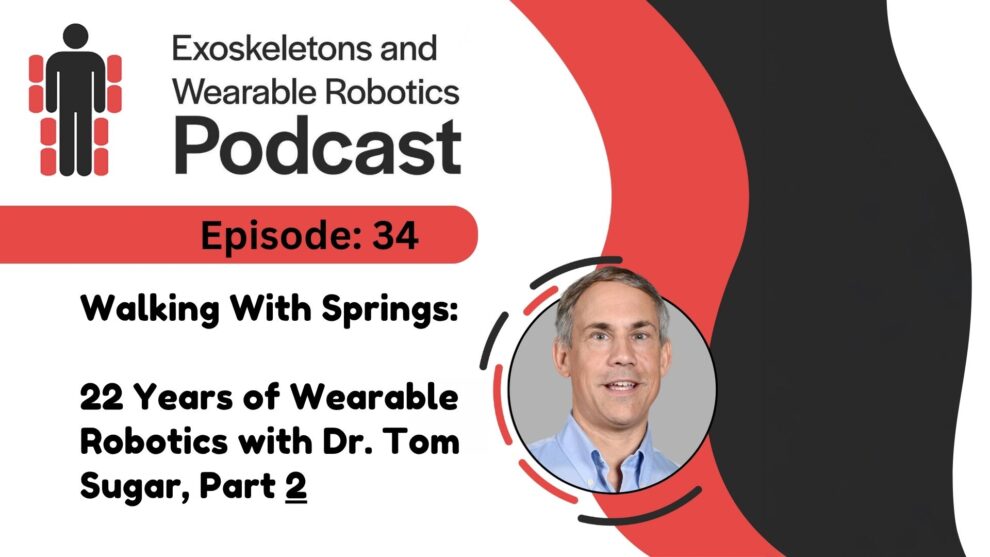
In Episode 34 of the Robotics and Exoskeletons Podcast, Bobby Marinov continues his interview with longtime co-host Dr. Thomas “Tom” Sugar, exploring the projects that followed his early work on rehabilitation robots and powered prosthetic ankles. Part 2 follows experiments in running assistance and load carriage into occupational exoskeletons, personal cooling, and newer rehabilitation and arm-support projects. Throughout the conversation, Tom returns to the challenge of building devices that assist people while preserving their freedom to move.
YouTube Version:
Topics:
- 0:00 Introduction and Part 1 Recap
- 4:55 The Running Jetpack, Pogo Suit, and AirLegs
- 23:02 ROLLE Load Support and HeSA Hip Assistance
- 33:49 WearRA, WearRAcon, and Personal Cooling
- 44:07 APEx: Lifting, Pushing, and Air Force Field Testing
- 54:53 New Projects: Elbow Rehabilitation, RISE, and Glovebox Arm Support
FYI: You can catch the first half of Tom’s career in the previous episode: Walking with Springs, Part 1: The Early Projects That Shaped Dr. Thomas Sugar’s Career in Wearable Robotics
Multiple Audio-Only Versions:
For those who prefer to just relax and listen, you can take advantage of the embedded version here:
Or visit any of the major audio platforms and look for the Exoskeletons and Wearable Robotics podcast series:
YouTube, Apple Podcasts, Spotify, Amazon Music, Podcast Index, Overcast, iHeartRadio, Podcast Addict, Castro, Castbox, Podchaser, Pocket Casts, Deezer, Listen Notes, Player FM, Goodpods, TrueFans
Summarized Transcript:
Tom revisits the Four Minute Mile running jetpack, the Pogo Suit’s moving backpack, and AirLegs’ pneumatic hip and ankle assistance, explaining how precisely timed forces can support human movement. The conversation follows SpringActive’s ROLLE load-carrying system and the HeSA-powered hip exoskeleton, then explores the origins of the Wearable Robotics Association and WearRAcon, experiments with personal cooling, and APEx field testing with Air Force aerial porters. Tom also introduces newer work on elbow rehabilitation with Mayo Clinic, the RISE exoskeleton, and a student-built arm-support system for glovebox work sponsored by Los Alamos National Laboratory:
Four Minute Mile running jetpack. Tom begins with the running jetpack developed with student Jason Kerestes as part of the Four Minute Mile project. Electrically powered ducted fans applied thrust to help the wearer run faster, following early experiments in which the researchers explored assistance by towing a runner with a golf cart. Tom explains that the jetpack never demonstrated the four-minute mile suggested by the project’s name, but recalls that it could take a roughly six-minute mile down to about five minutes. Its considerable electrical demand limited operation to approximately four to six minutes. Archival footage also highlights how Jason’s welding and fabrication experience helped the team quickly turn ideas into working prototypes. Bobby remembers seeing Tom demonstrate the jetpack at a WearRAcon opening.
Pogo Suit and Pogo Pack. The Pogo Suit explored whether moving a backpack’s load in time with the wearer could make carrying it easier. A sensor near the belt tracked the body’s vertical movement, while an actuator moved the backpack along a rail. When synchronized correctly, the pack could provide a lifting sensation as the wearer stepped upward. An archival hiking demonstration illustrates that effect on an Arizona trail. Tom also recalls deliberately reversing the timing: the system then pushed the wearer downward just as they wanted to rise. The experiment makes the importance of timing tangible, showing how the same mechanism could either assist or interfere with movement.
AirLegs pneumatic hip and ankle assistance. Working with Jason Kerestes, Tom developed AirLegs to assist both the hips and ankles using compressed air. The hip actuators pushed and pulled as the legs moved, while smaller actuators tensioned elastic cords to assist ankle push-off. Valves controlled the assistance in rhythm with the wearer, and the demonstrations include changing step lengths, running, stairs, and slopes. Tom describes the comfortable, compliant feel of pneumatic assistance, while identifying the challenge of carrying an adequate air supply. He recalls approximately a 10% reduction in metabolic cost during running.
Pneumatic hopper and phase-based control. To explain the control approach behind these devices, Tom shows a small pneumatic hopping mechanism. Its controller uses position and velocity to determine where the mechanism is in its movement cycle and when to add energy. In the demonstration, Tom interrupts the hopping motion with his hand, and the system settles into a new rhythm. He explains that the actuator replenishes energy lost through friction and damping, sustaining repeated movement. The example illustrates the principle carried into wearable systems: assistance should respond to the movement already taking place and deliver energy at a useful point in that cycle.
ROLLE load-carrying exoskeleton. SpringActive’s ROLLE system addressed the burden of heavy backpacks by creating a supporting structure that transferred load toward the ground. Its joints deliberately departed from the arrangement of the human knee, and a linear actuator worked with a spring mechanism to support the load. Tom compares the concept to a wheelbarrow attached to the wearer’s legs. Archival demonstrations show walking over rocky terrain, stepping over obstacles, and bouncing while carrying a backpack weighing more than 100 pounds. Tom explains how the springs helped support the load during these movements.
HeSA powered hip exoskeleton. HeSA carried lessons from the pneumatic systems into a motorized hip exoskeleton intended for military and potentially occupational use. Tom describes a lightweight combination of motors, springs, and lever arms that assisted hip flexion and extension, with demonstrations of walking, running, climbing stairs, kneeling, and sitting in machinery. A distinctive feature allowed the mechanism to disengage beyond part of its working range, giving the wearer freedom to take larger steps or adopt other postures. Tom also emphasizes backdrivability—the wearer’s ability to move the mechanism without feeling locked in place. He recalls assistance of up to about 30 newton-meters per side and the use of a standard power-tool battery.
Wearable Robotics Association and WearRAcon. Tom then discusses the effort to bring researchers, companies, and potential users together through the Wearable Robotics Association. He recalls conversations with colleagues, including Joe Hitt, about helping wearable robotics move from academic research toward commercialization and organizing a U.S. conference with military, industrial, and medical participation. Bobby explains how searching for wearable-robotics domain names led him to discover the association, and how he subsequently covered the first WearRAcon in 2016. Both remember a community in which many groups worked separately and were cautious about showing their devices. The conference created opportunities to compare work, try equipment, and build relationships, with the Innovation Challenge becoming an early part of that exchange.
Personal cooling suit. An undergraduate project approached human assistance through temperature management. The team built a wearable refrigeration system that chilled water and circulated it through a shirt, addressing the discomfort and demands of working in hot environments. Tom connects the idea to Arizona conditions and the needs of aerial porters moving equipment in extreme heat. He also points to ASU’s ANDI thermal manikin as an example of related research. Bobby suggests that exoskeletons could provide a platform for incorporating personal cooling because they already carry components such as batteries, sensors, controllers, and attachment structures.
APEx aerial porter exoskeleton. APEx developed the powered hip-assistance approach for Air Force aerial porters performing lifting and pushing tasks. Tom explains that the design needed to assist the legs individually during movement and together during tasks such as lifting or pushing cargo. Practical requirements shaped the hardware: concerns about snagging discouraged exposed Bowden cables, modular construction allowed components to be replaced, and heat and comfort considerations led the team toward a structure concentrated around the wearer’s sides. The system could also disengage to allow free movement. An eight-week field evaluation took the device into actual cargo-handling work, where airmen provided feedback and, according to the account shown in the episode, began requesting it for heavier tasks. Tom particularly values the moment when experienced users started teaching newcomers how to use it. The episode also includes a subsequent demonstration exploring its potential for civilian workplaces.
Phoenix commercialization. In a later review of the project list, Tom briefly identifies Phoenix as a commercialization effort drawing on APEx and mentions Dr. Kevin Hollander’s involvement. The reference connects the research prototypes and field demonstrations to the additional work of developing a commercial system, although the conversation does not explore Phoenix’s specifications or present availability.
Mayo Clinic elbow rehabilitation. Tom briefly describes work with Mayo Clinic on an elbow exoskeleton intended to assist rehabilitation following surgery for brachial plexus injuries. The project returns the discussion to upper-limb assistance and the needs of people recovering arm function. He introduces it as another area of continuing research without going into the device’s detailed control system or clinical results.
RISE and upright mobility. RISE is introduced as an exoskeleton intended to help a person get up from the floor. Tom also describes his continuing interest in upright mobility, including walking, balance, fatigue, and the timing of added assistance. These subjects appear as directions for future discussion, extending the earlier work on movement assistance into other everyday mobility tasks.
Glovebox arm-support exoskeleton. A recent undergraduate capstone project sponsored by Los Alamos National Laboratory tackled the difficulty of supporting a worker’s arms while preserving access to specialized glovebox gloves. Tom describes two successive approaches: an earlier concept used Bowden cables for shoulder and elbow assistance, while the later design used linear actuators mounted to a hip structure to support the arms near the elbows. The arrangement allowed the wearer to raise and lower their arms while reaching into the gloves. Tom clarifies that this prototype did not use the spring-in-series arrangement found in many of his other devices. He identifies spring-based assistance and improved understanding of user intention as possible areas for future development.
The episode closes with Bobby and Tom discussing the work of communicating wearable robotics clearly as the field becomes more visible and consumer products become more widely available. They emphasize the need to explain what devices do, acknowledge their limitations, and distinguish useful assistance from advertising claims. Looking back across the projects, Tom gives particular credit to the students he has worked with. Both hosts return to the people behind and within these machines: the researchers who build them and the wearers whose needs give the technology its purpose.
Relevant Links:
- See the first part of this podcast episode here: Walking with Springs, Part 1: The Early Projects That Shaped Dr. Thomas Sugar’s Career in Wearable Robotics
- Dr. Thomas Sugar at Arizona State University: https://search.asu.edu/profile/227786
- Human Machine Integration Lab: https://thomassugar.github.io/hmil/
- SpringActive: https://springactive.com/
- ASU’s look inside Tom Sugar’s lab and early wearable robotics projects: https://news.asu.edu/20151002-tom-sug…
- APEx — Air Force exoskeleton field testing: https://news.asu.edu/20210712-solutio…
Special thanks to our Patreon members, for encouraging and keeping this effort going!

Add Comment