

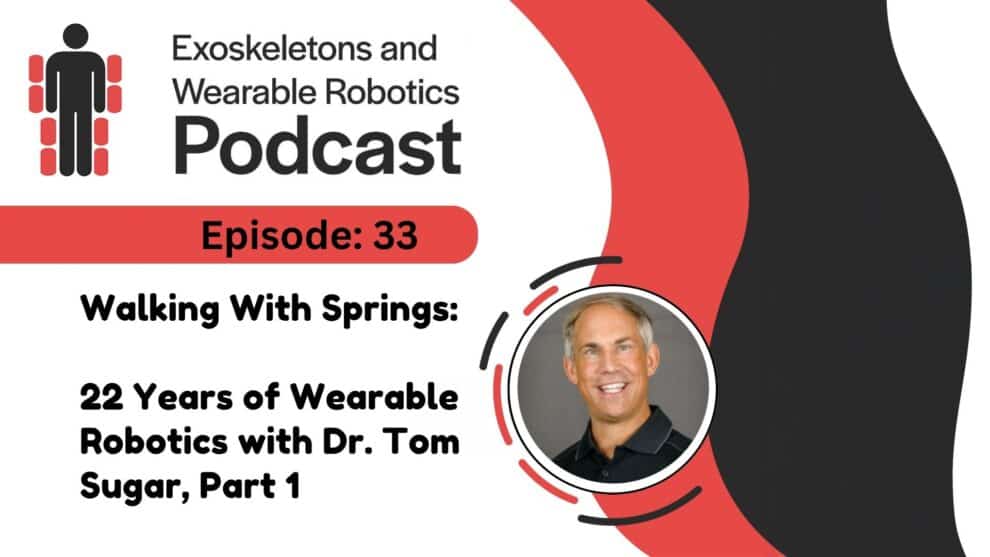
Who is Dr. Thomas “Tom” Sugar, and why is he the co-host of the Exoskeletons and Wearable Robotics podcast!? Welcome to episode 33, where I turn the interview inward. Rather than presenting Tom’s career as a list of publications, we follow the machines, jobs, experiments, and engineering ideas that gradually led Dr. Sugar into wearable robotics. The story begins with automobiles and waterproof footwear, moves through compliant robots and rehabilitation devices, and culminates in powered prosthetic ankles, Air Legs, the Joint Torque Augmentation Robot (JTAR), leaving APEx, and much more for later. Even after more than an hour, the episode still does not reach the midpoint of Dr. Sugar’s career, making this the first installment of a two-part series.
YouTube Version:
Topics:
- 0:00 Introduction – Who Is Dr. Thomas Sugar?
- 1:30 From Saturn and GORE-TEX to His First Robots and Patent
- 13:30 Springs, Compliance, and the Early ASU Lab
- 26:17 Early Orthoses, the Crutch Cast, and RUPERT
- 37:05 SPARKy and Powered Prosthetic Ankles
- 48:26 SpringActive, Air Legs, JTAR, and DARPA Warrior Web
Audio Versions:
For those who prefer to just relax and listen, you can take advantage of the embedded version here:
Or visit any of the major audio platforms and look for the Exoskeletons and Wearable Robotics podcast series:
Summarized Transcript:
Saturn: Diagnosing Squeaks, Rattles, Noise, and Vibration
One of Sugar’s earliest professional experiences was an internship with Saturn, where he worked at the Milford Proving Ground and the company’s manufacturing operation in Spring Hill, Tennessee. His assignment focused on the noises experienced inside a vehicle. Microphones were installed throughout the car, which was then driven over different road surfaces so that the team could identify squeaks, rattles, vibrations, and their mechanical sources.
Sugar had a strong personal interest in automobiles and had restored an old Triumph TR3 with his brother, so he initially imagined a future in the automotive industry. The early-1990s recession changed that trajectory. During the podcast, Marinov draws a connection between this early vibration work and present-day questions about whether vibrations are transmitted, dampened, or redistributed through wearable robots attached to the human body.
The University of Pennsylvania and Wharton: Engineering Meets Entrepreneurship
Dr. Sugar studied mechanical engineering at the University of Pennsylvania while also completing the Management and Technology program associated with the Wharton School. The program combined engineering with economics, business, and entrepreneurship at a time when entrepreneurship was not yet the common academic focus it is today.
This combination became an important part of his later career. Sugar was interested not only in whether a machine worked in a laboratory, but also in whether it could become a practical product.
The Parallel Pneumatic Manipulator: Sugar’s First Robot
Working with Professor Vijay Kumar, Tom helped build a compliant parallel pneumatic manipulator that he describes as one of his first robots. The three-degree-of-freedom mechanism could move vertically and rotate in two directions, making it conceptually suitable as either a robotic wrist or ankle.
Unlike a serial robotic arm, a parallel mechanism distributes its loads through multiple connected members. Its actuators can remain near the base, potentially producing a compact and powerful mechanism, although generally with a smaller workspace. The project introduced several themes that would recur throughout his career: parallel mechanisms, pneumatic power, ankle motion, and mechanical compliance.
- L. Gore & Associates: Waterproof Footwear, Manufacturing, and a First Patent
Tom spent approximately five years at W. L. Gore & Associates, the company best known for GORE-TEX. He worked on waterproof footwear, manufacturing systems, machinery, and the practical challenge of making a breathable membrane function reliably inside a shoe. This required more than material science; it involved understanding footwear construction, factory processes, quality control, and how a soft product interacts with the human body.
Cooperative Mobile Robots and Equilibrium-Controlled Stiffness
After returning to academia for his doctorate, Tom worked on teams of mobile robots that had to approach an object, grasp it together, and transport it cooperatively. The challenge was not simply controlling three individual machines. Their motions and forces had to be coordinated so that the robots behaved as a team rather than fighting one another.
Sugar’s part of this research returned to compliance. His mechanism used springs and controlled their equilibrium position to alter how stiff the robot felt during an interaction. If the robot moved with an applied force, the mechanism felt stiffer; if it moved away, it felt softer. Sugar’s group described the approach as “equilibrium-controlled stiffness,” while closely related work became widely known as series elastic actuation.
The principle would become fundamental to Sugar’s wearable robots. A machine attached to a person cannot behave like a rigid, non-backdrivable industrial mechanism. It has to yield when the wearer moves, transmit useful forces without locking the body into position, and remain physically compatible with the human operator.
The Early Human Machine Integration Lab at ASU
When Dr. Sugar arrived at Arizona State University, the Human Machine Integration Lab began as a small group with only a few students exploring several research directions. He initially hoped to continue working in mobile robotics, but difficulty obtaining funding in that area helped steer the laboratory toward human movement and medical devices.
Early projects included pneumatic systems for stroke rehabilitation, developed with Kinetic Muscles and medical collaborators. The group worked on devices for the arm, wrist, and ankle. These were not yet the compact, self-contained exoskeletons expected today, but they established the laboratory’s focus on machines that physically interact with people and help restore or assist movement.
Human Perception, Baseballs, and Predicting Intent
Another early ASU research line examined how people perceive and control movement. Sugar’s group studied how humans catch fly balls and ground balls. Rather than solving a detailed set of equations in their heads, people appear to use visual relationships that keep the ball moving along a manageable path in their field of view. When that visual pattern changes, the person moves to restore it.
The researchers also considered the order in which the body responds to a planned movement. A person’s gaze may shift first, followed by the head, feet, and finally the heavier torso. That sequence has clear implications for wearable robotics: the wearer’s eyes and head may reveal an intended action before the legs or arms begin executing it.
Tom recalls proposing an industrial system in which an exoskeleton would observe where a worker was looking and prepare to assist with inserting a component at that location. The grant was not funded, but the idea anticipated present-day research on intent recognition, eye tracking, and predictive exoskeleton control.
Omnidirectional Robots and the Perturbation Platform
Sugar’s mobile-robot research also involved omnidirectional platforms using powered casters, a mechanism now commonly associated with swerve-drive systems. Unlike an ordinary two-wheel mobile robot, an omnidirectional platform can translate sideways or combine rotation and translation without performing a sequence of back-and-forth maneuvers.
The team inverted the concept to create an omnidirectional human-movement platform. A person standing on it could be disturbed forward-backward, sideways, rotationally, or through a combination of movements. Because the participant did not know the direction of the next perturbation, the platform could be used to investigate balance recovery, gait, slips, trips, and falls. This work brought together Sugar’s interests in mobility, human perception, and unexpected physical interaction.
Early Powered Ankle Orthoses
Sugar’s first parallel manipulator was eventually redesigned around the human ankle. In one configuration, the wearer’s leg became part of the mechanism, with additional actuators placed around it. By coordinating two actuators, the device could assist ankle movement in the sagittal plane; by moving the actuators in opposite directions, it could also produce inversion and eversion.
These early orthoses served as a bridge between Sugar’s conventional robotics work and the later powered prosthetic ankles and lower-body exoskeletons for which his laboratory became better known. They also established his long-running preference for spring-based actuation and mechanisms that accommodate more than a single simplified joint motion.
The Crutch Cast
Working with Kevin Hollander and visiting students, Sugar’s group developed what they called the Crutch Cast. The concept was to provide powered ankle assistance even when the wearer’s lower leg was immobilized in a cast. A motor and spring were connected to a moving plate beneath the foot, allowing the system to assist ankle-like motion without requiring the injured leg itself to generate that movement. The project was around 2003–2004.
RUPERT: A Lightweight Upper-Limb Rehabilitation Exoskeleton
RUPERT demonstrated that Sugar’s early wearable-robotics work extended well beyond the legs. The device used pneumatic artificial muscles to assist the shoulder, elbow, and wrist of a person recovering from a stroke. Because the expected users could be older and physically impaired, the wearable portion had to remain light and comfortable. The pneumatic supply therefore remained off the body, while an adjustable carbon-fiber structure supported the wearable components.
The system was designed around functional movements such as reaching toward an object and bringing food toward the mouth. Rather than reproducing every possible shoulder motion, the researchers constrained the arm to planes that matched common reaching and feeding tasks.
This work also influenced Sugar’s interest in elevation angles -> the orientation of body segments relative to gravity. He explains that joint angles can vary considerably between people, while segment angles measured relative to gravity may reveal more consistent movement patterns. That perspective later informed how his group described and controlled human gait.
SPARKy: Building a Powered Prosthetic Ankle
SPARKy grew out of Sugar’s ankle-orthosis work, and a military research effort focused on people with lower-limb amputations. Sugar and Joe Hitt initially worked with Walter Reed Army Hospital and later with Brooke Army Medical Center. The team placed a motorized spring system behind the lower leg and began developing a powered prosthetic ankle.
Multiple versions followed, including devices for walking, running, jogging, outdoor movement, inclines, stairs, and irregular surfaces. The central engineering question was whether the powered ankle could provide enough useful assistance to overcome its own weight. The device needed to restore push-off during stance, lift the foot during swing to improve toe clearance, and avoid forcing the user into an unnatural gait.
One particularly significant experiment gave the wearer direct agency over the ankle. Rather than relying on electromyography, the researchers placed four sensors inside the prosthetic socket. When muscles in the residual limb contracted, their shape and pressure against the socket changed. The sensors detected that change and converted it into commands for the ankle. A participant who had initially questioned whether a powered ankle was necessary reacted enthusiastically when he realized he could intentionally reposition the foot. For Sugar, this illustrated that control and agency may be as important as the amount of mechanical power delivered.
SPARKy also became a platform for phase-based control. The researchers compared the shank’s angular position and angular velocity to create a phase variable that acted like a movement-dependent metronome. Instead of commanding assistance according to a fixed clock, the robot followed the wearer: it accelerated when the user walked faster, slowed when the user slowed, and recognized transitions between forward and backward movement. The compliant spring system allowed demonstrations on inclines, stairs, hard surfaces, and irregular terrain, including a wearer jumping onto and off a large rock without external support.
SpringActive and the Commercialization of SPARKy
SPARKy did not remain solely an academic prototype. The technology became part of the early work at SpringActive, which received Phase I and Phase II Small Business Innovation Research funding. Sugar explains that the powered-ankle technology was ultimately transferred to Össur, a major prosthetics and orthotics company with complementary work in powered knees.
RISE: Getting Up from the Floor and Returning to a Chair
The episode briefly shows a project called RISE, designed to help a person get up after being on the floor and then lower themselves back into a chair. The demonstration appears to show the wearer using the device to support a controlled transition through these difficult movements, and Sugar notes that the team obtained a patent related to the concept.
The Wall-Climbing Robot
A student-built wall-climbing robot appears as another unexpected project from the Human Machine Integration Lab. The machine was featured in a Best Buy television commercial, reportedly including broadcasts associated with the NBA playoffs or finals. Four undergraduate students involved in the project were each paid $10,000 for the commercial work—an amount that, at the time, could cover a substantial portion of their education.
Although it was not a wearable robot, the project illustrates the laboratory’s breadth and Sugar’s willingness to let students build unusual machines with real-world visibility beyond academic publications.
The Wearable Cooling Suit
Sugar also briefly shows a wearable cooling-suit project. The prototype incorporated a small compressor and circulated refrigerant through the system to remove heat from the wearer. This episode offers only a brief glimpse, so the discussion does not establish its full cooling capacity, intended use case, or stage of development.
Air Legs: Pneumatic Assistance and National Television
Air Legs applied Sugar’s phase-based control ideas to a pneumatic wearable system. A compressed-air source supplied power through pulleys, sensors, and braces around the legs. The system timed its assistance to help lift the wearer’s legs during activities such as walking, running, climbing, or carrying a load.
The project received public attention through a demonstration at the National Mall and a report on CBS This Morning. The news segment showed the system assisting a runner and presented it as part of DARPA’s effort to explore wearable robots for military personnel. While the television report emphasized ambitious future performance goals, the project’s technical importance lay in its attempt to provide assistance at the appropriate point in the movement cycle rather than continuously applying force.
JTAR and DARPA Warrior Web
The Joint Torque Augmentation Robot, or JTAR, brought many of Sugar’s earlier ideas together in a mobile hip-and-ankle exoskeleton. Motors and batteries were carried in a backpack, while Bowden cables delivered power to spring-loaded mechanisms at the hips and ankles. Assistance was concentrated in the sagittal plane, but the mechanisms were designed to preserve ankle inversion and eversion as well as hip rotation, abduction, and other out-of-plane movements.
The episode’s videos show the wearer kneeling, performing deep stretches and lateral lunges, crossing the legs while moving sideways, jumping in several directions, transitioning from walking to running, climbing a hill, moving through gravel, and running over obstacles. In one particularly impressive demonstration, the wearer runs toward a barrier, jumps onto or over it, pushes off, lands, and continues running. These movements required the exoskeleton to deliver power at the correct time while becoming mechanically unobtrusive during the rest of the motion.
SpringActive received work associated with JTAR and JTAR 2.0, while Arizona State University received work separately on Air Legs and controls. Other Warrior Web participants included institutions whose projects later became much more visible, helping explain why Dr. Sugar and SpringActive’s contributions may be unfamiliar even to people who closely followed the program.
Only the First Part of the Story
By the end of the recording, Bobby realizes that the discussion has covered only the early portion of Sugar’s career. Several additional machines, including a jetpack, other rehabilitation systems, and further wearable-robotics projects, are briefly visible or mentioned but not explored in enough detail to summarize responsibly. The episode also ends before the creation of the Wearable Robotics Association and its conference series, meaning that many of Sugar’s best-known activities remain ahead.
Part 1 therefore serves as an origin story. Across automobiles, footwear, mobile robots, rehabilitation systems, prosthetics, and military research, the same ideas continually reappear: use springs to make robots safer and more natural, understand the human before designing the controller, assist at the correct moment, preserve the wearer’s agency, and make sure the robot can get out of the way.
Links:
- Dr. Thomas Sugar at Arizona State University: https://search.asu.edu/profile/227786
- Human Machine Integration Lab: https://thomassugar.github.io/hmil/
- SpringActive: https://springactive.com/
- DARPA Warrior Web: https://www.darpa.mil/research/progra…
Special thanks to you, our Patreon members, for encouraging and keeping this effort going!


Add Comment