

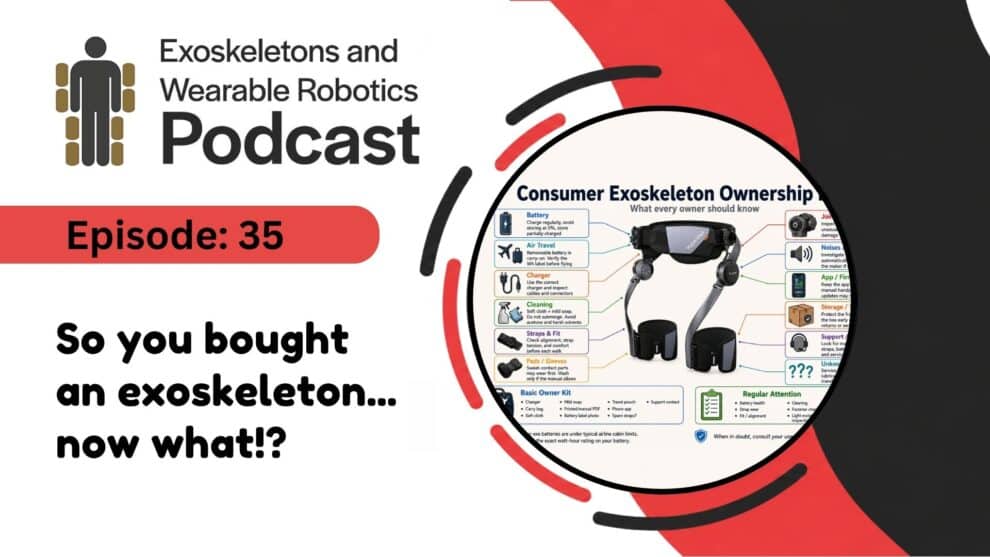
You bought an exoskeleton, took it out of the box, and went for your first walk. Now where do you keep it? How do you clean it? What happens when you want to take it on a plane? In Episode 35 of the Exoskeletons and Wearable Robotics Podcast, Dr. Thomas “Tom” Sugar and I talk through the everyday questions that come with owning an exoskeleton.
We use bicycles and e-bikes as a familiar comparison. Most people have some idea of what bicycle ownership involves: somewhere to store it, occasional maintenance, and a place to turn when something needs fixing. Consumer exoskeletons are still developing that shared knowledge, and even seemingly simple questions can have different answers depending on the device.
This episode is a starting point for a conversation about ownership. Tom and I share experiences, compare notes, and identify questions worth asking the manufacturer. We would love to hear what you have learned from owning an exoskeleton and anything you think we missed!
YouTube Version
Topics
- 0:00 Introduction: What Exoskeleton Owners Can Learn from E-Bikes
- 7:47 Battery Care, Charging, and Manufacturer Guidance
- 14:10 Flying with an Exoskeleton: Batteries, Packing, and Airport Travel
- 20:46 Cleaning, Washable Components, Straps, and Fit
- 29:09 Mechanical Checks, Water Resistance, Apps, and Firmware
- 38:43 Storage, Repairs, Accessories, and the Owner’s Checklist
Audio Versions
Prefer to listen? Find Episode 35 on Apple Podcasts, or follow the Exoskeletons and Wearable Robotics podcast on Spotify and Amazon Music. More listening options are listed on our podcast page.
Alternatively, you can also take advantage of the direct audio embed made by Buzzsprout here:
Summarized Transcript
Buying an exoskeleton is only the beginning. Bobby Marinov and Dr. Tom Sugar explore charging, cleaning, travel, maintenance, storage, and finding help. Bicycle and e-bike ownership provide a useful comparison: people generally expect those products to need basic care, occasional repairs, and somewhere to live. Consumer exoskeleton owners are still building the same practical understanding.
Battery care and charging. Bobby and Tom discuss battery storage, temperature, and charging habits, including the problems associated with leaving a battery empty for an extended period. The details depend on the manufacturer and battery model, so instructions for a phone, electric car, or e-bike cannot simply be carried over. Charging arrangements also vary: some batteries charge through the exoskeleton, while others need separate adapters or optional charging docks. Knowing which charger to use, checking connectors, and planning for periods of non-use are all part of ownership.
Flying with an exoskeleton. The conversation turns to battery capacity, spare batteries, terminal protection, and the importance of checking both current aviation guidance and the airline’s requirements before a trip. Bobby shares how much suitcase space an exoskeleton’s original packaging can occupy and describes traveling with devices protected among his clothes. Tom recalls taking a LifeGlider mobility device through an airport and gate-checking it. These experiences highlight practical questions to resolve before arriving at the terminal; the appropriate arrangements depend on the equipment and the airline.
Cleaning and washable components. Cleaning starts with understanding which components can get wet and which cannot. Bobby and Tom discuss soft, damp cloths and mild soap, with the manufacturer’s instructions determining which products and methods are suitable. Bobby recalls damaging his car’s dashboard with a cleaning product as a reminder that material compatibility matters. Removable straps, belts, or padding may have separate washing instructions, sometimes involving a mesh laundry bag. Washable fabric components do not make the complete exoskeleton suitable for a washing machine.
Straps, accessories, and fit. Bobby describes how some hip exoskeletons can slide down his body and why he appreciates suspenders or shoulder straps that help hold them in place. Accessories deserve attention, including whether they are intended for the device and how they distribute pressure. Tom notes that an exoskeleton can feel very different when worn correctly. Discomfort, rubbing, and alignment are worth paying attention to, much as a cyclist notices an incorrectly positioned saddle. Both hosts identify fitting as a subject deserving an episode of its own.
Mechanical checks and water resistance. Frayed straps, damaged housings, obstructions, unusual noises, and excessive heat are among the changes discussed. Passive and occupational exoskeletons also need attention, even without motors or batteries. Rain raises another question: what does the particular device’s water-resistance rating allow? Resistance to splashes and suitability for submersion are different things. Bobby and Tom also point out that improvised covers can create problems if they interfere with moving joints or trap heat.
Apps and firmware. Apps can provide firmware updates, usage information, and settings that are difficult or impossible to reach through physical buttons alone. Bobby explains that many consumer devices make their main functions available through onboard controls, while Tom prefers an app because it makes settings easier to see and change. The conversation includes basic connection troubleshooting, such as checking Bluetooth and restarting the phone and exoskeleton. Available functions differ between products and software versions.
Storage, repairs, and support. Keeping the original box can make it easier to protect and transport the device, and photographing its position before unpacking can help with repacking. The hosts also discuss avoiding sustained pressure on the frame from objects stacked on top of it. Manuals, tutorial videos, replacement straps, batteries, and warranty information are useful resources to locate early. Service intervals, lubrication requirements, resale, and repair networks are less established across this young consumer market. Bobby and Tom see opportunities for trained repair centers, distributors that offer service, and accessories that let owners personalize their devices.
The owner’s checklist. The episode closes with a modest collection of useful items: the appropriate charger, compatible cleaning supplies, a protective bag or pouch, relevant apps, and a record of the battery label. Bobby and Tom compare the growing body of exoskeleton ownership knowledge with the early days of personal 3D printing, when users gradually built and shared practical experience. They are encouraged by what consumer exoskeletons can already do and invite listeners to help answer the everyday questions that come with them.
Relevant Links
- Hypershell — User Manuals and Downloads
- Hypershell — Support, Battery Care, Cleaning, and Troubleshooting
- DNSYS — User Manuals and Video Tutorials
- VIGX — Frequently Asked Questions, Maintenance, and Replacement Parts
- FAA PackSafe — Flying with Lithium Batteries
- ASTM F3392-20 — Standard Practice for Exoskeleton Wearing, Care, and Maintenance Instructions
- Wearable Robotics Association
For device-specific instructions, consult your manufacturer’s current manual. Check your airline’s battery and baggage requirements before traveling.
Thank You to Our Patreon Supporters
Thank you all for your support and encouragement. We love making these episodes and having these discussions! Special thanks to our Patreon members for helping keep the podcast and Exoskeleton Report going.
If you would like to support this work, visit Exoskeleton Report on Patreon. Have an ownership tip, a question, or something we missed? Please share it in the comments.




Add Comment