

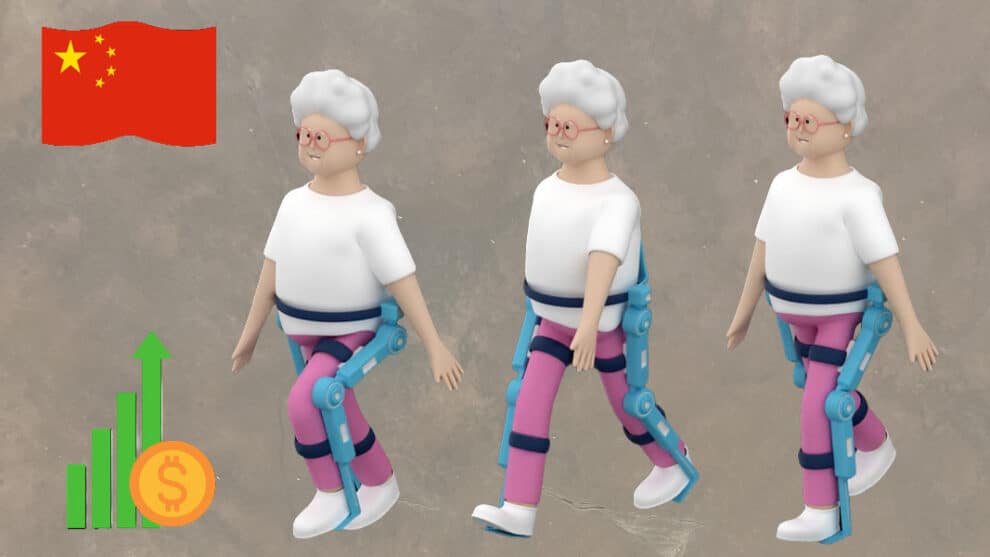
On June 8, 2026, AgeClub published the Chinese-language article “5年增长15倍!蚂蚁美团联手、沙特资本入局,外骨骼成银发科技‘战略入口’?”, roughly translated as: “Five Years, 15x Growth! Ant and Meituan Team Up, Saudi Capital Enters the Game: Has the Exoskeleton Become a Strategic Entry Point for Silver-Age Tech?” An accessible repost is also available through 36 EKR. Below is an English reader’s guide to the Chinese-language AgeClub article and its accompanying tables:
The reason this article is worth highlighting for ExR readers is its point of view. It does not look at exoskeletons only as rehabilitation robots, industrial tools, or futuristic wearable machines. It looks at them through China’s senior-care, aging, and “silver economy” lens: mobility preservation, scenic-area rentals, local government investment, family purchases for elderly parents, and the possibility that medical connectivity platforms may treat mobility assistance as part of a broader elder-care ecosystem.
Why the Chinese silver-economy perspective matters
For years, the exoskeleton industry has been divided into familiar buckets: medical rehabilitation, industrial ergonomics, defense, research, and consumer/outdoor products. The AgeClub article reframes the category around a different question: who pays when mobility is the product?
From a silver-economy perspective, the buyer is not necessarily a hospital, factory, or defense department. It could be an older adult, an adult child buying for a parent, a scenic area renting devices to visitors, a community elder-care service provider, a health insurer, an e-commerce platform, a local government, or an internet company trying to build a larger health-and-aging services ecosystem. That is a meaningful shift in framing.
The original article (linked in the first paragraph) argues that exoskeletons are being pulled into everyday life by the convergence of falling prices, lighter hardware, AI-based gait and intention recognition, and the demand for mobility assistance among older adults. AgeClub also cites strong retail momentum, including a reported 785.5% year-over-year increase in online retail sales for intelligent walking-assist exoskeletons during January-April 2026.
How to read the first table: MIIT / AI medical-device shortlist
The first table in the article is not a financing table. It is a cropped list from China’s 2025 Artificial Intelligence Medical Device Innovation Task shortlist. The highlighted row is important because it places an exoskeleton rehabilitation system inside the official “brain-computer hybrid intelligence product” category. In plain English: China is not treating all exoskeleton work as consumer hardware. Some of it is being advanced as AI-enabled medical devices and brain-computer interface rehabilitation technology.
The visible rows in the screenshot translate as follows:
- 2025-AINJZN-01007 — Chinese name: 阿尔兹海默症经颅刺激系统; translation: Transcranial stimulation system for Alzheimer’s disease; organization: 北京银河方圆科技有限公司, Beijing Yinhe Fangyuan Technology Co., Ltd.
- 2025-AINJZN-01008 — Chinese name: 脑机接口下肢外骨骼康复系统; translation: Brain-computer-interface lower-limb exoskeleton rehabilitation system; organization: 杭州程天科技发展有限公司, Hangzhou ChengTian Technology Development Co., Ltd.; ExR name: RoboCT / Hangzhou RoboCT.
- 2025-AINJZN-01009 — Chinese name: 面向运动功能障碍的植入式脑机接口系统; translation: Implantable brain-computer-interface system for motor dysfunction; organization: 北京智冉医疗科技有限公司, Beijing Zhiran Medical Technology Co., Ltd.
- 2025-AINJZN-01010 — Chinese name: 基于实时汉语言解码的植入式脑机接口系统; translation: Implantable brain-computer-interface system based on real-time Chinese-language decoding; organization: 西湖灵犀科技(北京)科技有限公司, Westlake Lingxi Technology (Beijing) Technology Co., Ltd.;
- 2025-AINJZN-01011 — Chinese name: 睡眠呼吸障碍诊疗系统; translation: Sleep-disordered breathing diagnosis and treatment system; organization: 大连理工大学, Dalian University of Technology;
- 2025-AINJZN-01012 — Chinese name: 植入式脑机接口外骨骼康复系统; translation: Implantable brain-computer-interface exoskeleton rehabilitation system; organization: 武汉衷华脑机融合科技发展有限公司, Wuhan Zhonghua Brain-Computer Fusion Technology Development Co., Ltd.;
How to read the second table: exoskeleton financing, 2025-2026
The second table is a financing summary for the exoskeleton sector from January 2025 through May 2026. The table is useful because it shows the diversity of capital entering the field: local government funds, state-backed funds, strategic investors, consumer internet giants, professional venture firms, and international investors.
- 2025 — 傅利叶智能 — literal / translated name: Fourier Intelligence; ExR name: Fourier Rehab / Fourier; investment: 近8亿元, nearly RMB ¥800 million [approximately US$118 million]; round: Series E; investors listed: Guoxin Investment, Pudong VC, Zhangjiang Science & Technology Investment, Zhangke Yaokun Fund, Prosperity7 / Saudi Aramco’s VC arm, Junshan Capital, and others.
- 2025 — 程天科技 — literal / translated name: ChengTian Technology / Hangzhou ChengTian Technology Development Co., Ltd.; ExR name: RoboCT / Hangzhou RoboCT; investment: 近亿元, nearly RMB ¥100 million [approximately US$15 million]; round: Series B; investors listed: Wuxi VC led the round, with HaoYue Capital as financial adviser.
- 2025 — 优龙机器人 — literal / translated name: Youlong Robot / EULON Robot; ExR name: EULON Robotics / Eulon Robot – Changsha Eulon Robot Co., Ltd.*; investment: 数千万元, tens of millions of RMB [roughly US$3-13 million if interpreted as RMB ¥20-90 million; exact amount undisclosed]; round: Series A; investors listed: Changsha City Development Group, through Lingxin Fund, as the exclusive investor.
- 2025 — 傲鲨智能 — literal / translated name: Aosha Intelligent, literally “Proud Shark Intelligence”; ExR name: ULS Robotics / Shanghai Aosha Intelligent Technology Co., Ltd.; investment: 数千万元, tens of millions of RMB [roughly US$3-13 million if interpreted as RMB ¥20-90 million; exact amount undisclosed]; round: Series B; investors listed: Binfu Capital led, with Guoyi Capital following. The table mentions the VIATRIX consumer line starting at RMB ¥6,799.
- 2025 — 极壳科技(Hypershell) — literal / translated name: Jike Technology, literally “Extreme Shell Technology”; ExR name: Hypershell; investment: approximately RMB ¥475 million [US$70 million]; round: Pre-B + Series B; investors listed: Series B co-led by Guanghe VC / 光合创投 and 5Y Capital, with Meituan Long-Z / Meituan Longzhu following; Pre-B led by Monolith, with 5Y Capital following and oversubscription by existing investors IDG Capital, HongShan China, and Oasis Capital.
- 2025 — 优龙机器人 — literal / translated name: Youlong Robot* / EULON Robot*; ExR name: EULON Robotics / Eulon Robot – Changsha Eulon Robot Co., Ltd.*; investment: 数千万元, tens of millions of RMB [roughly US$3-13 million if interpreted as RMB ¥20-90 million; exact amount undisclosed]; investors listed: multiple funds under Yian Group / HEYER Group. The table notes that EULON completed two financing rounds during 2025.
- 2026 — 布法罗机器人 — literal / translated name: Buffalo Robot; ExR name: Buffalo-Robot / Buffalo Robot Technology; investment: 千万级, ten-million-RMB level [approximately US$1.5 million+ if using RMB ¥10 million as a lower bound; exact amount undisclosed]; round: Series A; investors listed: Chengdu Science & Technology Innovation Investment Group, through the Chengdu Future Industry Angel Investment Fund, led the round.
- 2026 — 程天科技 — literal / translated name: ChengTian Technology / Hangzhou ChengTian Technology Development Co., Ltd.; ExR name: RoboCT / Hangzhou RoboCT; investment: 亿元级, hundred-million-RMB level [approximately US$15 million+; exact amount undisclosed]; round: Series B+; investors listed: ABC Capital led, with Inovance Industrial Investment and Hangzhou Capital following; HaoYue Capital acted as financial adviser. The table notes that RoboCT’s consumer exoskeleton, priced at RMB ¥2,599, [ASCENTIZ being their consumer-facing wing]
- 2026 — 极壳科技(Hypershell) — literal / translated name: Jike Technology; ExR name: Hypershell; investment: approximately RMB ¥339 million [US$50 million]; round: Series B+; investors listed: Ant Group and Meituan Long-Z / Meituan Longzhu co-led, with Sofina and Granite Asia following; Gaohu Capital acted as financial adviser. The table says cumulative financing exceeded US$120 million, which is roughly RMB ¥814 million at the exchange rate used here.
Notes:
*EULON / Fulong note: AgeClub’s article text mentions 伏龙机器人 / Fulong Robot in one sentence about exoskeleton companies developing products for older adults. Based on the surrounding article context and the related financing rows for 优龙机器人 / EULON, the best working directory mapping is: 伏龙机器人 / Fulong Robot → 优龙机器人 / EULON Robotics.
Currency note: The original table mixes RMB and U.S. dollar financing amounts. For USD-denominated rounds, the RMB figure is a conversion estimate. For phrases such as “数千万元” or “千万级,” the amount is intentionally imprecise in the source, so the U.S. dollar estimate is a range or lower-bound approximation. Approximate exchange rate of RMB ¥6.78 = US$1 was used for this article.
Name reconciliation for the elderly product companies mentioned in the article text
The original article names several companies that have launched products relevant to older adults. For English readers, the names can be confusing because the Chinese name, the literal translation, the English brand, and the ExR directory name may not match one-to-one.
- 大艾机器人 — literal / translated name: DaAi Robot, roughly “Great AI Robot”; ExR mapping: DaAi Robot / Sichuan Walking Technology. The company is not part of the financing table above, but it is part of the elderly-product context in the article.
- 迈步机器人 — literal / translated name: Maibu Robot, roughly “Step Robot”; ExR mapping: MileBot Robotics / Shenzhen MileBot Robotics Co., Ltd.. This company is mentioned in the article text, but does not appear in the funding table shown above.
Historical alignment with ExR’s 2017 view
This Chinese silver-economy framing also fits a long-running ExR theme. In 2017, ExR published an exclusive interview with Fourier Intelligence at WearRAcon17. At the time, Fourier was introducing itself to the U.S. exoskeleton community and was described as the maker of China’s first powered lower-body exoskeleton. The interview emphasized the need for cross-regional exchange: China had its own market, its own rehabilitation pathway, and its own lessons for North American and European observers.
Nearly a decade later, Fourier’s appearance in the AgeClub financing table shows how far that company, and the Chinese sector around it, has moved. The table lists Fourier with a near RMB ¥800 million Series E round, a reported valuation around RMB ¥8 billion, and a role spanning rehabilitation robots, humanoid robots, and exoskeletons. Whether one approaches the story from medical robotics, humanoids, or aging services, Fourier is now part of a much larger Chinese robotics ecosystem than the one ExR encountered at WearRAcon17.
ExR made a related argument in 2017 in “Why wearable exoskeleton technology?” That article specifically highlighted quality of life, mobility preservation, and the potential for assistive exoskeletons to keep older adults moving longer. Nine years later, the AgeClub article reads like a Chinese-market validation of that same idea: the technology is not only about industrial productivity or high-end rehabilitation. It is also about the ability to stay active, remain mobile, and reduce the burden of aging-related mobility loss.
What ExR readers should take away?
The AgeClub article shows what the exoskeleton field looks like when viewed from China’s aging-services market, domestic policy environment, and consumer-platform economy. The tables in it show three trends:
- Regulatory/medical direction: BCI and exoskeleton rehabilitation systems are appearing in official AI medical-device programs.
- Capital direction: state-backed funds, internet giants, and international investors are funding both rehabilitation and consumer exoskeleton companies.
- Market direction: the narrative is shifting from expensive hospital equipment to lower-cost, lighter, more accessible mobility products for consumers and older adults.
For ExR readers outside China, the most important lesson may be methodological: no single country’s point of view gives the full picture of exoskeleton technology. North America, Europe, Japan, Korea, China, and other regions each frame the same technology through different markets, payers, regulations, users, and cultural expectations. To understand where wearable robotics is going, we need all of those views. In this case, exoskeletons / wearable robotics are framed as tools for aging, mobility, and quality of life.
Original and reference links
- Original Chinese article: AgeClub – 5年增长15倍!蚂蚁美团联手、沙特资本入局,外骨骼成银发科技“战略入口”?
- Accessible repost in English: 36 EKR – 15x Growth in 5 Years, Joint Efforts by Ant Group and Meituan, Saudi Capital Enters the Market – Are Exoskeletons Becoming the “Strategic Entry Point” for Silver Tech?
- Regulatory source for the AI medical-device list: 2025 AI Medical Device Innovation Task shortlist PDF
- ExR historical [2017] context: Interview with Fourier Intelligence at WearRAcon17 — An ExR Exclusive Report
- ExR historical [2017] context: Why wearable exoskeleton technology?
Editorial Notes:
The ExR headline number is obtained by adding the financing rows shown in the AgeClub table. Because several Chinese entries are deliberately imprecise – for example, 数千万元, “tens of millions of RMB,” and 千万级, “ten-million-RMB level” — this should be treated as a directional funding estimate rather than an accounting total. Using the assumptions explained below, the table points to roughly RMB ¥1.88 billion in 2025-May 2026 exoskeleton financing, or about US$278 million. The headline rounds that down to RMB ¥1.8B+ / US$270M+.
Exoskeleton Report was not involved in the writing, editing, translation, or publication of the original AgeClub article. It should be read as a separate Chinese-market analysis. That said, ExR is aligned with the broad vision presented in it: exoskeleton technology is moving beyond the lab and the clinic toward mobility preservation, independence, safety, and quality of life.



Add Comment