

When people hear the term “lifting technology,” they usually think of cranes, ropes, slings, or hoists. Hardly anyone thinks of exoskeletons. And yet, the path from traditional lifting technology to modern exoskeletons is surprisingly straightforward. Ultimately, both pursue the sareme goal: reducing the physical strain on people.
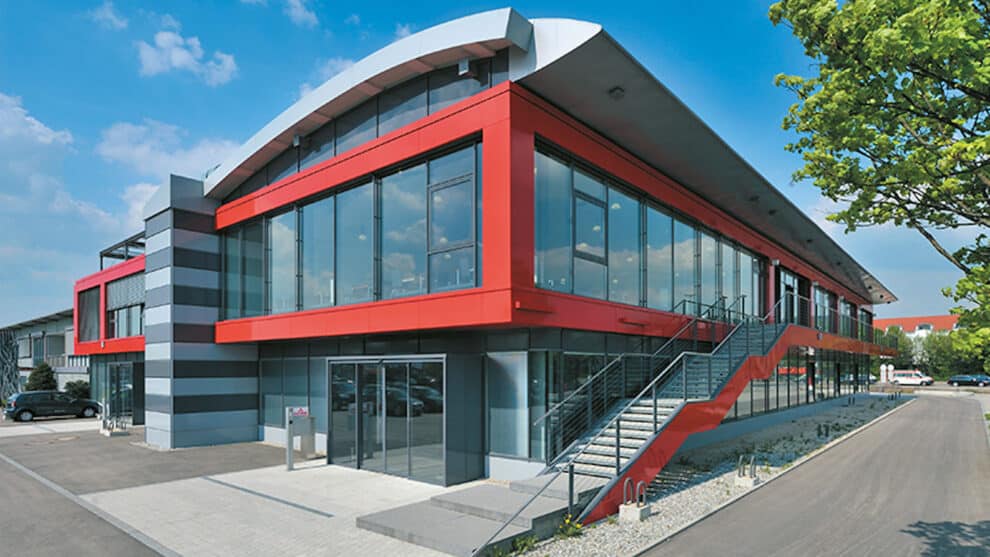
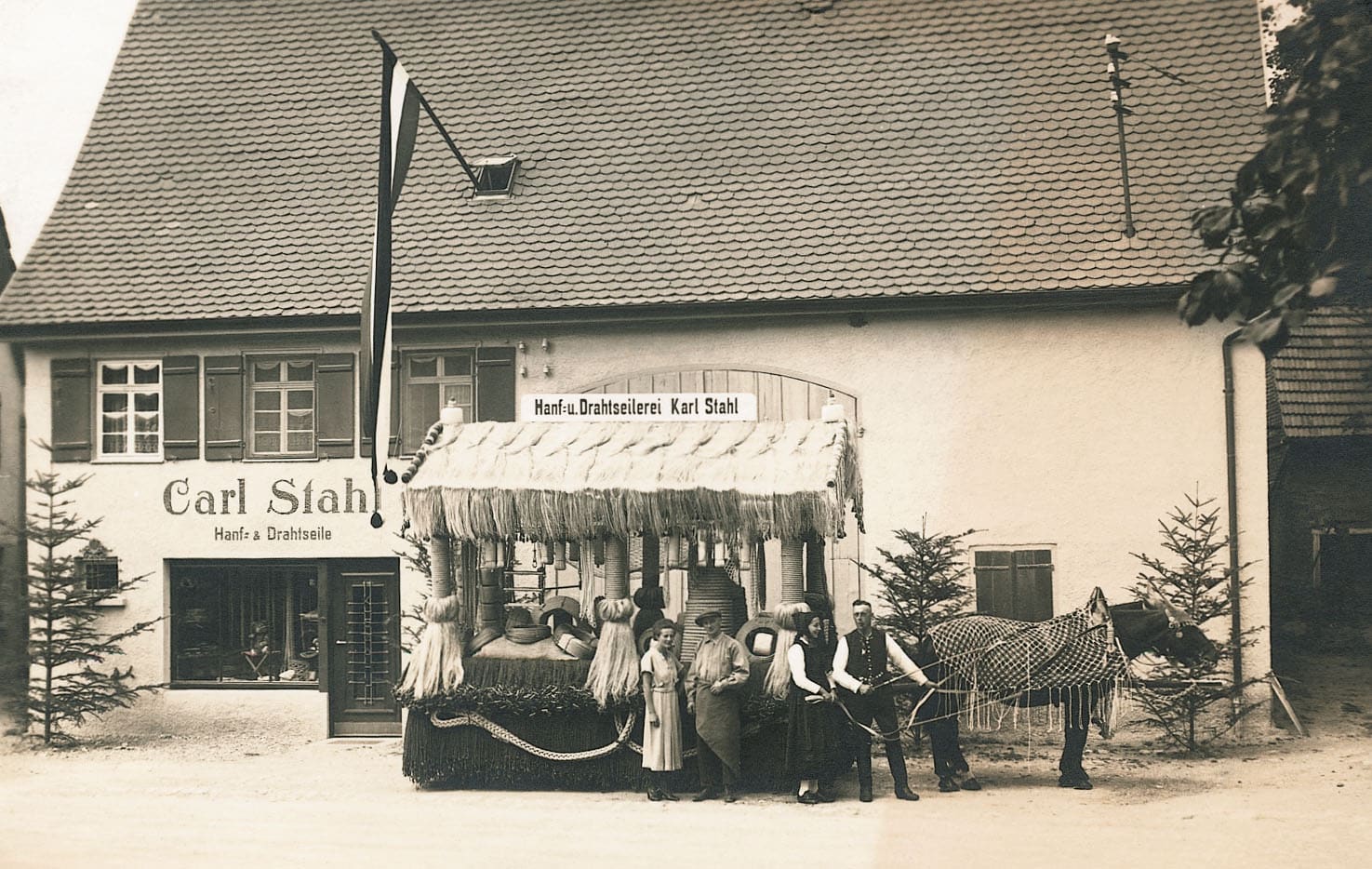
For more than a hundred years, Carl Stahl has been developing solutions for lifting, moving, and securing loads. Every day, in industrial facilities, shipyards, manufacturing plants, and on construction sites, technologies are used that make forces manageable and support people in physically demanding tasks. What began in 1880 as a rope-making business later developed into a traditional lifting technology company that evolved over the course of the 20th century and continues to this day as an international provider of solutions focused on safety, efficiency, and industrial work processes in the field of lifting technology.
Throughout this journey, the fundamental focus has always been on the same challenge: gravity.
It determines, among other forces, what stresses parts, components, and people are exposed to every day. At its core, lifting technology is nothing more than an attempt to make the effects of gravity controllable and manageable. Cranes handle heavy loads. Lifting slings distribute forces. Hoists reduce physical exertion. The entire industry has always grappled with the same question: How can necessary work be made safer and more efficient?
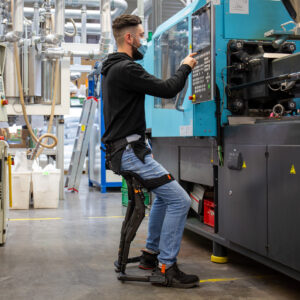
Modern production facilities move components weighing several metric tons fully automatically through the manufacturing process. Driverless transport systems handle internal logistics. Robots perform highly precise sequences of movements. Yet while machines are moving more and more loads, numerous physically demanding tasks remain an unchanged part of the daily work routine. Employees assemble components overhead. They work in awkward positions. They stand for hours at workstations that can only be ergonomically optimized to a limited extent. They continue to perform thousands of repetitive movements per shift.
Unlike many technologies, industrial exoskeletons do not stem from a desire for higher productivity. Their origin lies in ergonomics. They were developed to support people in physically demanding tasks without restricting their freedom of movement. Instead of taking over the loads entirely, they reduce the strain on muscles, joints, and tendons.
Carl Stahl is deeply familiar with the principles behind this. After all, lifting technology is based on the same concepts. It’s not about defying the laws of physics, but about using them intelligently. Forces are redirected, distributed, and absorbed. The only difference is that traditional lifting technology acts on loads, while exoskeletons act directly on the human body.
The more the company delved into the subject, the clearer it became: exoskeletons do not represent a new or unfamiliar market. They are the logical extension of what lifting technology has been achieving for generations.
This realization initially led to a sales partnership with noonee.
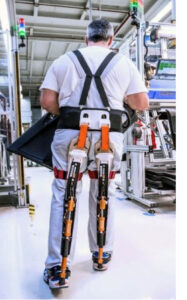
The story of noonee does not begin in a factory, but rather at ETH Zurich, one of the world’s leading technical universities. There, co-founder Keith Gunura grappled with a question that seems surprisingly simple at first glance: Why do people often have to stand for hours while working, even though many tasks could just as easily be performed while sitting?
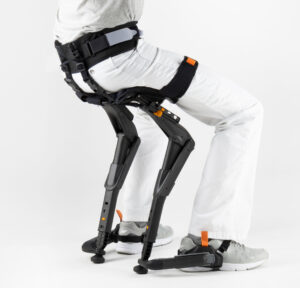
Gunura developed the original idea for what would later become the Chairless Chair while he was still a student at ETH Zurich. Instead of focusing on futuristic robotics or fully automated systems, he turned his attention to an everyday problem faced by millions of workers worldwide. Together with his team, this led to the creation of a wearable seating system that allows people to switch to an ergonomic sitting position at any time without sacrificing their freedom of movement. From this idea emerged noonee, a company that, within just a few years, became one of the best-known pioneers in the industrial exoskeleton industry.
Success was not long in coming. International industrial companies took notice of the technology. The Chairless Chair demonstrated that exoskeletons are not science fiction; they can solve real-world problems right here and now. Public reports show that major industrial companies like Audi began working with the Chairless Chair early on, making them among the first prominent users of this technology.
Since its market launch in 2016, noonee has established itself internationally as one of the best-known providers of passive exoskeletons. In many countries, the brand has become synonymous with the practical use of exoskeletons in industrial work environments. Customers worldwide associate the name noonee with innovative technology that puts people first.
New Insights and a New Partnership
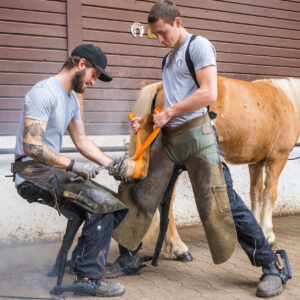
But it is not the individual product that matters most. What matters is the insight that emerges from it: The topic of exoskeletons is not a product decision; it’s a systems decision.
Anyone who takes a closer look at the market quickly realizes that each exoskeleton is designed for different applications. Some systems support the back when lifting and carrying heavy loads. Others relieve strain on the shoulders and neck during overhead work. Still others reduce the strain of standing for long periods or performing static tasks. With each new product, the market grew and, at the same time, became more confusing for users.
While noonee was establishing itself as a leader in exoskeletal research and design, Carl Stahl was arriving at the same conclusions from a different direction. If lifting technology serves to move loads more easily, safely, and efficiently, why shouldn’t the same logic be applied to people themselves? From this perspective, exoskeletons did not appear to be a foreign or unrelated technology, but rather a logical extension of fundamental principles that the company had been putting into practice for decades.
For Carl Stahl, this was the true turning point.
This initially led to a partnership with noonee. Even before the acquisition, the two companies had been working closely together on the distribution of the Chairless Chair. It quickly became clear that both companies not only brought complementary expertise to the table but also shared the same vision. Carl Stahl had decades of experience in industrial applications and global distribution networks. noonee brought market experience and one of the industry’s best-known exoskeleton innovations to the table.
So when the opportunity arose in 2024 to fully acquire noonee, this was not merely a strategic acquisition. It was the logical continuation of a shared journey. Carl Stahl did not simply acquire a product or a brand. The company acquired one of the pioneers of a young industry, a globally recognized technology, and, above all, a vision that aligned remarkably well with its own history and philosophy.
Both companies had arrived at the same conclusion from different directions: The future of industrial work lies not only in moving loads, but in relieving the burden on people. Even before the acquisition, noonee had already established itself worldwide as the provider of the Chairless Chair and, due to the growing market, was seeking a strategic partner for the next step in its development.
Noonee as a Marketplace for Exoskeletons
But the acquisition raised a new question.
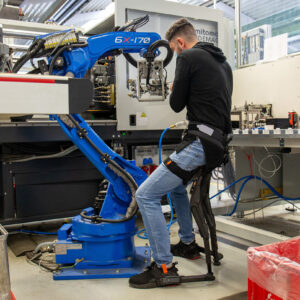
The exoskeleton market had changed. While there were only a few providers at the beginning, the industry has continued to evolve. New products have emerged for various applications. Some systems support the back and hips during lifting. Others relieve strain on the shoulders during overhead work. Still others help with prolonged standing or static tasks.
With every new exoskeleton, the selection has become more complex. Companies are facing a challenge that Carl Stahl, with its expertise in lifting technology, knows all too well. The “best” product rarely exists in a general sense. It always exists only for a specific application. This insight gave rise to the idea of repositioning noonee.
Instead of being solely a manufacturer or supplier of individual products, noonee has become the central point of reference for industrial exoskeletons. The brand has therefore deliberately evolved into a specialized exoskeleton marketplace. The goal is not only to provide companies with access to products but also to guide them through a market that is constantly growing and becoming more complex.
Choosing an exoskeleton today is similar to choosing a lifting solution. No one would choose a crane without knowing the load, the location of use, or the safety requirements. Similarly, an exoskeleton cannot be evaluated based solely on technical data. The decisive factors are operating conditions, movement sequences, load profiles, and the people who will eventually use the system.
This is precisely why a marketplace is gaining in importance. It enables comparison in a market that is becoming increasingly difficult to navigate due to its diversity. Companies are given the opportunity to compare different approaches and focus on the actual question: Which solution provides the greatest benefit in the specific workplace?
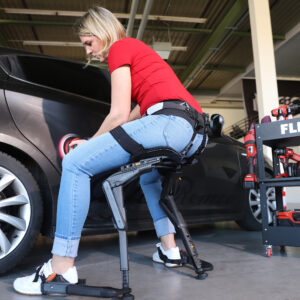
This is precisely where it becomes clear why Carl Stahl is particularly well-suited for such a task.
The company has decades of experience integrating technical solutions into real-world workflows. In lifting technology, success is not determined by the product alone, but by how it interacts with the entire process. What forces are at work? What risks arise? What interfaces must be considered? And which solution provides the greatest benefit for the user?
The same line of thinking applies to exoskeletons.
Their effectiveness does not depend solely on their design. What matters is how well they fit a specific application, how they are accepted, and how effectively they can be integrated into existing work environments.
This perspective distinguishes a product provider from a solution provider.
Carl Stahl does not view exoskeletons as a trend or as an isolated technology. They are part of a larger context. They combine ergonomics, occupational safety, productivity, and health.
Perhaps that is the real story behind the acquisition of noonee. It is not about a company entering a new market. It is about a company that has recognized that its original mission has expanded.
The struggle against gravity has remained the same. For centuries, it focused on loads, machines, and materials. Today, there is an equally important focus on the human being.
Thus, exoskeletons are now just as much a part of Carl Stahl’s history as ropes, cranes, and hoists. They do not represent a departure from tradition; rather, they are its logical evolution.
Image credits: All images in this article were provided by Carl Stahl.


Add Comment