

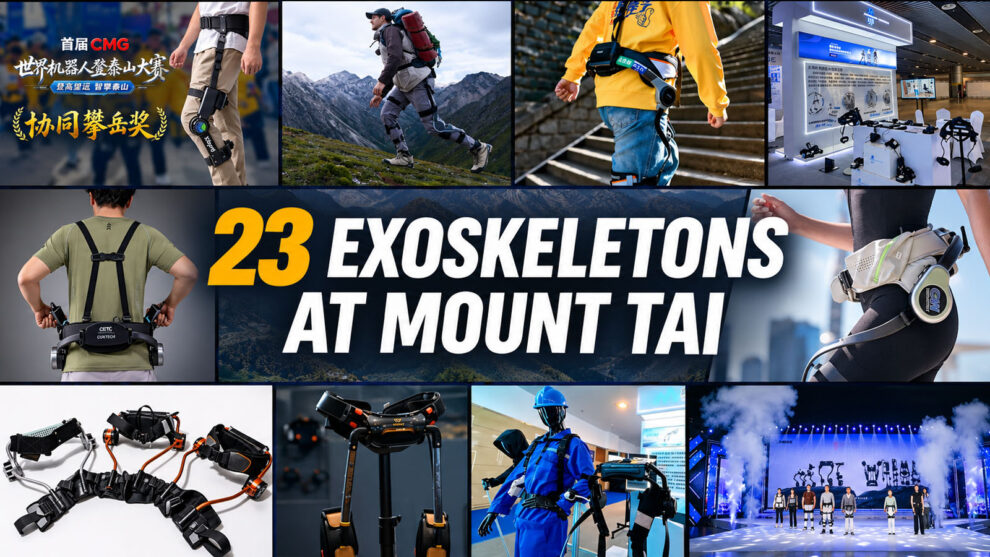
In the previous article, Exoskeletons on Parade on Mount Tai, we mentioned that there were dozens of different exoskeleton products on display, and this is a deep-dive continuation of that, which lists them. Some of these wearable robots should be familiar to Exoskeleton Report readers, while others are likely new to Western readers.
Original article by Exo-Work / Exoskeleton Robotics Outpost (外骨骼机器人前哨) on WeChat. Republished in English with permission on Exoskeleton Report. Special thanks to Exo-Work for allowing us to translate and share this article with our readers. Read the original Chinese article on WeChat. Specifications, prices, performance claims, and assessments below are retained from the original article. All prices are in Chinese yuan (RMB).
For the first time, the exoskeleton-assisted event at the inaugural CMG World Robot Mount Tai Climbing Competition brought products already on sale in China and those still in development onto the same course. The list below is not a ranking; it simply matches competition entry numbers to specific products. Specifications come from official websites and product manuals, while prices are the advertised selling prices on official websites and e-commerce platforms. (For more on the event, please read the previous Exo-Work article: Exoskeletons on Parade on the 3100 Steps of Mount Tai).

Poster for the inaugural CMG World Robot Mount Tai Climbing Competition. Image reproduced from Exo-Work’s original WeChat article.
Poster text: “Inaugural CMG World Robot Mount Tai Climbing Competition.” Slogan: “Climb high and look far; compete with intelligence on Mount Tai.” Date: November 2, 2026. The upper-right logos identify CCTV News and CMG’s Shandong bureau.
01 The lineup
The entry numbers shown in CCTV’s live broadcast ran from A01 to A31, with A15, A26, and A29 absent, leaving 28 entrants. The post-race honors list included 25 teams; the three not listed were A06 Yuanqidian (源奇点), A24 Haier, and A25 State Grid Joint Team (国网联队).
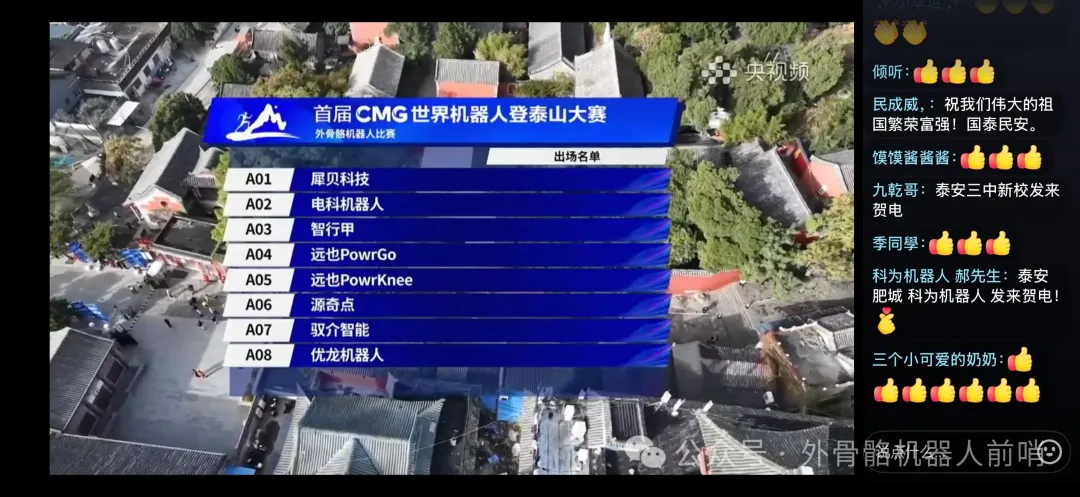
The broadcast roster shown in the original article lists the first eight entrants. Image reproduced from Exo-Work’s original WeChat article.
Roster excerpt: A01 — Xibyrd / Xibei Technology (犀贝科技); A02 — CETC Robotics (电科机器人); A03 — SENTINEX (智行甲); A04 — Yrobot PowrGo; A05 — Yrobot PowrKnee; A06 — Yuanqidian (源奇点); A07 — DRVEXO (驭介智能); A08 — EULON Robotics (优龙机器人).
02 The 23 products
1 Xibei Technology (犀贝科技) Xibyrd powered knee
Competition entry A01
Specifications: Approximately 1 kg (2.2 lb); assistance at the knee joint; extension assistance when climbing and damping when descending; can be worn on one leg.
Highlights: The lightest product in the field and the only one that can be worn on just one side. Incubated at the Chongqing Mingyue Lake Research Institute of Beijing University of Technology. Received the Collaborative Mountain Climbing Award at this competition.
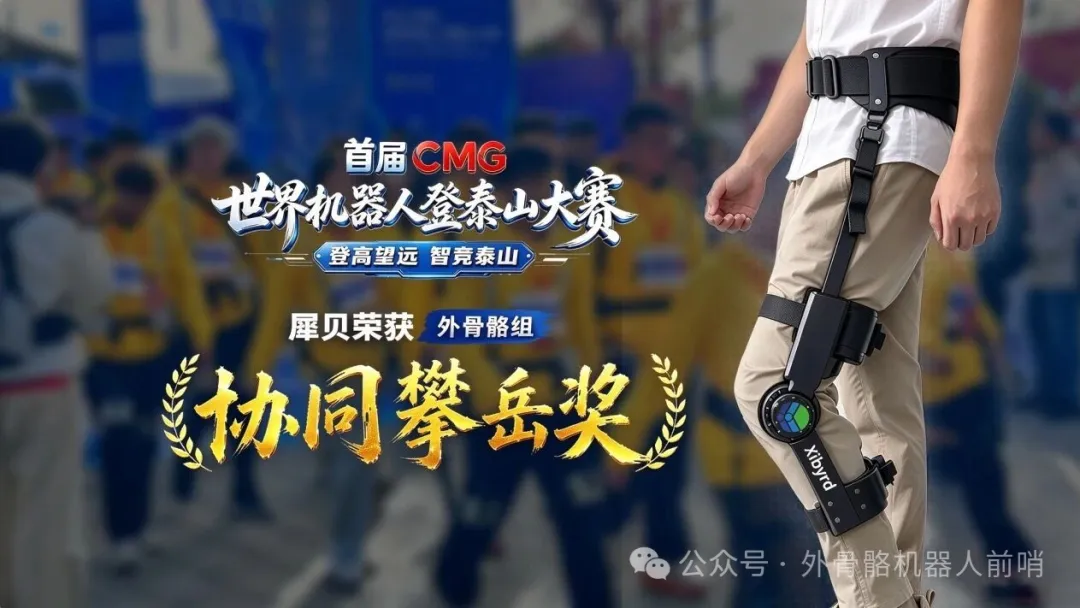
Xibyrd’s powered knee device in an award announcement. Image reproduced from Exo-Work’s original WeChat article.
The graphic states that Xibyrd received the “Collaborative Mountain Climbing Award” in the exoskeleton category of the inaugural CMG World Robot Mount Tai Climbing Competition.
2 CETC 21st Research Institute Baihong Tansuo (白虹·探索)
Competition entry A02
Specifications: Lower-body model: 2.2 kg (4.9 lb), approximately RMB 6,000. Upper-body Yunqing (云擎): 4.8 kg (10.6 lb), 36 N·m (26.6 lbf·ft), approximately RMB 20,000.
Highlights: Technology from a state-owned research organization is reaching the consumer market. The lower-body model runs directly from a power bank. It has supported China International Import Expo volunteers walking 30,000 steps a day.
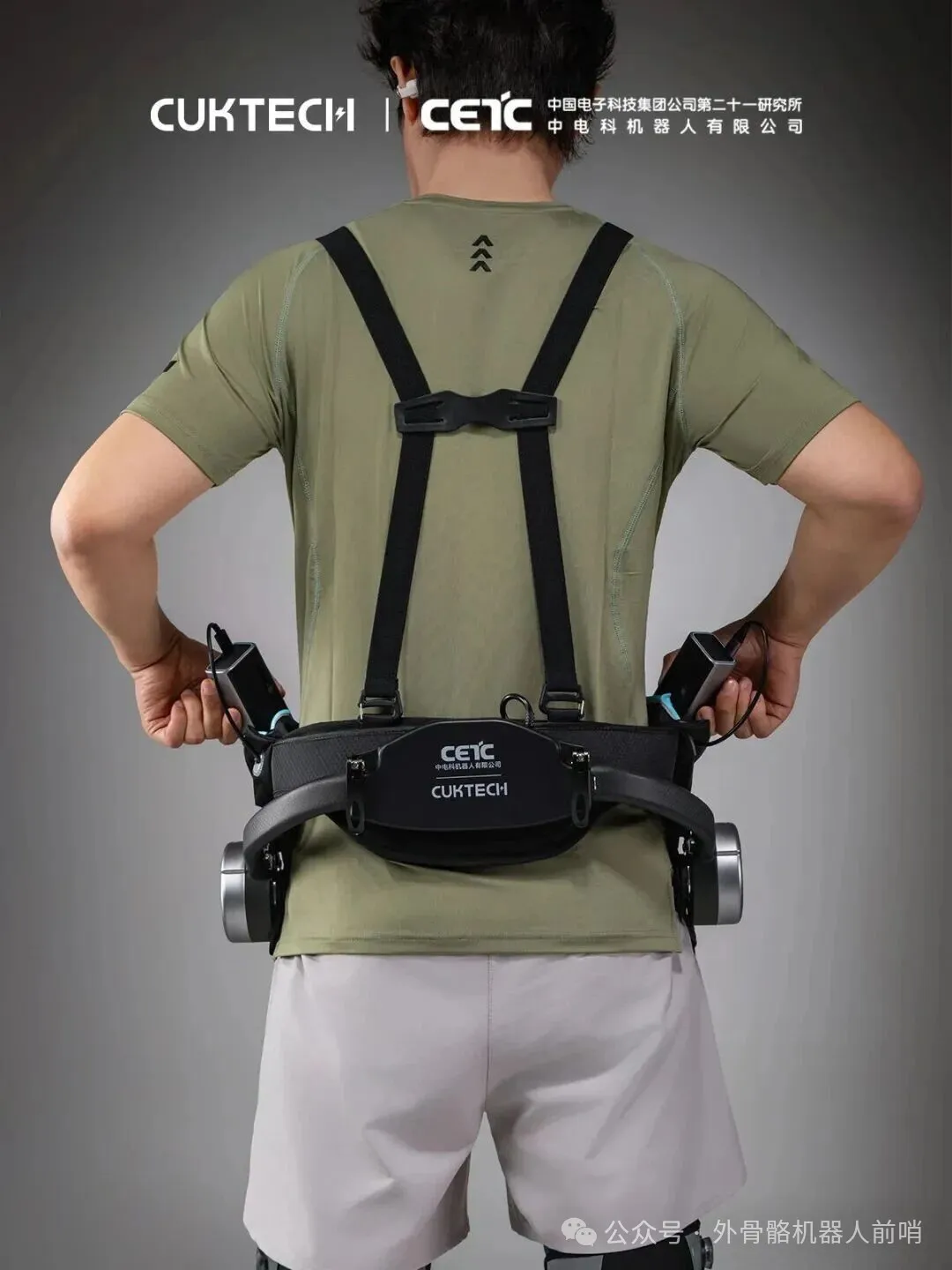
Rear view of an exoskeleton bearing CETC and CUKTECH branding. Image reproduced from Exo-Work’s original WeChat article.
The Chinese text beside the logos identifies China Electronics Technology Group Corporation’s 21st Research Institute and CETC Robotics Co., Ltd.
3 SENTINEX (智行甲) T100
Competition entry A03
Specifications: No more than 2 kg (4.4 lb), excluding the battery; assistance to both legs, 34 N·m (25.1 lbf·ft); 18 km/h (11.2 mph); operating time of at least 1.5 hours; IP54.
Highlights: The T100 uses carbon-fiber waist and leg supports. Rentals are already available at 23 scenic destinations, including Mount Wugong and Changbai Mountain. Received the Collaborative Mountain Climbing Award at this competition.
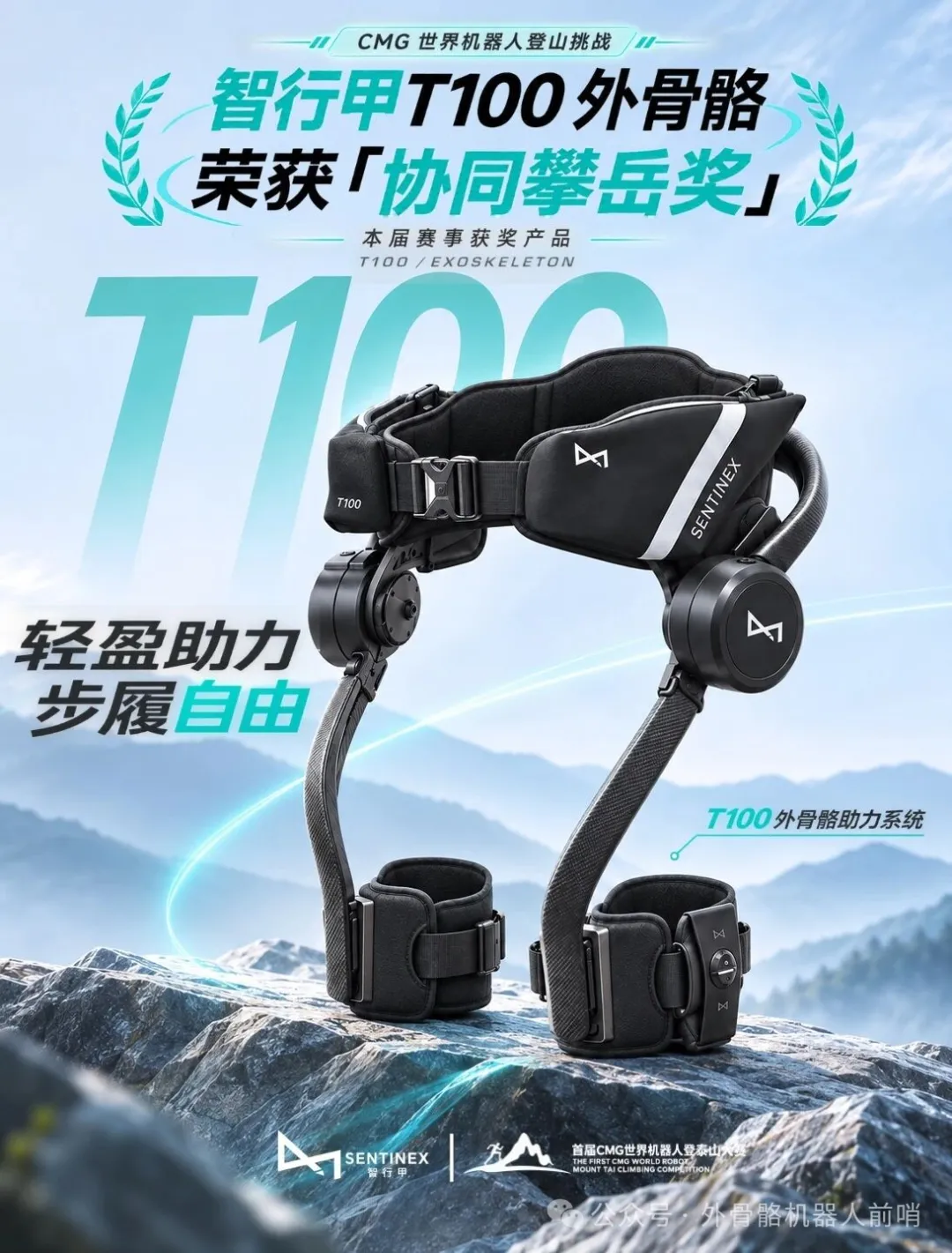
SENTINEX T100 in a promotional poster marking its competition award. Image reproduced from Exo-Work’s original WeChat article.
Headline: “SENTINEX T100 exoskeleton wins the Collaborative Mountain Climbing Award.” Other text reads “Award-winning product at this competition,” “Lightweight assistance, freedom with every step,” and “T100 exoskeleton assistance system.”
4 Yrobot (远也科技) PowrGo and PowrKnee
Competition entries A04 / A05
Specifications: RMB 7,999 / 12,999 / 18,999; 2–3 kg (4.4–6.6 lb); 1,000–1,520 W; range of 32–40 km (19.9–24.9 mi); IP54.
Highlights: Independent knee assistance supports knee extension when climbing stairs and is reported to take on 60% of the impact when walking downhill. Red Dot and iF award winner. Its two product lines occupied two competition entry numbers.
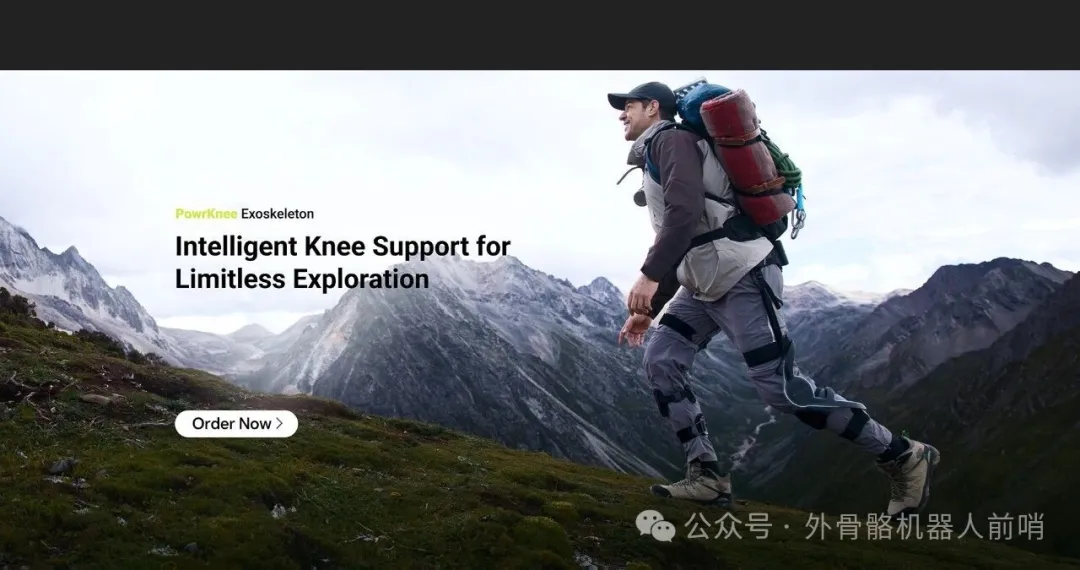
PowrKnee shown in a hiking promotional image. Image reproduced from Exo-Work’s original WeChat article.
5 DRVEXO (驭介智能) Lin I (林-Ⅰ)
Competition entry A07
Specifications: RMB 3,599 / 3,999; an open-source hip-joint platform, with the mechanical design, hardware, and algorithms all open.
Highlights: Sold to universities and developers rather than as a consumer product. The company serves both “people who can build” and “people who want to build.”
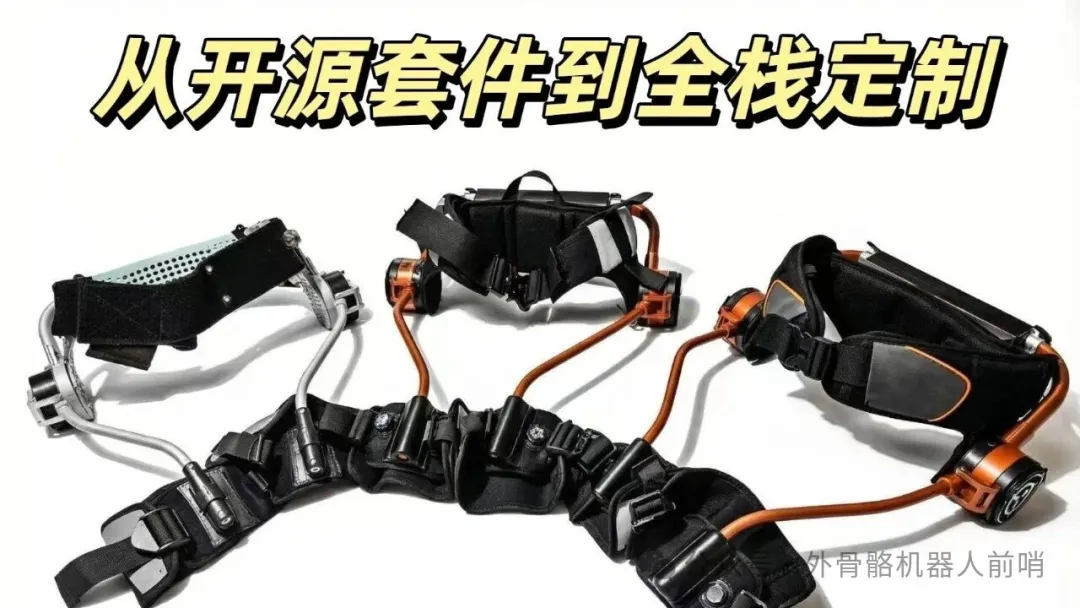
Exoskeleton configurations illustrated in DRVEXO’s open-source platform section. Image reproduced from Exo-Work’s original WeChat article.
Headline: “From open-source kits to full customization.”
6 EULON (优龙机器人) Youlong 1.0 PRO
Competition entry A08
Specifications: 2.4 kg (5.3 lb); 32 N·m (23.6 lbf·ft); approximately 22,000 steps per charge; IP54; approximately RMB 9,800.
Highlights: Assists hip lifting on both sides in a form resembling a smart belt. The company also offers the Qilin 3.0 (麒麟3.0) children’s model, rated at 24 N·m (17.7 lbf·ft).
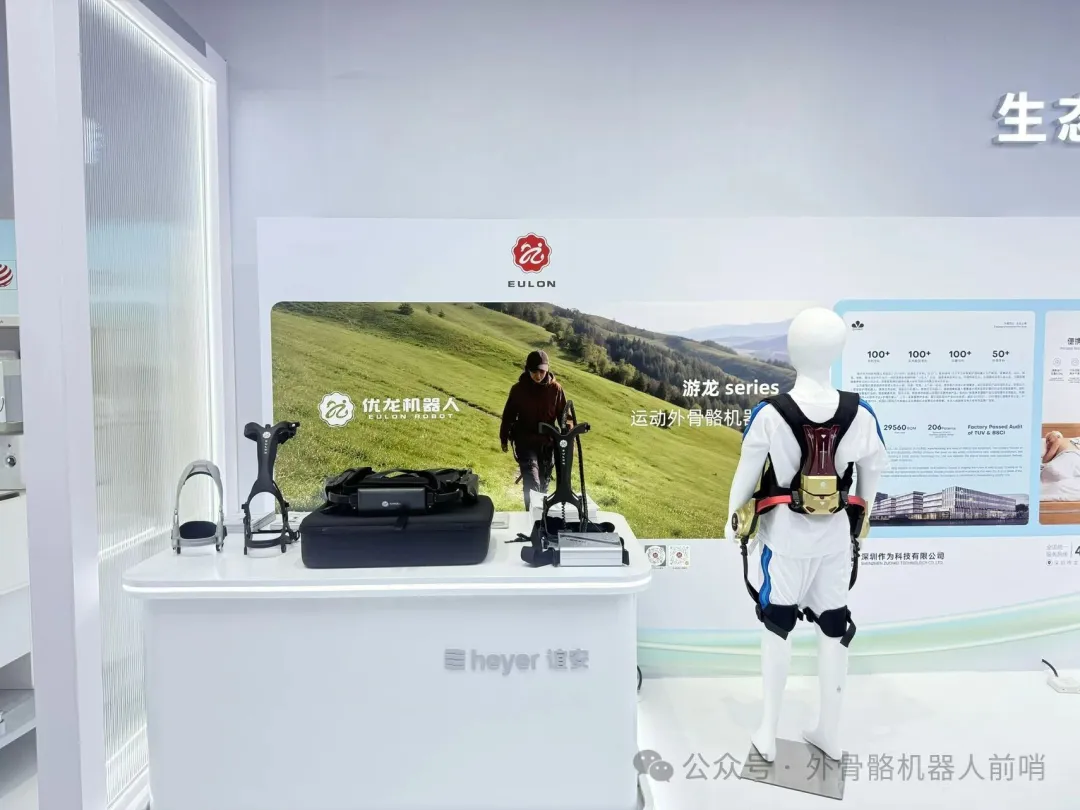
EULON’s exhibition display includes several wearable devices and components. Image reproduced from Exo-Work’s original WeChat article.
The background identifies “EULON Robot” and the “Youlong series” of sports exoskeleton robots.
7 Tongcheng Intelligent Manufacturing (同程智造)
Competition entry A09
Specifications: Complete-device specifications have not been disclosed.
Highlights: The cultural-tourism technology arm of Tongcheng Travel says its independently developed exoskeleton will be introduced at several major scenic destinations. An online travel agency is entering the field through its tourism use cases.
8 Toread (探路者) Crest C3
Competition entry A10
Specifications: 1.8 kg (4.0 lb); dual motors, 800 W; 4 hours / 20 km (12.4 mi); IP54; RMB 7,699.
Highlights: Recognizes more than 10 operating conditions and provides assistance described as equivalent to lifting 18 kg (39.7 lb). A battery swap takes three seconds, with stable output at −20°C (−4°F).
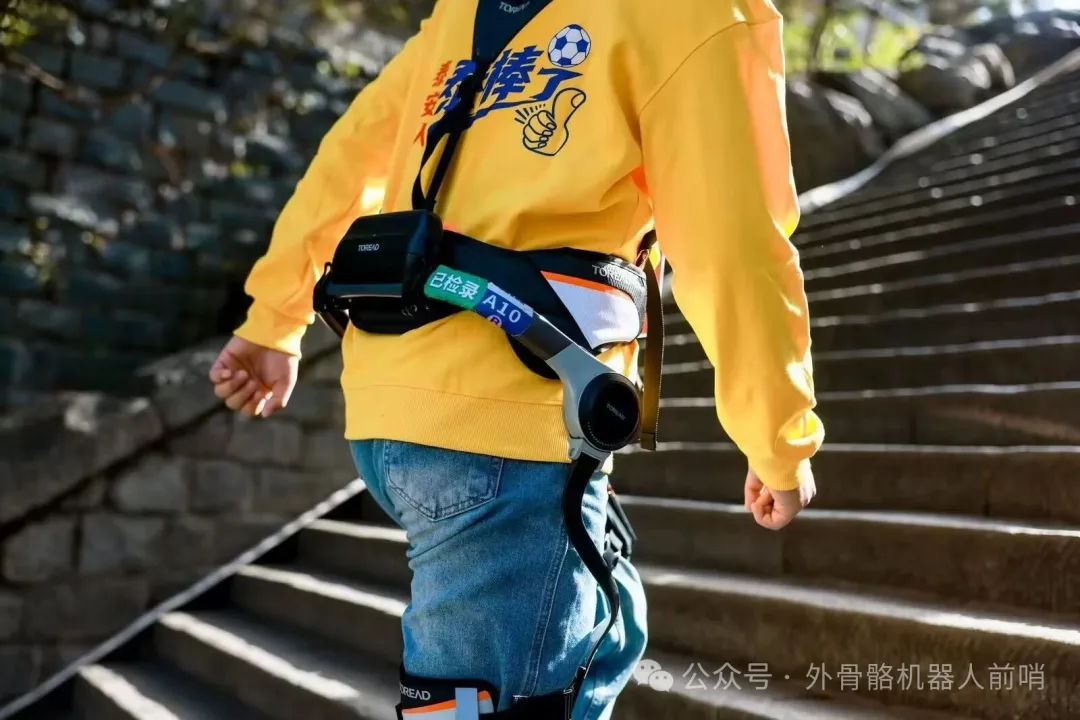
A participant wears a Toread exoskeleton at the competition. Image reproduced from Exo-Work’s original WeChat article.
The green label 已检录 means “Checked in”; the entrant number is A10.
9 Taishan Culture and Tourism × Kenqing Technology (泰山文旅 × 肯綮科技) second-generation Daidong (岱动二代)
Competition entries A11 / A13
Specifications: 1.2 kg (2.6 lb); camera plus radar vision; quad-core main processor; recognizes nine types of terrain and six types of movement.
Highlights: The main unit has been reduced to the size of a drinking cup and can be removed to free the wearer. It is already in routine service at the Hongmen rental point, at RMB 80 for three hours.
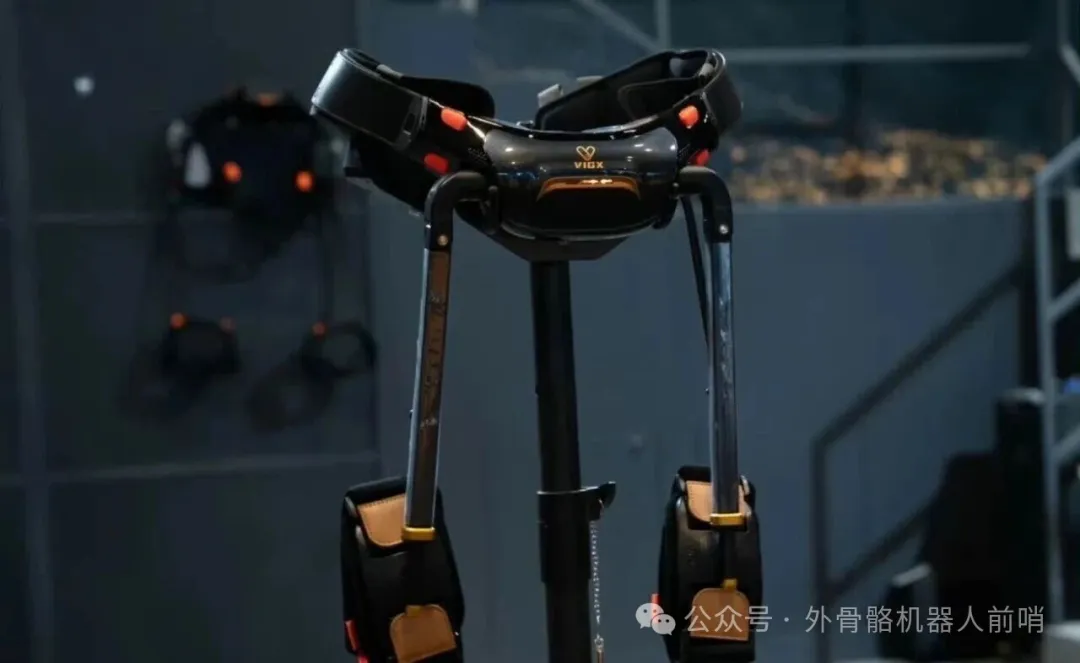
A VIGX-branded exoskeleton on display. Image reproduced from Exo-Work’s original WeChat article.
10 TPRUNEX (拓跑), Yuling Technology (驭领科技), TP01
Competition entry A12
Specifications: Approximately 2 kg (4.4 lb), with magnesium-alloy construction; dual motors, 40 N·m (29.5 lbf·ft); IP54; five operating modes and 10 assistance levels.
Highlights: Magnetic quick-lock fasteners allow one person to put it on in 30 seconds. An AI tour guide provides commentary on Hongmen and Wanxian Tower during the climb. Received the Collaborative Mountain Climbing Award at this competition.
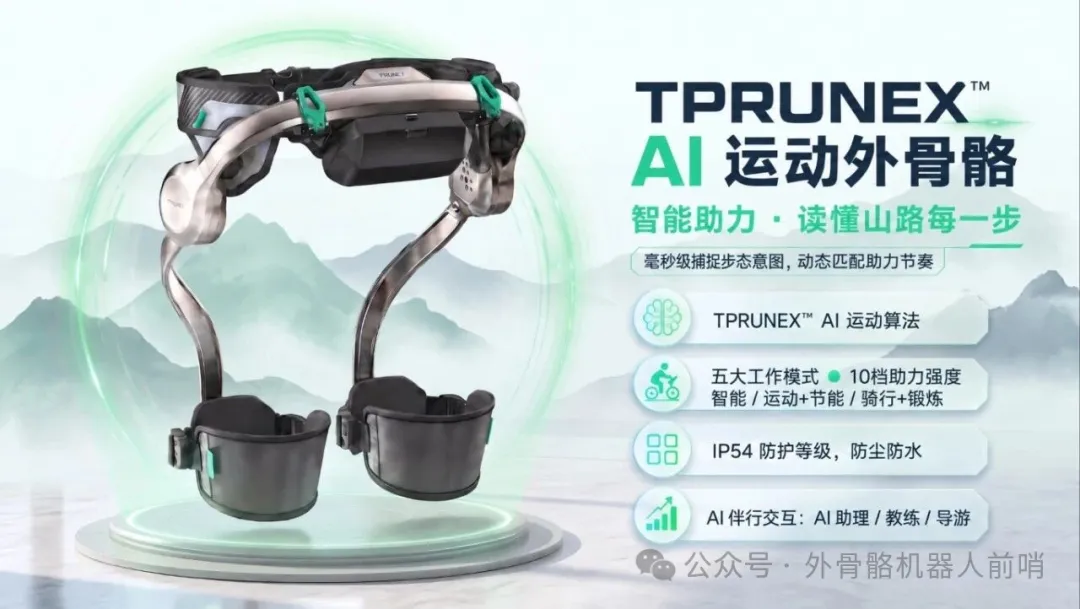
TPRUNEX promotional graphic outlining its assistance modes and AI functions. Image reproduced from Exo-Work’s original WeChat article.
The graphic describes an “AI sports exoskeleton” that detects gait intent in milliseconds and matches assistance dynamically. Its listed features are a proprietary AI movement algorithm; five operating modes and ten assistance levels; IP54 dust and water protection; and AI assistant, coach and tour-guide interaction. The five modes are smart, sport, energy saving, cycling and exercise.
11 JuRoot (巨鲁特) T01 series
Competition entry A14
Specifications: T01 / T01-Pro / T01-Ultra; carbon-fiber construction, approximately 1.8 kg (4.0 lb); 30 seconds to put on or take off.
Highlights: Incubated at Tongji Science and Technology Park, with independently developed intent sensing. Ranked first in the scoring for a Shanghai government procurement of lower-limb exoskeletons; carries EU CE marking. Received the Collaborative Mountain Climbing Award at this competition.
12 Zhongshuai Robotics (众帅机器人) K3 Yunduan (云端)
Competition entry A16
Specifications: 1.8 kg (4.0 lb); independently developed motors with noise below 45 dB; five operating modes; 10 seconds to put on or take off.
Highlights: The left and right legs can receive assistance independently. A fall automatically cuts power and triggers notification of an emergency contact. Walking data are uploaded to the cloud.
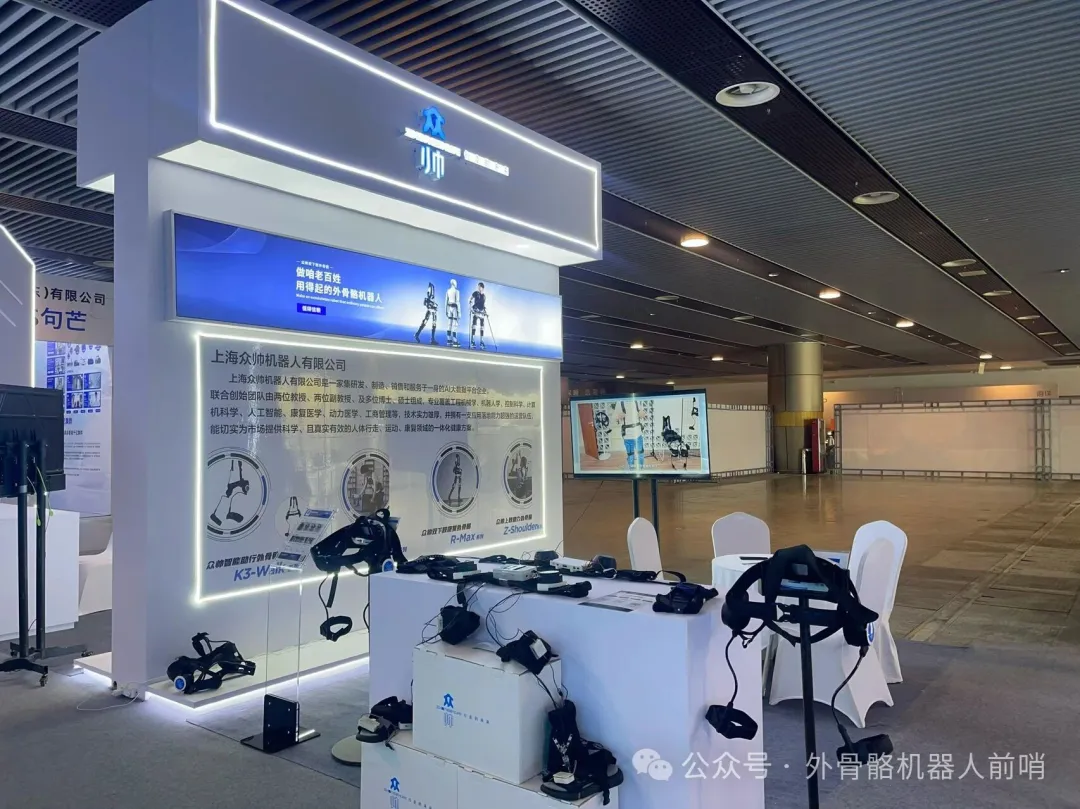
The Zhongshuai Robotics exhibition booth. Image reproduced from Exo-Work’s original WeChat article.
The company panel reads “Shanghai Zhongshuai Robotics Co., Ltd.” Its slogan is “Exoskeleton robots ordinary people can afford.” Visible product labels include K3-Walk, R-Max and Z-Shoulder.
13 Qimengzhe (启梦者)
Competition entry A17
Specifications: Complete-device specifications have not been disclosed.
Highlights: A Shandong company that has established a joint robotics training center with Dalian Engineering College (大连工程学院). In addition to competing, it helped organize the dedicated exhibition area.
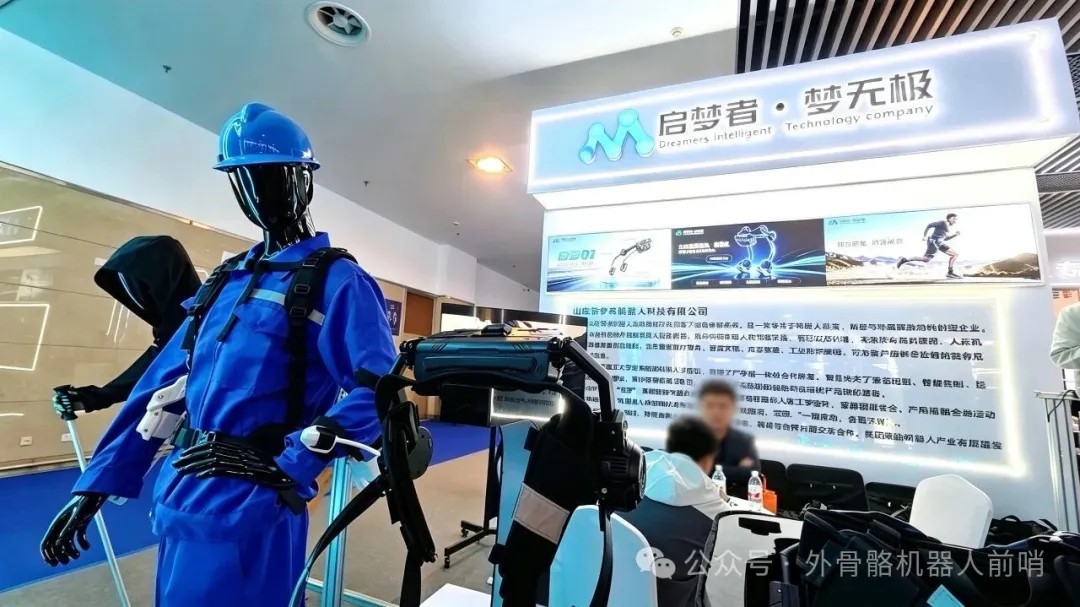
Wearable devices displayed at Qimengzhe’s exhibition booth. Image reproduced from Exo-Work’s original WeChat article.
The booth heading reads “Qimengzhe · Dreams without limits.” The company panel identifies Shandong Qimengzhe Robotics Technology Co., Ltd.
14 Xeno Dynamics (奇诺动力) Yibu (翊步)
Competition entry A18
Specifications: 2.3 kg (5.1 lb); peak power of 1,000 W; 42 N·m (31.0 lbf·ft); operating range or time not disclosed.
Highlights: Recognizes more than 10 gait patterns. Reported testing found a reduction of up to 40% in physical effort. Approximately 10 seconds to put on or take off, with a dynamic display and animated light strip.
15 Planck Robotics PLANKEXA (普朗克) Walker One and Pro
Competition entry A19
Specifications: Powered hip assistance; an independently developed AI algorithm for dynamic gait control.
Highlights: Targets both climbing at scenic destinations and walking assistance for older people. A separate Pandengzhe (攀登者, “Climber”) series is also available, with product lines named for their use cases.
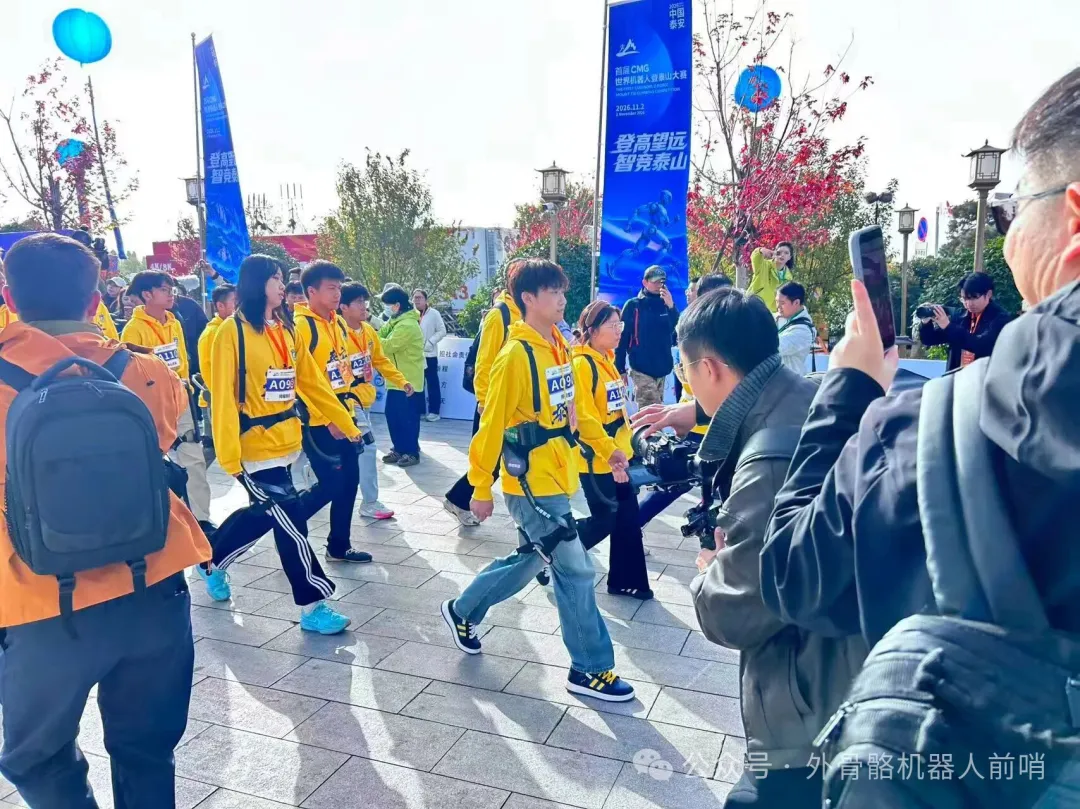
Participants wearing exoskeletons move through the competition venue. Image reproduced from Exo-Work’s original WeChat article.
16 Linglida (零力达)
Competition entry A20
Specifications: 1.8 kg (4.0 lb), excluding the battery; dual motors, 36 N·m (26.6 lbf·ft); range of 25 km (15.5 mi); IP56; 15 seconds to put on.
Highlights: Uses 15 sensors and identifies gait in 1 millisecond. Ranked first with a perfect score in pre-race testing. Rental cabinets have already been installed at Badaling. A brand of Wuxi Shuzhidao (无锡术之道).
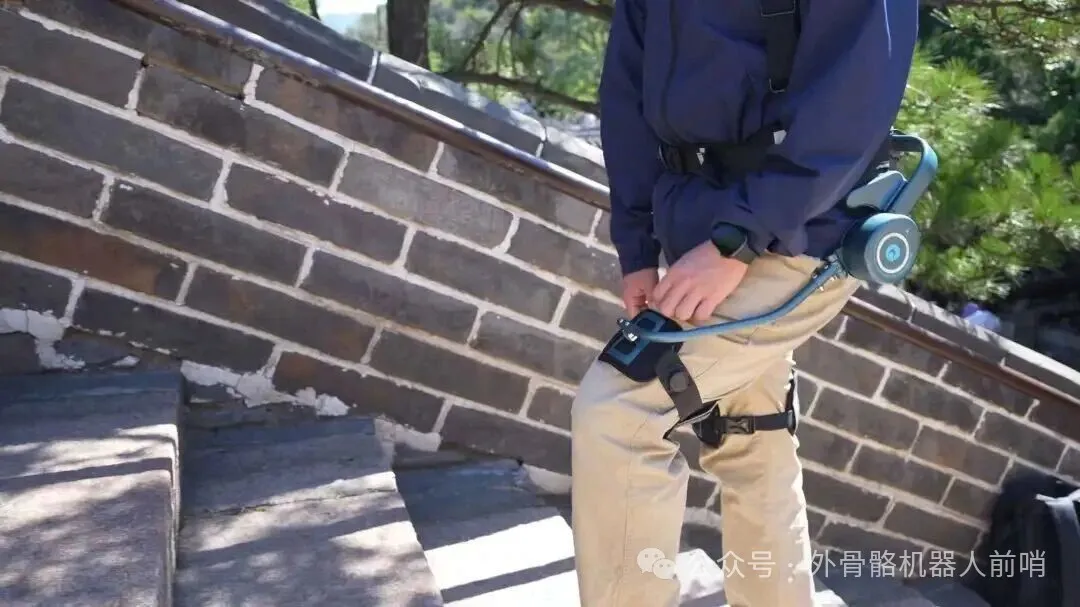
A wearer adjusts an exoskeleton in the image accompanying the Linglida entry. Image reproduced from Exo-Work’s original WeChat article.
17 JinPeng Robotics (锦鹏机器人) Tuojie (拓界)
Competition entry A21
Specifications: Approximately 2 kg (4.4 lb), with magnesium-alloy construction; 15 seconds to put on; independently developed AI sensing algorithms.
Highlights: A Shenzhen company with more than 10 years of development and over 100 patents. Its principal markets are eldercare facilities and rehabilitation centers. Received the Collaborative Mountain Climbing Award at this competition.
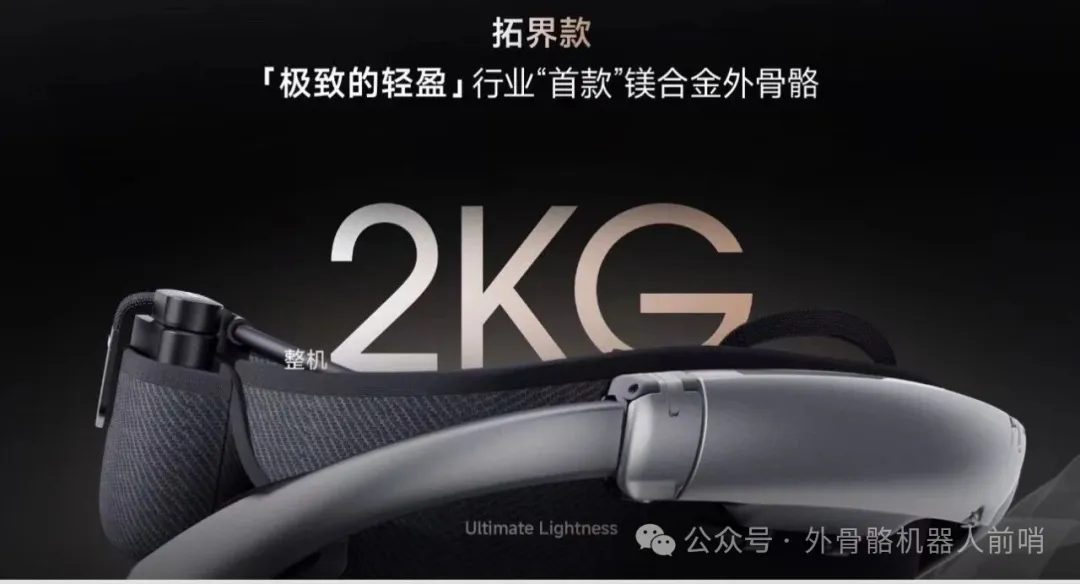
A promotional graphic for JinPeng’s Tuojie exoskeleton. Image reproduced from Exo-Work’s original WeChat article.
Text: “Tuojie model,” “Extreme lightness,” “the industry’s ‘first’ magnesium-alloy exoskeleton,” and “Total device weight: 2 kg (4.4 lb).”
18 Huali Lingyue Team (华理凌跃团队) Lingyue TurboSuit
Competition entry A22
Specifications: 2.6 kg (5.7 lb); 4–17 N·m (3.0–12.5 lbf·ft) per leg; 18 km/h (11.2 mph); 70 minutes of operating time; carbon-fiber construction.
Highlights: Developed jointly by Shanghai Jinling Motor and CETC Robotics. Smoothly switches between level ground, slopes, and steps.
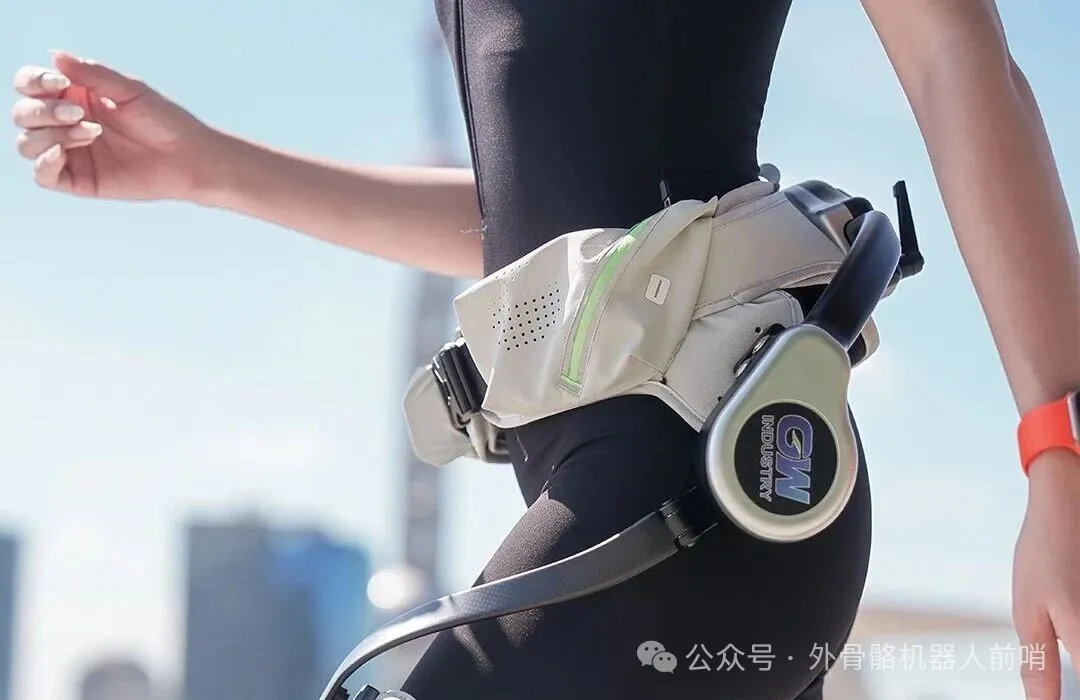
A close view of the exoskeleton illustrated in the Lingyue TurboSuit entry. Image reproduced from Exo-Work’s original WeChat article.
19 AlpWalk (远山智行) Tashan (踏山)
Competition entry A23
Specifications: 2.4 kg (5.3 lb); eight operating modes; family connectivity.
Highlights: Provides hip assistance for walking and has been deployed in more than 50 cities across China. The same company also offers the passive Xieshan (卸山), Jushan (举山), and Banshan (搬山) lines.
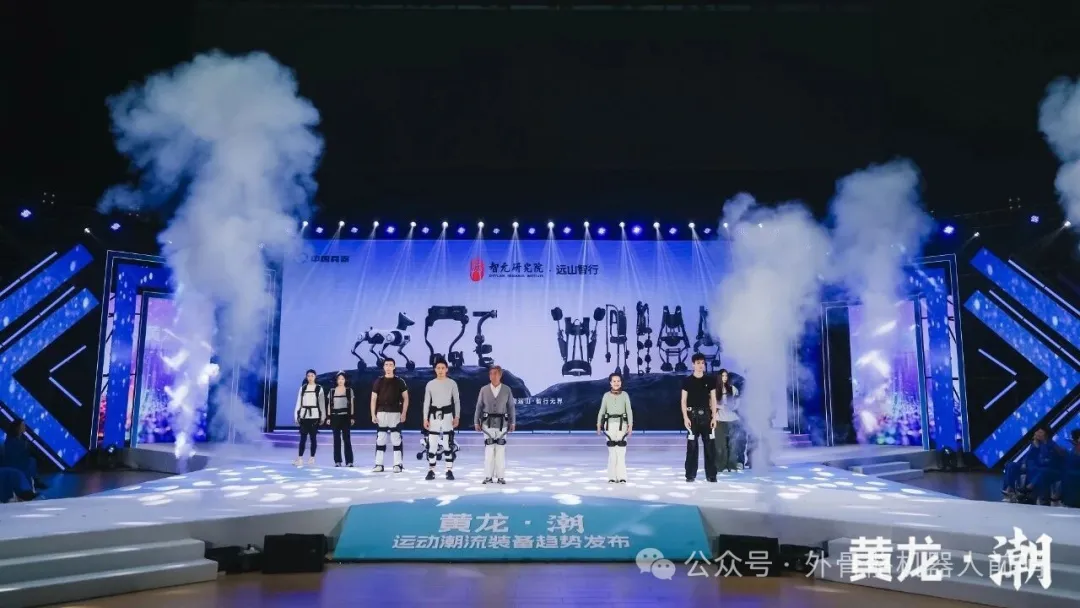
A stage presentation pictured in the AlpWalk section. Image reproduced from Exo-Work’s original WeChat article.
The screen includes the name “Yuanshan Zhixing.” The stage sign reads “Huanglong · Chao” and “Sports equipment trends showcase.”
20 Haier Robotics (海尔机器人) W1, W2, and W3
Competition entry A24
Specifications: W1: 24 N·m (17.7 lbf·ft) and five assistance levels. W2: 2.2 kg (4.9 lb) and 32 N·m (23.6 lbf·ft). W3: 1.65–1.7 kg (3.6–3.7 lb).
Highlights: The W2 combines carbon-fiber leg supports with a swappable battery and a reported 39% reduction in physical effort. The W3 uses carbon fiber and titanium alloy. Official website prices are RMB 11,999 / 11,999 / 15,999, respectively.
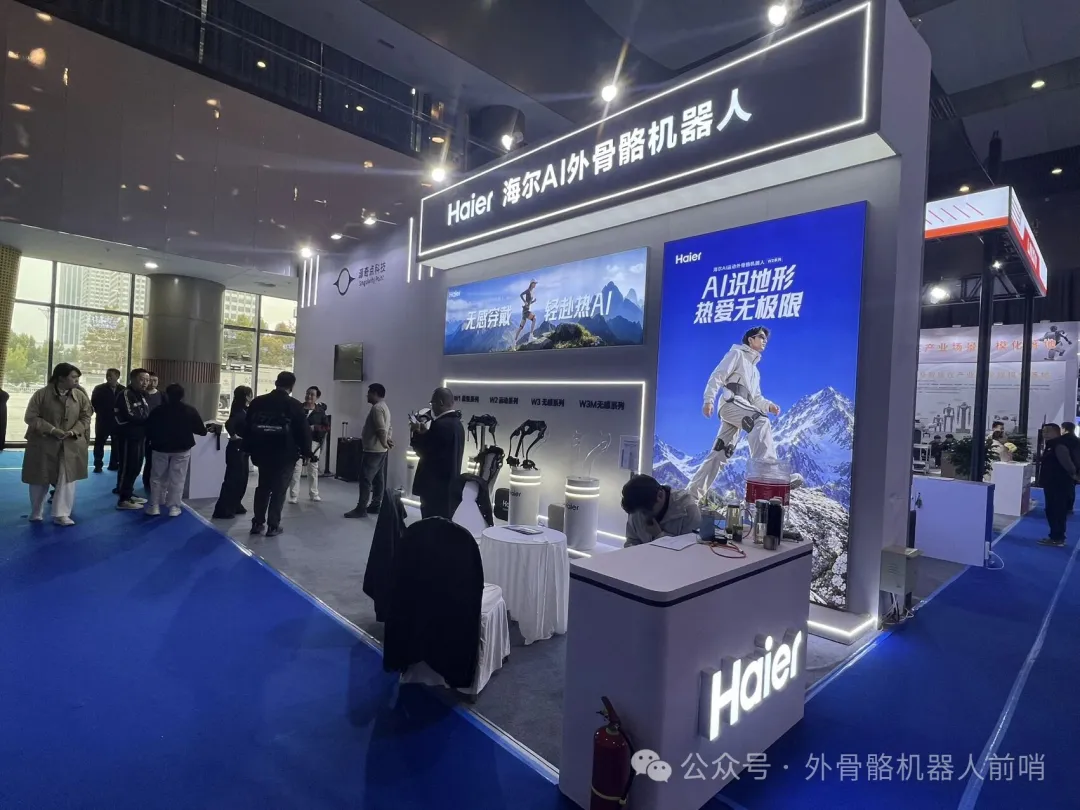
Haier’s AI exoskeleton booth at the exhibition. Image reproduced from Exo-Work’s original WeChat article.
The booth heading reads “Haier AI exoskeleton robots.” The right-hand advertisement says “AI terrain recognition” and “Passion without limits.”
21 RoboCT (程天科技) GoGo-H Pro and GoGo-K Ultra
Competition entry A28
Specifications: GoGo-H Pro: 2.2 kg (4.9 lb), range of 18 km (11.2 mi), IP54. GoGo-K Ultra: 1.7 kg (3.7 lb).
Highlights: Its algorithms were trained on rehabilitation data covering one billion steps and can recognize hemiplegic and shuffling gait patterns. The K Ultra provides support to slow the wearer’s descent when going downstairs.
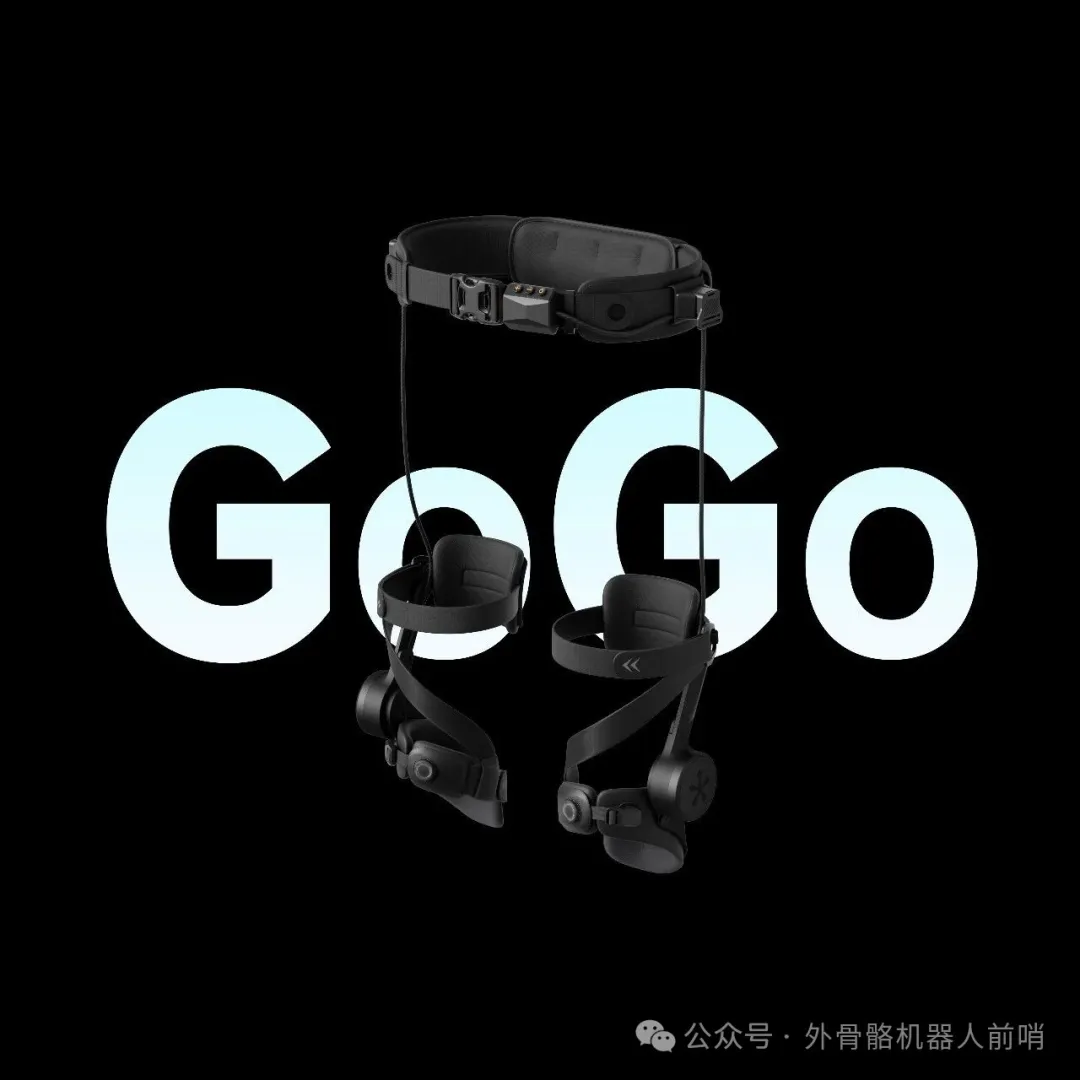
A GoGo knee exoskeleton shown in RoboCT’s product section. Image reproduced from Exo-Work’s original WeChat article.
22 Anhui MileBot Robotics (安徽迈步机器人) K series
Competition entry A30
Specifications: Aircraft-grade aluminum leg supports; dual motors; IP-rated protection and CE certification, as reported in the original article.
Highlights: Assistance stops immediately if walking stops abruptly, and force is automatically released during sitting and standing. Reflective strips are added to the straps. Designed for frequent rentals at scenic destinations.
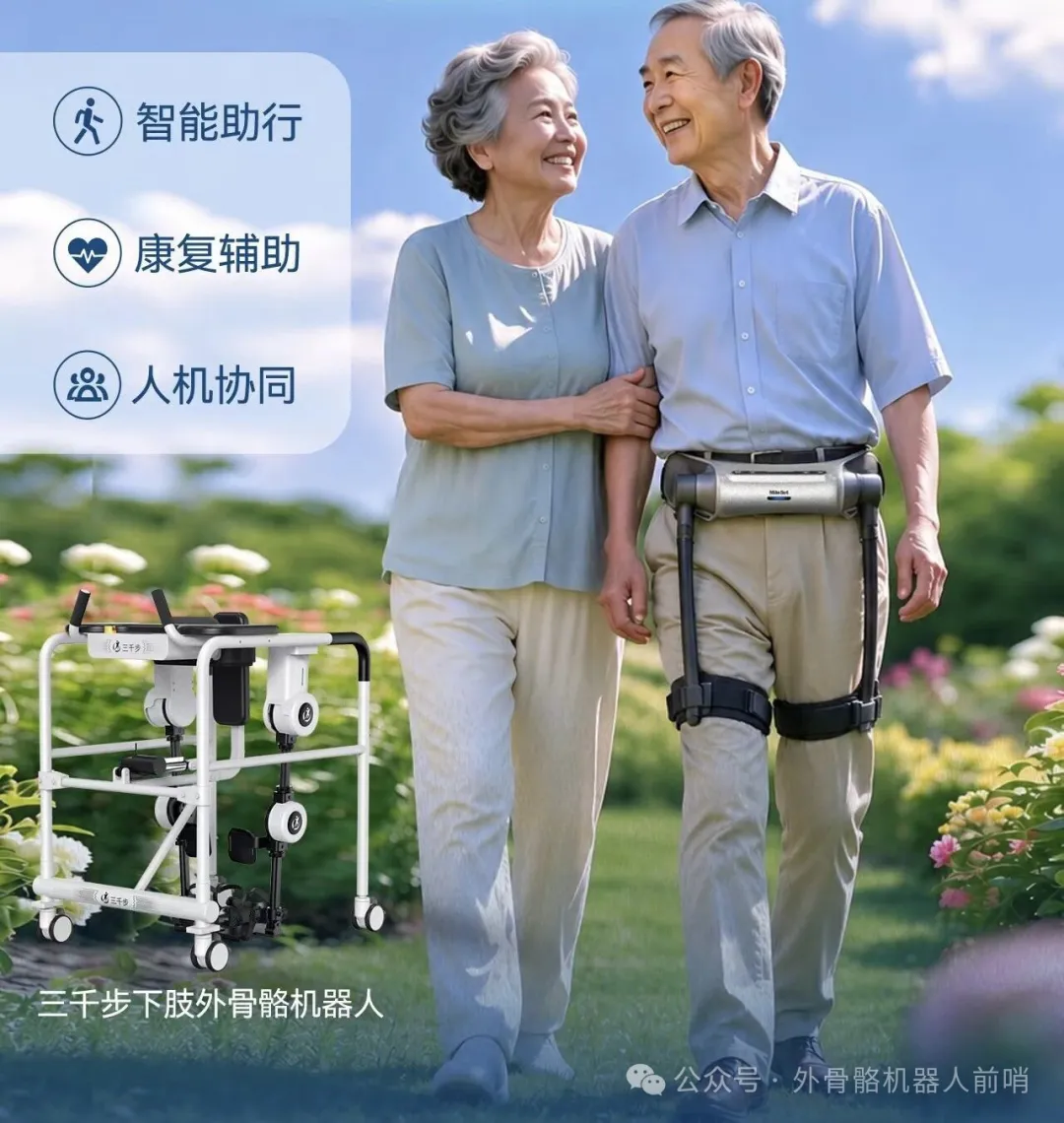
Promotional imagery reproduced in the Anhui MileBot entry. Image reproduced from Exo-Work’s original WeChat article.
The three labels read “Intelligent walking assistance,” “Rehabilitation support,” and “Human–machine coordination.” The lower label reads “Sanqianbu lower-limb exoskeleton robot.”
23 REUDYN (睿动) Hip X26
Competition entry A31
Specifications: Powered hip assistance; launched in September; very few specifications disclosed.
Highlights: Competed under the name Tuofeng Team (拓峰队). Its product had only just gone on public sale, making it the newest entrant in the field.
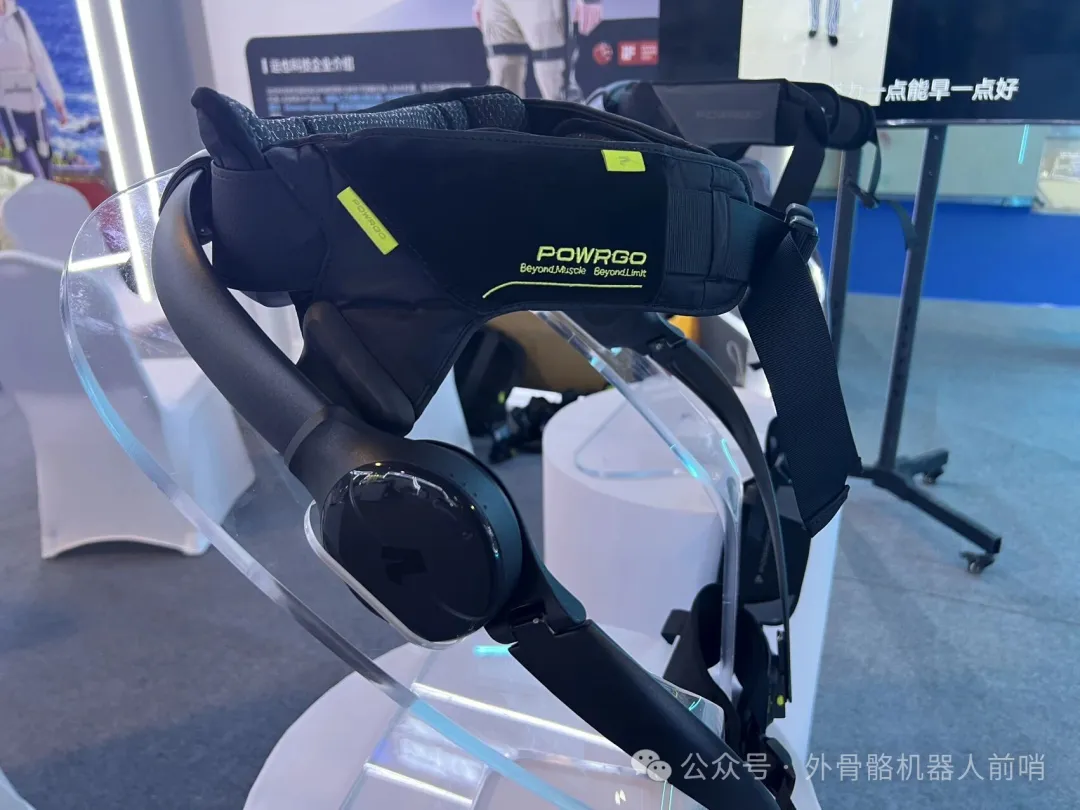
A PowrGo-branded exoskeleton on display. The original article places this image beneath its REUDYN Hip X26 entry. Image reproduced from Exo-Work’s original WeChat article.
03 Comparison
| Brand and model | Weight | Power or assistance | Operating time or range | Reference price | Entry |
|---|---|---|---|---|---|
| Xibyrd powered knee | Approx. 1 kg (2.2 lb) | Knee assistance / damping | Not disclosed | Not disclosed | A01 |
| CETC Baihong Tansuo | 2.2 kg (4.9 lb) | Lower-limb walking assistance | Power-bank powered | Approx. RMB 6,000 | A02 |
| SENTINEX T100 | ≤2 kg (4.4 lb)* | Both legs, 34 N·m | ≥1.5 h | Not disclosed | A03 |
| Yrobot PowrKnee Ultra | Approx. 2 kg (4.4 lb) | 1,520 W | 40 km (24.9 mi) | RMB 18,999 | A05 |
| DRVEXO Lin I | — | Open-source platform | — | From RMB 3,599 | A07 |
| EULON 1.0 PRO | 2.4 kg (5.3 lb) | 32 N·m | 22,000 steps | Approx. RMB 9,800 | A08 |
| Toread Crest C3 | 1.8 kg (4.0 lb) | 800 W, dual motors | 4 h / 20 km (12.4 mi) | RMB 7,699 | A10 |
| Kenqing second-generation Daidong | 1.2 kg (2.6 lb) | Vision-based anticipation + both hips | Not disclosed | Rental: RMB 80 / 3 h | A11 |
| TPRUNEX TP01 | Approx. 2 kg (4.4 lb) | 40 N·m | Not disclosed | Not disclosed | A12 |
| JuRoot T01 | Approx. 1.8 kg (4.0 lb) | Powered assistance at both hips | Not disclosed | Not disclosed | A14 |
| Zhongshuai K3 | 1.8 kg (4.0 lb) | Both hips | Not disclosed | Not disclosed | A16 |
| Xeno Dynamics Yibu | 2.3 kg (5.1 lb) | 1,000 W / 42 N·m | Not disclosed | Not disclosed | A18 |
| Linglida | 1.8 kg (4.0 lb)* | 36 N·m, dual motors | 25 km (15.5 mi) | Not disclosed | A20 |
| JinPeng Tuojie | Approx. 2 kg (4.4 lb) | Both hips | Not disclosed | Not disclosed | A21 |
| Lingyue TurboSuit | 2.6 kg (5.7 lb) | 4–17 N·m per leg | 70 min | Not disclosed | A22 |
| AlpWalk Tashan | 2.4 kg (5.3 lb) | Hip walking assistance | Not disclosed | Not disclosed | A23 |
| Haier W3 | 1.65–1.7 kg (3.6–3.7 lb) | 960 W / 32 N·m | Swappable battery | RMB 15,999 | A24 |
| RoboCT GoGo-H Pro | 2.2 kg (4.9 lb) | Dual motors | 18 km (11.2 mi) | From approx. RMB 6,200 | A28 |
An asterisk (*) indicates a weight excluding the battery. A dash or “Not disclosed” means the manufacturer has not disclosed the information, not that the product lacks the feature.
Three price bands are clear: DRVEXO’s open-source platform is the only offering in the RMB 3,000 range; six products are clustered between RMB 6,000 and RMB 12,000, the main consumer battleground; above RMB 15,000, only the top Haier and Yrobot models remain.
04 Assessment
1 Mechanical designs have converged
Of the 18 products with quantitative specifications in the comparison table, five weigh between 1.65 and 1.8 kg (3.6–4.0 lb). Only two reach 1.2 kg (2.6 lb) or less: Xibyrd at 1 kg (2.2 lb) and the second-generation Daidong [VIGX π6] at 1.2 kg (2.6 lb). The combination of carbon-fiber and aluminum-alloy leg supports has essentially reached its limits. Further weight reductions will come from how the device is secured to the body and how its battery is configured, rather than from the materials.
2 Knee assistance remains the only configuration that is not yet crowded
Among the 23 products, only three product lines use a knee-assistance approach: Yrobot, RoboCT’s GoGo-K, and Xibyrd. The other clearly identified configurations are all powered hip devices. This is where the opening lies, and where the cost pressure is greatest: knee assistance places the highest demands on the torque density of each motor.
3 Use cases and sales channels now distinguish products more than specifications do
TPRUNEX has built an AI tour guide into its remote control; SENTINEX has established a rental network at 23 scenic destinations; Linglida has brought rental cabinets to Badaling; and Kenqing rents devices at Hongmen for RMB 80 for three hours. These details do not appear in a torque table, but they determine whether visitors remember the device after they come down the mountain.
Sources and image credits
Original article: 23 Exoskeleton Products at the First CMG World Robot Mount Tai Climbing Competition, by Exo-Work / Exoskeleton Robotics Outpost (外骨骼机器人前哨).
Specifications and prices were compiled from official websites, product manuals, and e-commerce listings, as described by Exo-Work. All 22 images are reproduced from the original article; the credits identify that source without assigning individual photographer ownership.
Acknowledgment and translation notes
Special thanks to Exo-Work / Exoskeleton Robotics Outpost (外骨骼机器人前哨) for granting permission to translate and republish this article in English on Exoskeleton Report, and for sharing this reporting and imagery with our readers.
English translation and editing prepared for Exoskeleton Report. The author’s figures, product groupings, and opinions are retained. The 23 profiles include product families and do not cover every competing team separately. Approximate imperial equivalents are added after metric measurements. Established English company names and official links are used where identifiable; other names retain pinyin and Chinese characters.
English captions, image-text translations, and alt text are additions for this edition. Images retain their Chinese lettering. Descriptive translations of awards and other names are not confirmed official English titles.
Read the original and follow Exo Work
Support the original reporting: Read Exo-Work’s original Chinese article on WeChat and visit Exoskeleton Robotics Outpost’s account.


Add Comment