

More manufacturers and products moving closer to the mainstream market: Original article by Exo-Work / Exoskeleton Robotics Outpost (外骨骼机器人前哨) on WeChat. Published and updated November 3, 2026
Republished in English with permission on Exoskeleton Report. Special thanks to Exo-Work for allowing us to translate and share this article with our readers. Read the original Chinese article on WeChat. First-person observations and analysis below are those of the original author. All yuan prices are in Chinese yuan (RMB).
On November 2, the inaugural CMG World Robot Mount Tai Climbing Competition opened in Tai’an. Among nearly 90 competing teams, one event had immediate relevance to ordinary people: the exoskeleton-assisted climbing race. The route from Hongmen to Zhongtianmen covered 3.9 km (2.4 mi) and more than 3,100 stone steps. The test was not how fast a robot could run, but whether a person wearing one could comfortably complete the climb.
The 2026 China (Mount Tai) Embodied Intelligence Industry Ecosystem Exhibition opened the same day. More than 50 of its 110 exhibitors were exoskeleton companies, and they were given a dedicated hall, Hall C. For the first time, this product category had its own exhibition hall.
After visiting the competition and exhibition, our strongest impression was that the industry’s products had visibly improved from 2025 to 2026. Compliant (back-drivable) control, pricing, and functionality were all converging, with the market poised for clear growth. But strong brand recognition had yet to emerge.
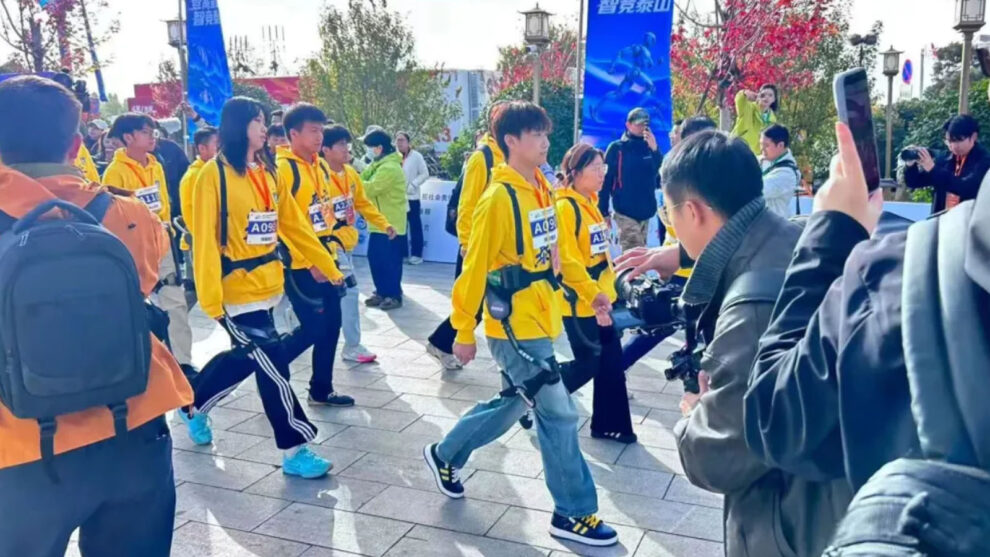
Participants wearing exoskeletons at the Mount Tai competition. (Caption added for the English edition.) Image reproduced from Exo-Work’s original WeChat article.
Banner text: “First CMG World Robot Mount Tai Climbing Competition,” November 2, 2026. The slogan reads, “Climb high and look far; compete with intelligence on Mount Tai.”
01 Market One Hall and Fifty Companies
At this time last year, exoskeletons were still scattered among the corners of various robotics exhibitions. At this Mount Tai exhibition, the organizers made exoskeletons a separate major exhibition category, bringing more than 50 exoskeleton companies together in Hall C.
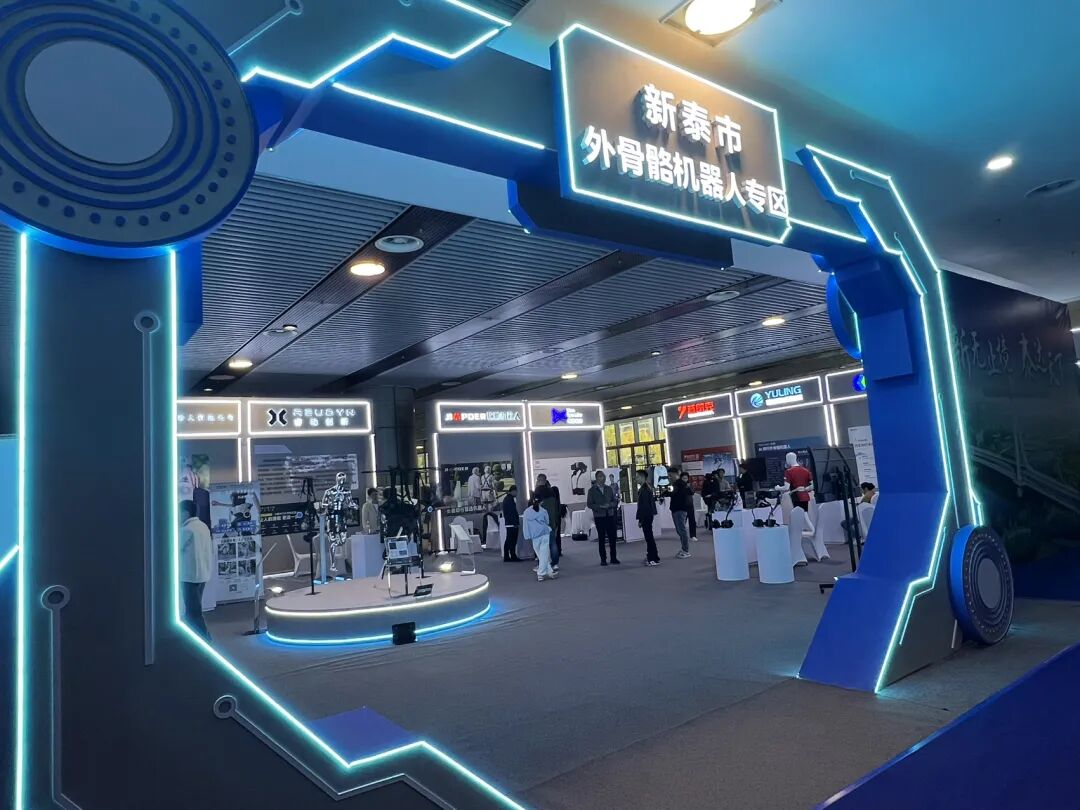
Xintai City exoskeleton robotics exhibition area. Photo: Exo-Work / Exoskeleton Robotics Outpost.
The competition roster reflected the same concentration. The exoskeleton-assisted race included specialist companies such as Kenqing Technology (肯綮科技) and EULON (优龙), joint teams pairing a scenic destination with a manufacturer, such as Taishan Culture and Tourism, and a number of less familiar names, including JuRoot (巨鲁特), MileBot (迈步), Tuopao (拓跑), Zhongshuai (众帅), and Qimengzhe (启梦者).
A large number of manufacturers typically signals an industry entering a period of rapidly expanding sales volumes. China shipped approximately 26,000 wearable robots in 2025, with consumer assistance models accounting for 72.8% by units. Consumer shipments in the first half of 2026 were already approaching 20,000 units, while online retail sales of smart exoskeletons grew by 458.4% year over year. Both investment and attention are flowing in, and everyone wants to secure an early position.
But the flip side of so many manufacturers is that their products look increasingly alike.
02 Products Converging on the Same Design
Compare the products exhibited and entered in this competition, and the convergence is unmistakable:
| Feature | Typical in 2025 | Typical in 2026 | What has changed |
|---|---|---|---|
| Total device weight | 1.8–3.0 kg (4.0–6.6 lb) | 1.2–2.6 kg (2.6–5.7 lb) | The second-generation Daidong (岱动) is down to 1.2 kg (2.6 lb) overall, with a main unit about the size of a drinking cup, according to Tai’an Daily. |
| Price range | Several thousand to RMB 16,000 | RMB 2,599–14,000, with core models at RMB 6,000–8,000 | Passive models have reached the low-thousands of yuan, while powered models are concentrated in the middle of the range. |
| Assistance mechanism | Single-motor hip assistance | Dual-motor hip assistance, with some models also assisting the knees | Powered assistance is expanding from the hips to multiple locations at the hips and knees. |
| Sensing approach | Inertial measurement unit (IMU) and pressure sensing; responding after movement begins | Predictive assistance algorithms, with vision introduced in some new models | Moving from response to anticipation; see the next section. |
“The scope for product differentiation is closing rapidly. This usually means that a category is about to enter the mainstream market.”
The other side of convergence is sameness. A waist-mounted unit, thigh straps, and assistance links have become the configuration of almost every consumer product. Nearly all of the main models sit in the RMB 6,000–7,000 price range. A year ago, a weight of 1.8 kg (4.0 lb) and 30,000 steps from two batteries were benchmark specifications. Today, they are the minimum requirements for entering the market.
03 Real Progress in Compliant Control from Response to Anticipation
The Mount Tai course gave every product a test that could not be gamed: 3,100 natural stone steps, with uneven heights and widths and the narrowest measuring just 13 cm (5.1 in).
Products in 2025 addressed the question, “Can it provide assistance?” Products in 2026 address, “Does that assistance feel smooth?” This is the central change in the current round of technological development. The industry calls it compliant control. To the wearer, it feels like “someone supporting your legs from behind,” rather than “a machine pulling you along.”
There are three layers to this change:
Sensing: Inertial sensing remains the mainstream approach, while vision is only beginning to emerge. Most products still use inertial measurement units (IMUs), with algorithms interpreting the wearer’s intended gait. A new generation of flagship models is starting to introduce vision. The second-generation Daidong (Daidong” (岱动) is the name of the Mount Tai climbing-assistance exoskeleton jointly developed by Kenqing Technology and Taishan Culture and Tourism Group. It is a product name associated with that collaboration. The cited report describes both its first and second generations), jointly developed by Taishan Culture and Tourism Group and Kenqing Technology and launched on October 23, combines a full-HD camera and radar vision system, plus a quad-core main processor. According to official claims, it can recognize nine types of terrain and six types of movement, anticipating an action before the wearer takes a step and matching assistance in advance, as reported by Tai’an Daily on October 28, 2026. It should be made clear that vision has so far been implemented in only a small number of new models and is not yet an industry standard. Its significance is that it points toward a shift from response to anticipation.
Response: Latency has fallen sharply. Algorithm response times have dropped from roughly 200 milliseconds in earlier systems to around 10 to 50 milliseconds. Some new products emphasize “anticipation approximately 0.2 seconds in advance and 2,500 adjustments per second.” The goal of human–machine coordination is moving from delivering substantial force to making the assistance feel almost imperceptible.
Terrain: Assistance strategies switch automatically. Algorithms are beginning to identify level ground, uphill and downhill slopes, and stairs, then change their assistance strategies automatically, reducing the need to select modes manually. Many products in this competition had already reached the point where users could “put it on and leave it to work.”
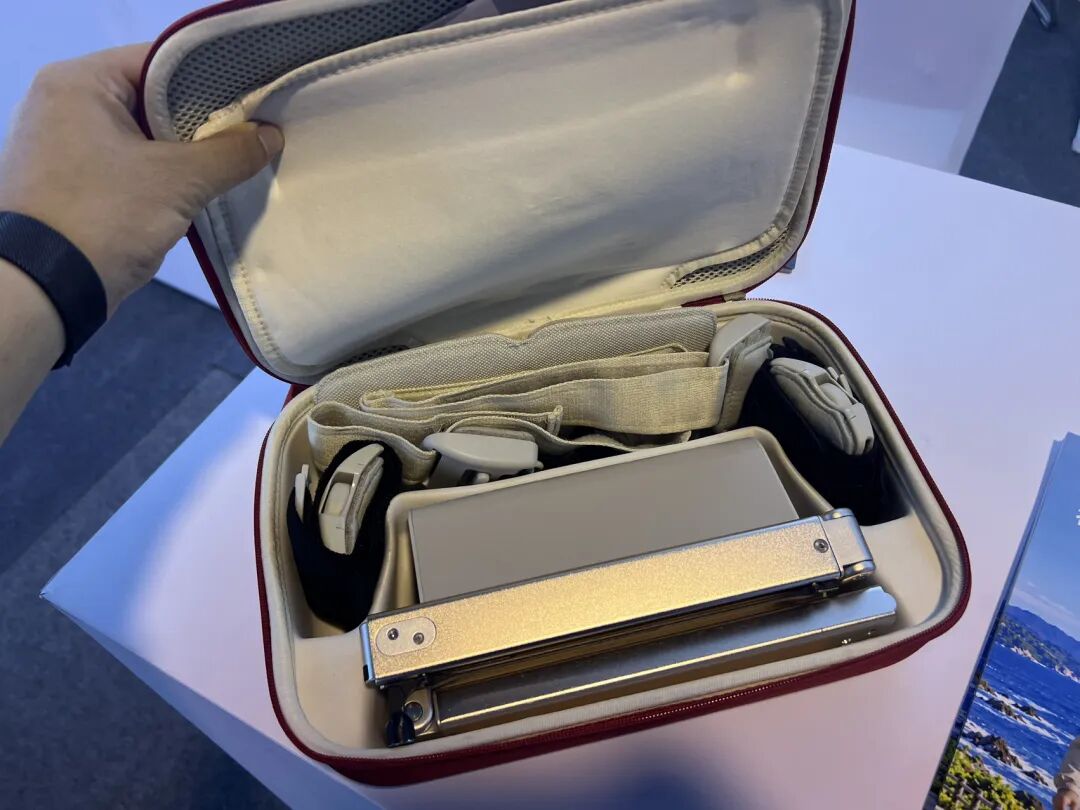
A waist-mounted unit and thigh straps have become the standard configuration for consumer exoskeletons. Photo: Exo-Work / Exoskeleton Robotics Outpost.
“The essence of compliant control is to turn an exoskeleton from a piece of ‘equipment’ into a ‘leg.’ Only after crossing that threshold is there a basis for discussing user retention.”
The unresolved limitations also need to be stated clearly. Biosignal sensing, such as electromyography, remains a challenge, while the share of high-end torque sensors produced domestically in China is still only around 35%. Whether algorithms generalize across individuals, whether a gait model that works well in the laboratory can perform reliably for users with different heights, weights, and walking habits, still depends on the long-term accumulation of data from real use. That is precisely what makes events in real environments such as Mount Tai valuable.
04 Price and Functionality at the Threshold of Everyday Use
- 458% – Year-over-year growth in online retail sales in the first half of 2026.
- RMB 2,599 – Lowest price for a passive model.
- 50+ – Scenic destinations offering exoskeleton rentals.
Mainstream powered models: Kenqing’s π series costs approximately RMB 6,000–7,000; Hypershell models cost RMB 6,999–13,999.
Rentals at scenic destinations: RMB 50 – 100 for three hours. Rentals have expanded to more than 50 scenic destinations nationwide, with approximately 500 units deployed at Mount Tai alone. One model has cumulatively served more than one million visitor sessions.
Rentals at scenic destinations are effectively this category’s largest “experience showroom.” A device costing RMB 7,000 can pay for itself after several dozen rentals and can remain in use for three to five years. Demand has proved real: even when users have no awareness of a brand, the use case alone persuades people to pay.
The direction of functional development is equally clear. Some new products can charge other devices, doubling as a power bank during a climb. Quick-release designs allow the main unit to be removed while the belt stays on the wearer. Algorithms are being optimized for older people, whose movements may be smaller and whose intentions may change quickly. Products are shifting from a competition over specifications to a competition over the user experience, a typical sign of a category moving toward the mainstream market.
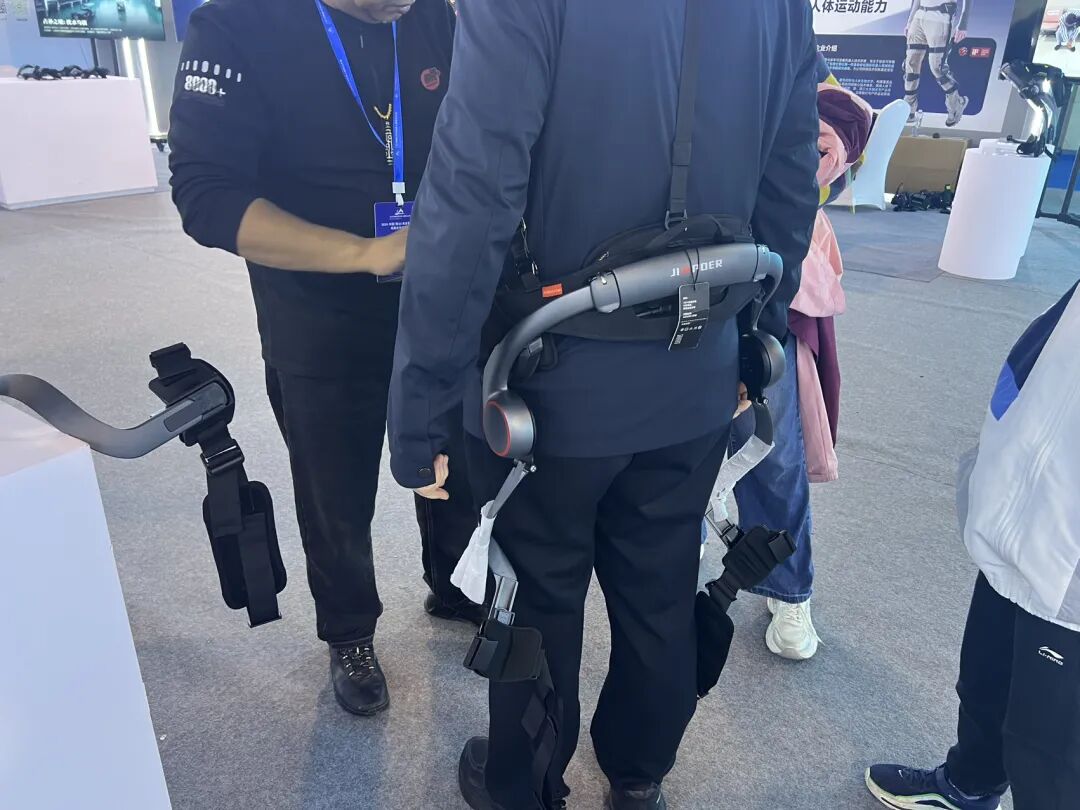
Visitors try on exoskeletons at an exhibition booth. Photo: Exo-Work / Exoskeleton Robotics Outpost.
05 Brand Recognition has yet to Catch up with Demand
Here is where we need to temper the enthusiasm, and it is also our most important assessment.
Users at scenic destinations remember “the service at Mount Tai,” rather than a particular brand. Consider the hard measures of brand dominance, one by one. Is a brand the first one users think of, and will they pay a premium for it? Has it led in at least one sales channel for two product cycles? Can its user-retention performance be measured? Must new entrants spend more to achieve the same position? At present, none of these conditions is fully met.
Companies, however, are moving quickly. Kenqing has partnered with Mount Tai, where the second-generation Daidong is already in use. Hypershell has established a presence at Mount Hua and the Yellow Mountains and completed an extreme test involving an exoskeleton ascent of Mount Everest. Haier has opened physical experience stores and exhibited its full product range. Toread (探路者) has brought exoskeletons into its outdoor apparel distribution channels. The contest for positions in sales channels has begun, but the competition for recognition in consumers’ minds has yet to truly start.
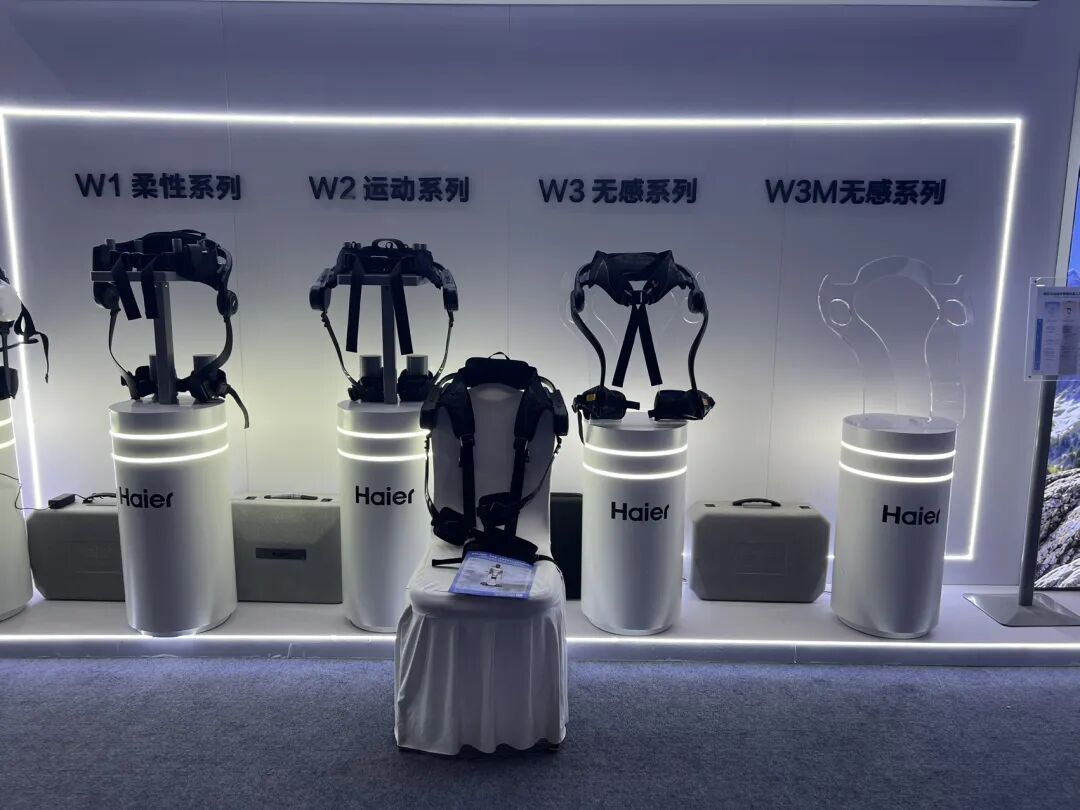
An exoskeleton robotics exhibition booth. Photo: Exo-Work / Exoskeleton Robotics Outpost.
Display labels translated from left to right: W1 Flexible Series; W2 Sports Series; W3 and W3M (Mom)
06 Growth Looks Certain with Differentiation Still to Come
Drawing on our observations from the competition and exhibition, we offer three quantitative assessments:
- Market growth is highly likely. China’s exoskeleton market is forecast to reach RMB 5.0 – 5.4 billion in 2026, up 25–29% year over year. The global market is forecast at US$3.5 billion, up 41%. Consumer shipments are expected to reach 60,000–100,000 units in 2026, making them the industry’s leading growth engine. Many manufacturers, converging products, prices reaching a floor, and proven use cases: with all four conditions present at once, 2027 is likely to be a year of substantial volume growth for consumer exoskeletons.
- Products will continue to converge, and competition will shift to supply chains and algorithms. Hardware has already become a commodity: frameless torque motors cost approximately RMB 160, planetary gearboxes about RMB 200, and IMUs about RMB 400. Anyone can buy the same components. The next round of cost differences will come from proprietary joint modules, controlling component counts, and assembly time. Leading companies could establish a relative hardware-cost advantage of 40%. The era of competing over specifications is over; the era of competing over user experience and cost structures has begun.
- Brand differentiation is likely to emerge around 2028. Implementation of standards, with development plans already issued for four national standards; expansion of physical sales channels; and an installed base of more than 100,000 devices purchased by households: only when these three factors fall into place will the first real reshuffling of brands begin. Until then, a gap in user retention still separates “a product that sells” from “a brand people recognize.”
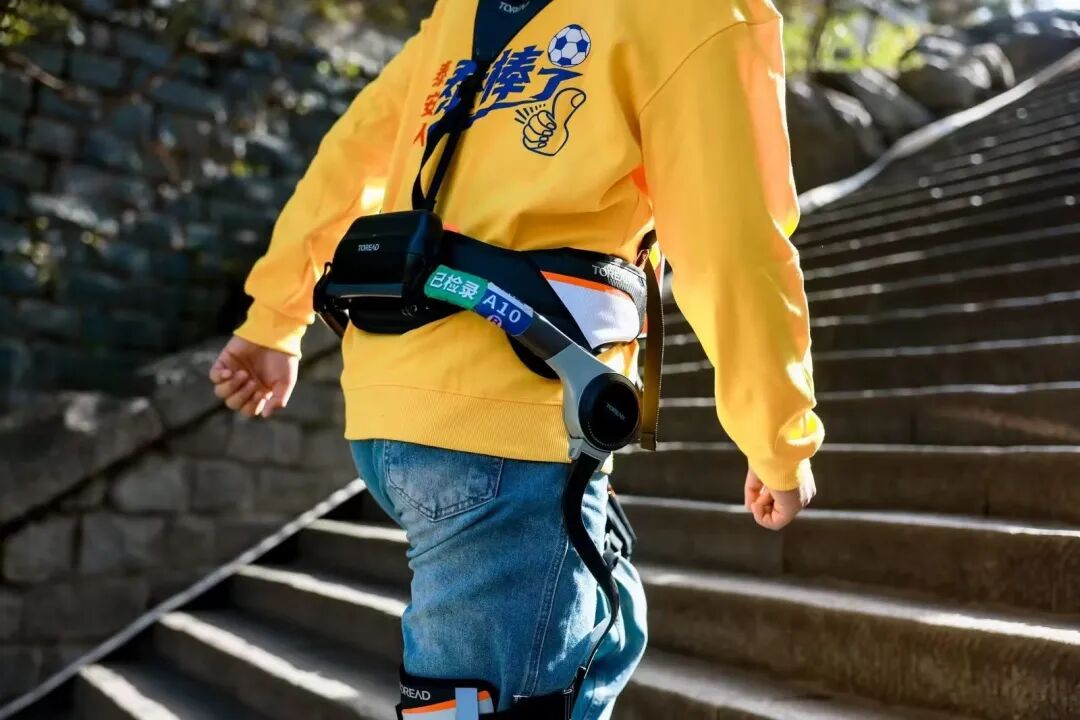
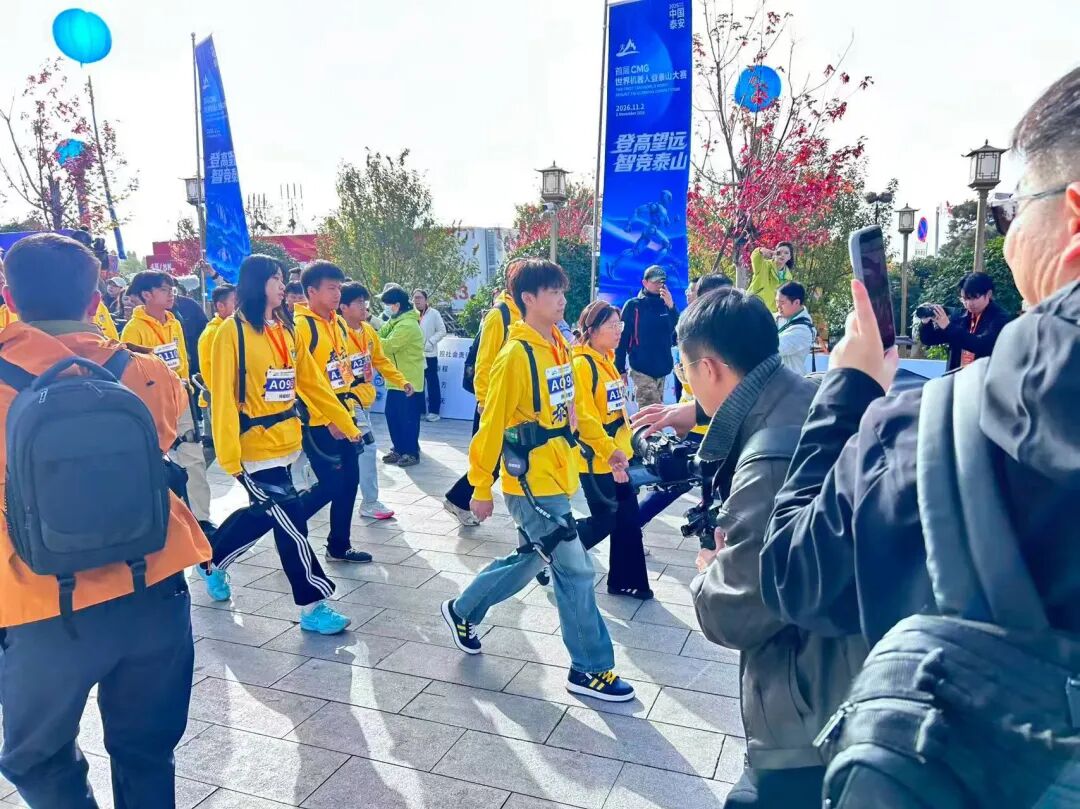
A participant wearing an exoskeleton climbs the Mount Tai steps. (Caption added for the English edition.) Image reproduced from Exo-Work’s original WeChat article.
The Chinese marking 已检录 on the competition bib means “Checked in.”
On the day of the Mount Tai competition, contestants in the exoskeleton event climbed the steps wearing products from various manufacturers, reaching Zhongtianmen in about an hour. Ordinary people without exoskeletons typically take two hours to cover this section. Technology has already made an “easier ascent” a reality. The next question for this industry is simple: when the excitement fades, whose name will people remember?
Sources and image credits from the original article
Sources for data and factual information: CCTV News; Tai’an Daily, including “Mount Tai’s Climbing Assistance Robots Receive an Upgrade,” October 28, 2026; China Tourism News Network; National Business Daily; Huxiu; Zhengguan News; the 2026 Global and China Exoskeleton Robotics Industry Development Insights White Paper; and other public reporting. Photographs taken at the exhibition were shot by the author. For prices and specifications, refer to each brand’s official channels.
The six images above are reproduced from the original WeChat article. Its credit identifies the exhibition photographs as the author’s own work. The two competition photographs are credited to the original article without assigning an individual photographer.
Reference links added for the English edition
- Original article by Exo-Work / Exoskeleton Robotics Outpost on WeChat — published and updated November 3, 2026. Original Chinese title: 泰山3100级台阶上的外骨骼机器人大阅兵:厂家很多,产品越来越接近市场。
- Tai’an Daily report on the upgraded Mount Tai climbing assistance robot — accessible republication on Sina, credited to Tai’an Daily and dated October 27, 2026. The original Exo-Work article cites October 28, 2026; that date is retained in the translation.
- 2026 Global and China Exoskeleton Robotics Industry Development Insights White Paper — third-party report listing and summary on Discovery Reports, dated July 1, 2026 and attributed there to M2 Consulting Embodied Intelligence Research Institute. This link is a listing, rather than the publisher-hosted full report.
Acknowledgment and translation notes
Special thanks to Exo-Work / Exoskeleton Robotics Outpost (外骨骼机器人前哨) for granting permission to translate and republish this article in English on Exoskeleton Report, and for sharing its reporting and exhibition photographs with our readers. This article was written by Exo-Work, who publishes on WeChat as Exoskeleton Robotics Outpost (外骨骼机器人前哨). Originally published in Chinese, it combines the author’s observations from the Mount Tai competition and exhibition with analysis of developments in China’s exoskeleton industry.
English edition prepared for Exoskeleton Report. The original author’s reported figures, forecasts, and opinions have been retained. Approximate imperial equivalents have been added after metric measurements. Established English company names are used where identifiable; other names retain pinyin and Chinese characters. The first and last photo captions and the image-text translations are editorial additions. The photographs retain their original Chinese lettering.
Support the original reporting: Read the article on WeChat and visit Exoskeleton Robotics Outpost’s account.
Our special thanks to Exo-Work for allowing us to share his reporting and photographs with an English-speaking audience, and for his ongoing exchange of information with Exoskeleton Report. His coverage helps connect readers with exoskeleton developments, companies, and experiences in China that they might otherwise have difficulty accessing.



Add Comment