

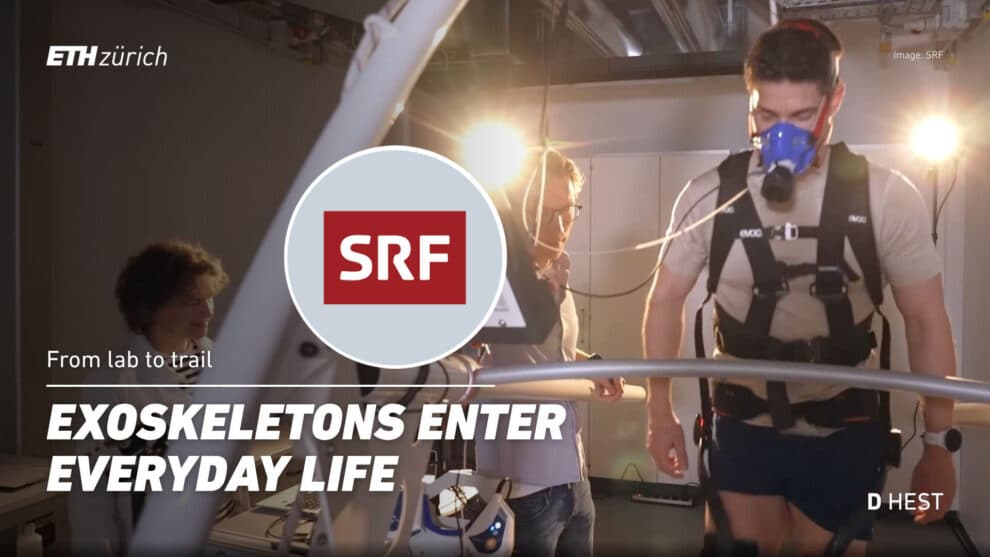
I think this episode of Einstein is the best television segment on exoskeleton technology I have ever seen. I wasn’t involved in its production. I saw it mentioned several times on social media, but I initially dismissed it because it was made for TV and in a language I needed translated; I enjoyed it so much that I want to highlight it here!
For readers like me, unfamiliar with the broadcaster, Einstein is a science program from SRF (Schweizer Radio und Fernsehen), the German-language division of the Swiss Broadcasting Corporation (SRG SSR). Founded in 1931, SRG SSR is Switzerland’s nonprofit public-service broadcaster.
The roughly 36-minute episode tackles a timely question: exoskeleton technology is clearly in a hype cycle, but how does the excitement compare with reality? It explores both occupational and consumer exoskeletons through workplace visits, personal experiences, and testing with researchers at ETH Zurich.
What particularly impressed me were the moments that felt authentic. At a logistics company that reportedly has used exoskeletons for two years, a worker puts on an Ottobock/suitX lower-back support exoskeleton by stepping into it. That is certainly an unconventional way to don the device! To me, this small detail feels like someone who has developed his own routine through regular use. The coverage also captures practical frustrations.
The occupational coverage extends to a vehicle workshop, a waste-handling operation, and the Swiss exoskeleton developer Auxivo. It explains how passive systems provide assistance through springs and elastic elements, while acknowledging that adoption requires adjustment and that workers respond differently. It also repeatedly asks an important question: will exoskeletons help people work with less physical strain, or will they simply lead to expectations that people do more? The episode boldly asks, too, if this technology is so popular, why isn’t it seeing wider adoption already?
On the consumer side, an 85-year-old woman (same age as my grandmother) tries a powered exoskeleton on a group hike, while presenter Tobias Müller tests its assistance during stair climbing, cycling, and treadmill walking. Researchers compare his impressions with measurements, revealing that feeling dramatically more powerful does not necessarily translate into an equally dramatic performance improvement. Meanwhile, the hiking experience captures both the device’s usefulness and the uncertainty of getting used to it. The possibility of continuing to join friends on a walk gives the technology a very human purpose. You can compare the professional segment to my latest hike with grandma with the exact same device: Grandma Tests the Hypershell Ultra S at Castle Rock Park | Hills, Fit & Limits
The episode is in German, but YouTube’s captions can be automatically translated into English. Turn on captions, then select Settings → Subtitles/CC → Auto-translate → English. Reading auto-translated captions can be annoying, especially when you also want to watch the people and equipment on screen. In this case, it is well worth the effort.
Read SRF’s accompanying article:
https://www.srf.ch/wissen/gesundheit/exoskelett-im-alltag-dank-roboter-anzug-wieder-auf-wandertour and watch the YouTube version of the episode here.


Add Comment