

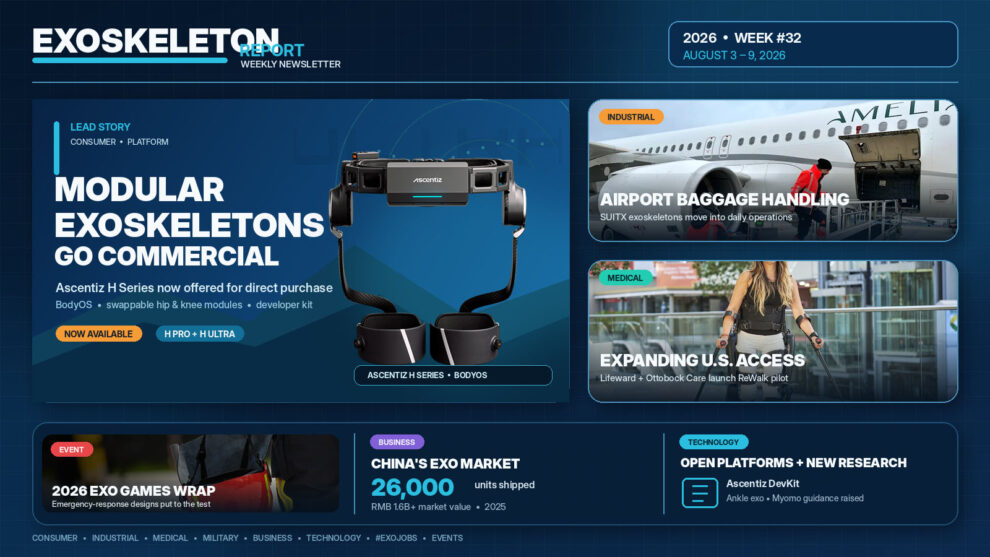
This page is an archive of the Exoskeleton Report email newsletter for August 3–9, 2026, capturing the week’s most notable developments in wearable robotics. Highlights include Ascentiz opening direct sales of its modular H Series, a new Lifeward–Ottobock pilot to expand access to the ReWalk 7, record exoskeleton sales in China, the conclusion of the 2026 ASTM Exo Games, and the latest research, deployments, business news, jobs, and events from across the industry. As usual, the archive comes in two versions: a visual email embed and a text-only searchable version:
Visual Archive:
Text-Only Archive:
Ascentiz Launches H Series Modular Exoskeleton for Everyday and Outdoor Mobility
Although Ascentiz’s modular exoskeleton has been publicly revealed for some time, including a prominent demonstration at CES 2026 (check out my summary if you have missed it), the hip-assist H Pro and H Ultra are now offered for direct purchase. Both are built around a shared Exo-Belt and Ascentiz’s BodyOS platform: the interchangeable H module provides hip propulsion, while the K knee module is now in mass production for sustained support and impact management during descents. The H Ultra also includes an expanded open-source software development kit, allowing developers to create customized functions and applications, while BodyOS is intended to support additional hardware modules (such as a shoulder component), software features, and third-party applications in the future, positioning Ascentiz as an expandable wearable-robotics platform rather than a single fixed exoskeleton. – PR Newsire
Athens International Airport – SUITX Exoskeletons im Baggage Handling – SUITX by Ottobock – YouTube
Exoskeleton Technology – Episode 36 | Meghan Kennelly – Construction Disrupted – YouTube
With Meghan Kennelly, the Head of Global Marketing at German Bionic:
- The specifics behind exoskeleton technology
- Is this a skills shortage saviour?
- How exoskeletons can help reduce injuries in the workplace
- Ergonomic data reshaping workplace safety
- Is there an ROI for everyone?
- AI tech and how this impacts future markets
Lifeward Launches Pilot Program with Ottobock Care to Expand National Access to ReWalk® Personal Exoskeleton
Lifeward has launched a six-month pilot program with Ottobock Care intended to broaden U.S. access to the ReWalk 7 Personal Exoskeleton. The companies plan to use Ottobock Care’s clinical expertise and regional infrastructure to introduce ReWalk 7 to more rehabilitation hospitals and spinal cord injury centers, while developing local capabilities for patient evaluation, training, reimbursement support and follow-up care. Ottobock Care operates more than 50 patient-care clinics across the United States, although the announcement does not specify how many locations will participate in the pilot.
Full article on Yahoo Finance.
Myomo Raises 2026 Guidance Following Stronger Q2
Myomo reported second-quarter 2026 revenue of $11.7 million, up 21% year over year, after recognizing revenue on 211 MyoPro units and receiving a record 255 orders. Gross margin climbed from 62.7% to 72.1%, while operating loss narrowed from $4.6 million to $2.3 million and adjusted EBITDA loss improved to $800,000. Citing growth from clinical referrals, O&P partners, the VA and its MyoConnect program, Myomo raised its full-year revenue guidance to $45–47 million. The company also said development of the MyoPro 3 continues and revealed that it introduced a prototype hand-only version for the German market at OTWorld in May. – Myomo.com
A Working Exoskeleton Is Not Enough: Human-Centered Design, Culture, Procurement, and Trust
Guest author Rita Vazquez-Torres draws on her decades of experience to explain why successful pilots and capable hardware are still far from standard issue for soldiers, firefighters, law-enforcement officers, and other frontline responders…
CHINA’S EXOSKELETON SALES HIT A RECORD AS ROBOTIC LEGS JOIN ITS PHYSICAL-AI PUSH – by Criptopolitan.com
| 2025 Chinese market segment (shipped within China) | Shipments | Market value |
|---|---|---|
| Medical rehabilitation | ~3,200 | ~RMB 1.42 billion |
| Consumer assistance | ~19,000 | ~RMB 110 million |
| Industrial applications | ~3,800 | ~RMB 80 million |
| Total | ~26,000 | More than RMB 1.6 billion (~ $236 M) |
IDC identified 傅利叶 (Fourier Intelligence), 程天科技 (RoboCT), and 迈步机器人 (Milebot Robotics) among the leading-share vendors in medical rehabilitation; 程天科技 (RoboCT), 肯綮科技 (Kenqing Technology), and 极壳 (Hypershell) in consumer assistance; and 傲鲨智能 (ULS Robotics), 程天科技 (RoboCT), and 迈宝智能 (MebotX) in industry applications. Notably, RoboCT was the only company named by IDC across all three market segments, although the public release does not disclose individual company sales, shares, or ranked positions.
The 2026 ASTM Exo Games have wrapped up, with Team TEMPO taking first place in the Challenge Competition, Cooper Union’s X.O. Exo finishing second, and the University of Michigan’s M-STARX placing third. Cooper Union also won the Presentation Competition, Vrije Universiteit Brussel received the Poster and Design award, and M-STARX earned both the Team Description Paper and competitors’ Team’s Choice awards. During the week, the university teams tested their exoskeletons in realistic emergency-response scenarios. –LinkedIn
Detachable 3rd arm demo with Ascentiz DevKit – YouTube – Ascentiz
The central hardware is called B-core Pi 1. A computing module that attaches to its exoskeleton and runs or provides access to BodyOS, powered by a Raspberry Pi Compute Module 5. (visit https://ascentizexo.com/pages/body-os for more information)
A lightweight passive ankle exoskeleton with dual-phase energy harvesting and stiffness adaptation
Researchers at Zhejiang University have developed a lightweight passive ankle exoskeleton (brace) that replaces the clutch mechanisms commonly used in spring-powered designs with two extension springs connected in series and a simple mechanical limit frame. During swing, the lower-stiffness spring stretches as the ankle dorsiflexes; once it reaches its travel limit, the mechanism shifts to a higher stiffness and the second spring stores additional energy as the shin advances over the foot during stance. Both springs then release their stored mechanical energy during late stance to assist push-off—so “dual-phase energy harvesting” refers to temporarily storing and returning the wearer’s own movement energy, not generating electricity. – Wearable Technologies
Job, events, and much more in the visual version above. Special thanks to all Patreon supporters for keeping this effort going!


Add Comment