


How WIRobotics’ WIM S Uses a Single Actuator, the Symmetry of Human Gait, and Adaptive Control to Support the Whole Gait Cycle
One of the most intuitive approaches to designing a wearable robot is to place an actuator at each joint that needs assistance. Directly actuating more joints and providing greater torque and power is undoubtedly an important technological approach in wearable robotics.
But when Korean robotics company WIRobotics developed its walking-assist wearable robot, WIM S, it started with a different question:
If we understand and make full use of human movement, does every joint really need a motor?
For WIRobotics, the challenge was not simply how much force a robot could generate. Equally important was how well the robot could understand the movement already inherent in the human body – and how naturally it could add assistance at the right moment without interfering with that movement.
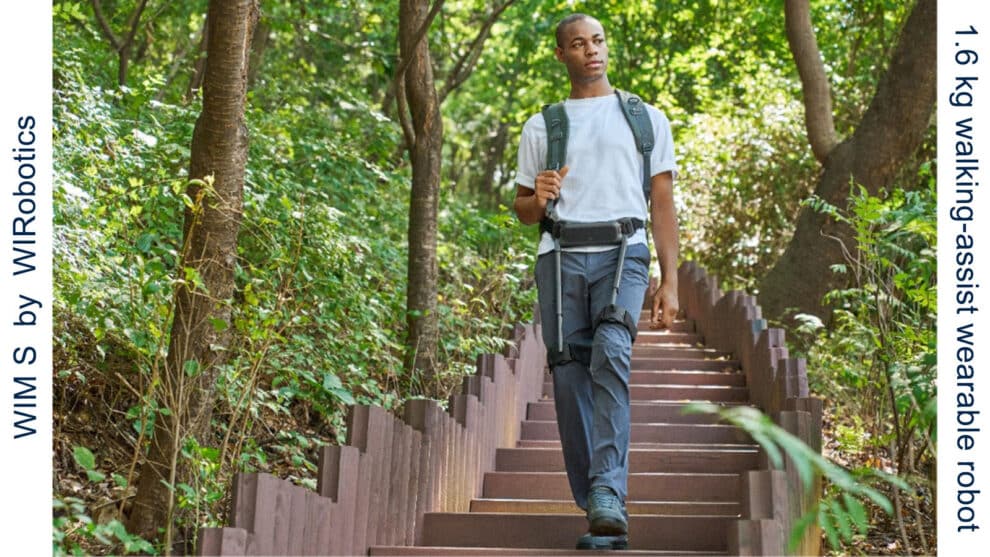
This approach led to WIM S, which uses a single actuator to assist bilateral hip flexion and extension (featured image above).
The decision to use a single actuator was not simply about reducing component count or weight. The answer lies in the mechanics of human gait itself.
A Single-Actuator Architecture Inspired by Human Movement
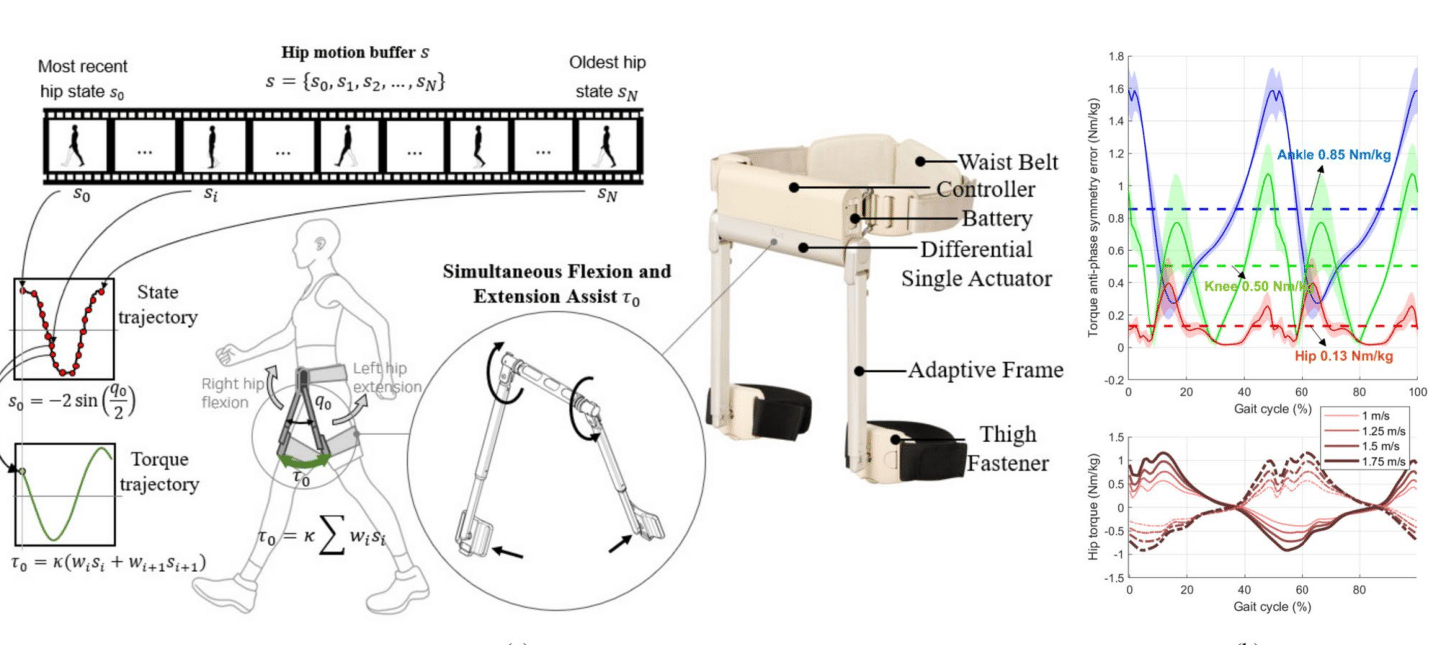
Figure 1. Gait assistance strategy based on hip torque anti-phase flexion-extension symmetry. (a) WIM’s single-actuator architecture and bilateral hip assistance strategy. (b) Comparison of anti-phase torque symmetry at the hip, knee, and ankle across walking conditions.[1] “WIM” refers to the WIM-series device used in the cited study; WIM S is a product in WIRobotics’ WIM series. Source: Reproduced from Lim, B., et al. (2025), Scientific Reports, under the Creative Commons Attribution 4.0 International License (CC BY 4.0).
When a person walks, one leg moves forward while the other moves backward. In particular, the flexion and extension torques of the left and right hips exhibit strong anti-phase symmetry.
A 2025 study published in Scientific Reports compared anti-phase torque symmetry at the hip, knee, and ankle. The symmetry error was 0.13 Nm/kg at the hip, compared with 0.50 Nm/kg at the knee and 0.85 Nm/kg at the ankle. The hip’s high degree of symmetry also remained consistent across walking speeds ranging from 1.0 m/s to 1.75 m/s.[1]
WIRobotics focused on this fundamental characteristic of human gait.
By mechanically linking the movement in which one hip flexes as the opposite hip extends, a single actuator can assist both left and right hip flexion and extension. The same degree of anti-phase symmetry was not observed at the knee or ankle.[1]
In other words, the design did not begin with the goal of reducing hardware. It began with understanding human movement – and that understanding made it possible to reduce the hardware required.
This is the foundation of the WIM S single-actuator architecture.
Efficient Engineering Rather Than More Hardware

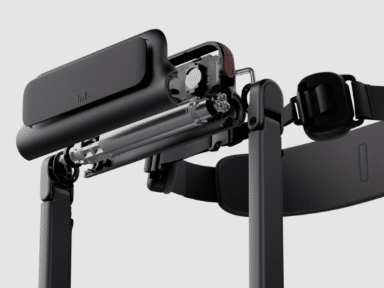
Figure 2. Detail views of the WIM S hardware and wearable structure. Image: WIRobotics
Using multiple actuators, sensors, and control systems can enable more independent control of individual joints. At the same time, such configurations can affect the size, weight, and structural complexity of the overall system.[1]
In developing WIM S, WIRobotics chose a different direction: make maximum use of the body’s natural movement while minimizing the mechanical intervention required from the robot.
WIM S uses a single actuator together with a minimized sensing and control architecture to assist bilateral hip flexion and extension.
The complete system weighs 1.6 kg (3.5 lb). The system incorporates 11 degrees of freedom to accommodate natural body movement, while bilateral hip assistance is generated by a single actuator. A low-reduction-ratio gearing system provides low mechanical inertia and backdrivability, reducing mechanical resistance to the user’s natural movement, including when the system is unpowered.[1]
What matters here is that the single actuator in WIM S does not simply mean “fewer motors.”
WIRobotics’ approach is about designing human movement, mechanical architecture, and control as one integrated system, rather than simply adding more hardware to the body.
One Actuator Does Not Mean One Assistance Strategy
The term “single actuator” can lead to a natural question:
If there is only one actuator, doesn’t that mean both legs must always receive the same assistance?
With WIM S, the answer is no.
WIM S incorporates Balance Mode, which can adjust the assistance delivered to the left and right sides to account for asymmetries in a user’s gait.
In other words, while retaining a mechanical architecture based on a single actuator, the system can use control strategies to adapt the assistance profile according to gait asymmetry.
The feature was developed with users who may exhibit differences between their left and right gait patterns in mind. It demonstrates that the single-actuator architecture of WIM S is not limited to a single, fixed symmetric assistance strategy.
In WIM S, “single” describes the number of actuators—not the sophistication of the assistance strategy.
And this is where another element becomes just as important as the mechanical architecture itself:
Control.
What Matters Is Not Only How Much Force, but When and How It Is Delivered
Torque and power are important metrics when evaluating wearable robots. But when a person actually wears a robot and walks, force magnitude alone does not create natural assistance.
Human gait is constantly changing. A person may walk slowly and then accelerate, alter stride length, transition from level ground to a slope, or encounter stairs.
Even a system capable of generating substantial force may struggle to provide natural assistance if the timing of that force does not align with the user’s intended movement.
For this reason, WIRobotics considered not only how much force the robot should generate, but also how naturally its assistance could be synchronized with human movement.
Delayed Output Feedback Control (DOFC), which forms the basis of the control technology used in WIM S, generates assistive or resistive torque based on the user’s hip movement, allowing the exoskeleton’s output to synchronize with the gait cycle.[1][2] Subsequent research expanded the approach for different walking and running conditions and for flexible human-exoskeleton interaction.[3]
Adaptive DOFC in WIM S builds on these principles to respond to changing gait patterns while pursuing natural interaction through a minimized sensing and control architecture.[1][2]
A study using the technology underlying WIM S in older adults described this approach as “synchronized hip flexion and extension assistance.”[4] Rather than forcing the user’s legs to follow a predetermined trajectory, the system adds force in coordination with the user’s natural gait.
This reflects a central principle behind WIRobotics’ approach to walking assistance:
How naturally assistance is delivered in coordination with the user’s movement can matter as much as how strongly the robot can push.
Performance in WIM S, therefore, is not simply a matter of peak power.
Power, timing, synchronization, and adaptability must work together to create assistance that feels natural to the person wearing the device.
Assisting the Hip, but Effects Beyond the Hip
 Figure 3. Changes in lower-limb muscle strength following a four-week outdoor walking program using WIM. Muscle strength was assessed across the hip, knee, and ankle, with the largest increases observed in ankle dorsiflexion (+75.4%) and plantarflexion (+43.8%).[1] Source: Reproduced from Lim et al. (2025), Scientific Reports, under CC BY 4.0.
 Figure 3. Changes in lower-limb muscle strength following a four-week outdoor walking program using WIM. Muscle strength was assessed across the hip, knee, and ankle, with the largest increases observed in ankle dorsiflexion (+75.4%) and plantarflexion (+43.8%).[1] Source: Reproduced from Lim et al. (2025), Scientific Reports, under CC BY 4.0.
WIM S applies torque directly at the hip.
But in human gait, the hip, knee, and ankle do not operate as three independent systems. Research using WIM S technology has observed changes extending beyond the directly assisted joint.
In a study published in Scientific Reports, nine older adults with a mean age of 78.6 years participated in a four-week outdoor walking program. Following the program, 10-meter walking speed improved by 14.8%, while six-minute walking speed increased by 10.6%. Performance on both the Timed Up and Go and Five Times Sit-to-Stand tests improved by 24.5%.[1]
Particularly notable were the changes in lower-limb strength.
Although assistance was applied directly at the hip, the most pronounced strength changes were observed farther down the kinetic chain, at the ankle.
Ankle dorsiflexion strength increased by 75.4%, while plantarflexion strength increased by 43.8%. Changes in hip and knee strength were comparatively smaller and were not statistically significant in this study.[1]
These results do not establish that hip assistance directly caused the increases in ankle strength. The study itself suggested that hip power support may have enabled participants to walk faster and for longer periods, while noting that further investigation is needed.[1]
However, changes beyond the directly assisted joint have also been observed in separate research.
A study published in JMIR mHealth and uHealth involved 23 community-dwelling adults aged 65 and older who completed 12 sessions of gait assistance and resistance training over six weeks.[4]
Significant increases were observed across all measured lower-limb strength parameters, including hip strength, knee flexion and extension, and ankle dorsiflexion and plantarflexion.[4]
Although WIM S applies torque directly at the hip, the study discussed how hip assistance may affect “the entire lower limb both directly and indirectly.” Drawing on previous research, it also noted that hip exoskeleton assistance can influence muscle activation not only at the proximal hip but also at the distal ankle.[4]
Again, these findings should not be interpreted as a simple causal claim that assisting the hip directly strengthens the knee and ankle.
The six-week program included both assistance and resistance training, with exercise performed across varied environments including level ground, slopes, and stairs. These factors may all have contributed to the observed improvements in lower-limb strength.[4]
What WIRobotics finds significant in these results is something more fundamental.
Human gait is not a collection of three independent systems at the hip, knee, and ankle. It is one interconnected movement.
These findings suggest that outcomes associated with wearable-robot training may extend beyond the joint at which assistive torque is directly applied. The mechanisms behind these broader effects, however, require further investigation.
This is an important part of understanding the single-actuator architecture of WIM S.
Another Perspective on Performance: The Single-Actuator Approach
 Figure 4. Reduced metabolic cost and applied torque during level, load-carrying, and uphill treadmill walking with WIM. In a supplemental study involving three young adults, the net metabolic cost of level treadmill walking at 4 km/h was 13.6 ± 3.2% lower with WIM assistance than without the exoskeleton. Load-carrying and uphill conditions were evaluated in one participant (S3). [1] Source: Reproduced from Lim et al. (2025), Scientific Reports, under CC BY 4.0.
 Figure 4. Reduced metabolic cost and applied torque during level, load-carrying, and uphill treadmill walking with WIM. In a supplemental study involving three young adults, the net metabolic cost of level treadmill walking at 4 km/h was 13.6 ± 3.2% lower with WIM assistance than without the exoskeleton. Load-carrying and uphill conditions were evaluated in one participant (S3). [1] Source: Reproduced from Lim et al. (2025), Scientific Reports, under CC BY 4.0.
For WIRobotics, a single actuator does not represent “limited hardware.”
It is a deliberately chosen engineering architecture.
In a metabolic test reported in Scientific Reports, participants wearing the 1.6 kg single-actuator system showed an average 13.6 ± 3.2% reduction in net metabolic cost compared with walking without the exoskeleton.[1]
Although this was not a direct comparative study, the authors noted that, despite the shorter training period and the use of a single-actuator configuration, the improvements in walking and balance observed in older adults were comparable to those reported in previous studies using dual-actuator hip exoskeletons.[1]
These findings offer another perspective on how performance in wearable robotics can be evaluated.
Performance is not defined only by actuator count, the number of joints directly assisted, peak torque, or peak power. It can also be considered in terms of how effectively the system delivers assistance while balancing weight, mechanical complexity, synchronization, and adaptability.
This leads to a broader set of questions:
How naturally is robotic assistance synchronized with the user’s movement?
How flexibly can the system adapt to differences between users and changes in gait?
How lightly can the robot integrate with the human body?
And how effectively can it support human gait with minimal hardware?
The single-actuator architecture and adaptive control of WIM S represent one answer from WIRobotics.
One actuator. Bilateral assistance. Adaptive control. Whole-gait thinking.
WIRobotics’ goal is not simply to build robots that are stronger than humans.
It is to build robots that understand human movement and move with it, rather than overpowering it.
The future of wearable robotics may not be determined solely by how many motors can be added to the human body.
An equally important technological capability may be how deeply we can understand human movement—and how efficiently that understanding can be translated into mechanical architecture and control to achieve more natural, adaptable assistance with less hardware.
For specifications, operating modes, and additional product information, see the WIM S entry in the Exoskeleton Report catalog.
References
[1] Lim, B., et al. (2025).
Ultra-lightweight robotic hip exoskeleton with anti-phase torque symmetry for enhanced walking efficiency.
Scientific Reports.
Primary reference for the WIM S single-actuator architecture, hip anti-phase torque symmetry, 1.6 kg system design, Adaptive DOFC, metabolic-cost findings, and the four-week older-adult walking program. The study reported lower anti-phase symmetry error at the hip than at the knee and ankle and described the biomechanical rationale for bilateral hip assistance using a single actuator.
[2] Lim, B., Jang, J., Lee, J., Choi, B., Lee, Y., & Shim, Y. (2019).
Delayed Output Feedback Control for Gait Assistance and Resistance Using a Robotic Exoskeleton.
IEEE Robotics and Automation Letters, 4(4), 3521–3528.
Research describing Delayed Output Feedback Control, which provides a foundation for the control approach used in WIM S, including flexible human-exoskeleton interaction across gait conditions.
[3] Lim, B., Choi, B., Roh, C., Hyung, S., Kim, Y.-J., & Lee, Y. (2023).
Parametric Delayed Output Feedback Control for Versatile Human-Exoskeleton Interactions During Walking and Running.
IEEE Robotics and Automation Letters, 8(8), 4497–4504.
Research describing a parametric delayed output feedback controller for versatile human-exoskeleton interaction across walking, running, assistance, and resistance conditions.
[4] Cho, E., Hwang, S., Heo, S.-J., Lim, B., Lee, J., & Lee, Y. (2025).
Feasibility and Effects of a Gait Assistance and Gait Resistance Training Program Using a Walking-Assist Wearable Robot for Community-Dwelling Older Adults: Single-Group, Pre-, and Posttest Study.
JMIR mHealth and uHealth, 13, e58142.
A six-week, 12-session study involving 23 community-dwelling adults aged 65 and older that evaluated changes in walking performance and lower-limb strength, including the hip, knee, and ankle.
Featured image (top): WIM S, WIRobotics’ 1.6 kg walking-assist wearable robot, uses a single actuator to provide bilateral hip flexion and extension assistance. Image: WIRobotics



Add Comment