

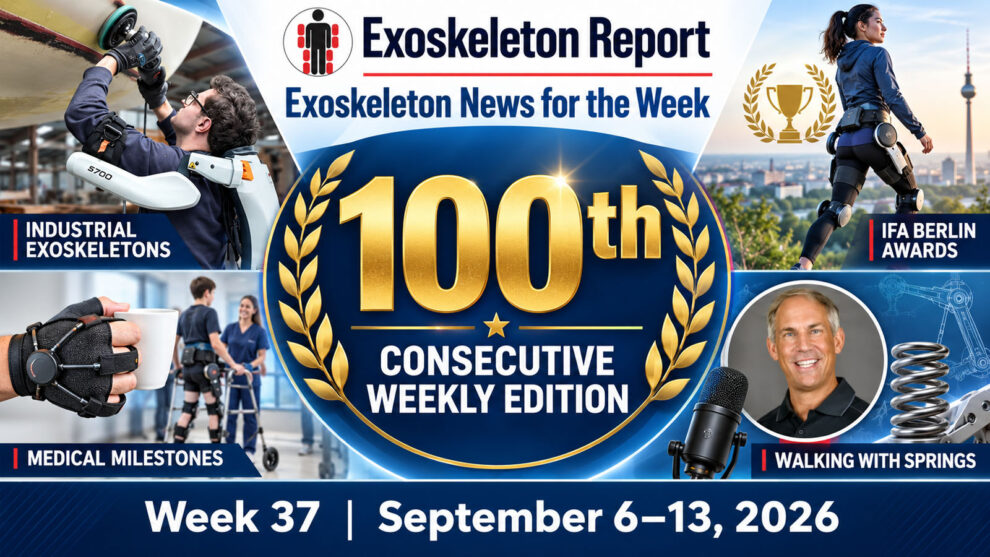
This week marks the 100th consecutive weekly edition of the Exoskeleton Report newsletter! I’m thrilled to have a place to bring together all things exoskeletons and wearable robotics, from major announcements to smaller stories that deserve attention, too. Putting together this newsletter week after week has let me emphasize how much is happening across this field. There is always something to share, explore, or highlight. You can find every previous edition in our newsletter archive and see that activity for yourself. Thank you for reading, sharing stories, and being part of this journey. I’m excited to keep it going!
Text Only Version
Week 37: September 6 – 13, 2026
Who is Dr. Tom Sugar!? Walking with Springs, Part 1: The Early Projects That Shaped Dr. Thomas Sugar’s Career in Wearable Robotics – ExoskeletonReport.com
Boat restoration workers describe six months with a shoulder exoskeleton
Wegener Jachtwerft in Wedel, Germany, describes using the S700 for overhead sanding, polishing, and masking during boat restoration, sometimes while handling tools weighing 3–4 kg. A boatbuilder reports less fatigue after approximately six months of use, with assistance settings adjusted for different tasks. – Case Study – ExoIQ
Exoskeleton Application Success Story: Phifer’s Award-Winning Safety Program
Highlighting a success story from 2025: Alabama manufacturer Phifer Incorporated’s use of occupational exoskeletons within its award-winning employee safety program. The company received a Theo Award, presented by Risk & Insurance to recognize outstanding workers’ compensation programs, including injury prevention and care for injured employees. About the awards
Phifer trialed three exoskeleton models before introducing wearables to address stress on employees’ hips, lower backs, and shoulders. Its safety leadership emphasized that the devices would not be used to justify increasing the physical demands of workers’ jobs. The deployment complemented a broader approach involving employee training, custom orthotics, and coordinated onsite healthcare. Together, these efforts helped Phifer reduce recordable workplace incidents, compensable claims, and workers’ compensation spending, with the company reporting its lowest metrics in more than 15 years. Read the Phifer success story →
Bioservo reaches 100 veterans fitted with Carbonhand
Bioservo reports that 100 U.S. veterans have been fitted with its Carbonhand powered grip-assistance glove through its relationship with the Department of Veterans Affairs. The company describes a network spanning more than 40 VA Medical Centers, with prescription access, individualized fitting, and continuing support. More details in their press release on Bioservo.com
Consumer Exoskeletons Collect Awards at IFA Berlin 2026
Consumer exoskeletons attracted recognition from both the organizers and technology media at IFA Berlin 2026. Hypershell reports receiving 21 awards and honors across its showing, including two official IFA Innovation Award Honoree distinctions for its new Halo exoskeleton, in Mobility and Design. The company says the remaining recognition came from media outlets including TechRadar, GameStar.de, T3, Netzwelt and Tom’s Guide. Its total covers multiple products: Gadgety’s published results, for example, name Halo as a winner and X Ultra S as an honoree.
Ascentiz also collected several distinctions for its modular approach to hip and knee assistance. At least four awards or “Best of” recognitions can be identified: an official IFA Mobility honoree distinction for the H Series, alongside selections from Android Headlines, Reviewed and Yanko Design. Reviewed highlighted the interchangeable hip and knee modules connected to a shared Exo-Belt, allowing users to configure assistance for different activities.
Other consumer-exoskeleton honorees included VIGX, whose π6 received two official distinctions; DNSYS, recognized for its Z1 Knee Exoskeleton; and AlpWalk, recognized for its S1 hip-assistance exoskeleton. Together with Hypershell and Ascentiz, these companies account for seven official IFA honoree distinctions across five brands. Official IFA results
Raik Deftech Reports Lighter Hanumanta Exoskeleton Prototype
Indian startup Raik Deftech has announced Hanumanta Exo 1.2, the latest iteration of its full-body passive rigid exoskeleton intended for military applications. The company reports reducing the frame’s weight from approximately 11.1 kg to 7.5 kg through redesign and prototype development. Founded by engineer Gaurav Kumar Rai, the team is developing the platform to support personnel handling heavy equipment. The latest version remains a development platform, with the company acknowledging that further improvements are needed to make it practical and field-ready. Company update.


Add Comment