

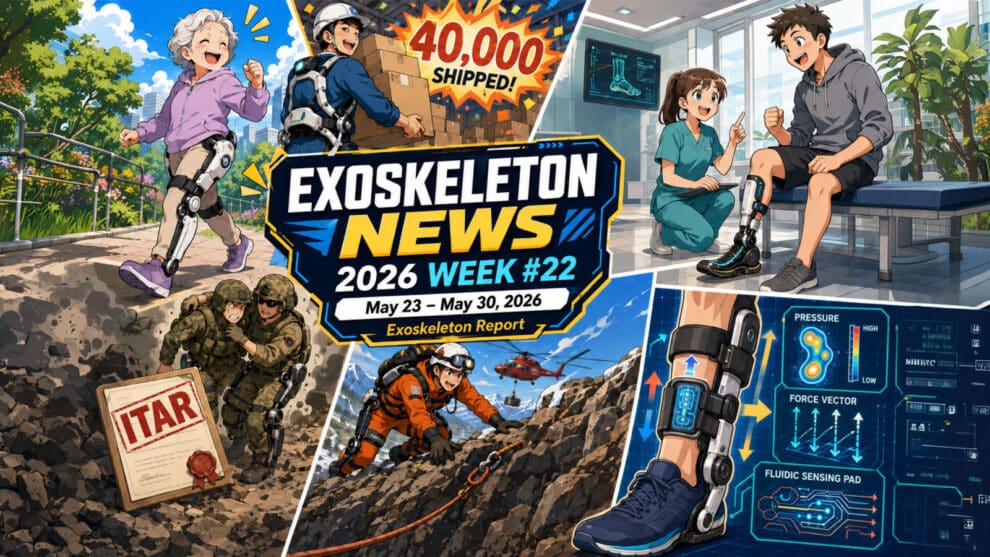
Below is the text version of the Exoskeleton and Wearable Robotics newsletter for the week ending on May 30, 2026. While we may live in a dynamic and sometimes challenging world, this is a way to document the steady progress of the field of physical human-augmentation technology. For the best results, subscribe to the newsletter and to Patreon to support us directly.
Visual Version of the Newsletter:
Special thanks to all of our Patreon supporters!!!
Text Version:
Advances in exoskeleton tech may provide answers for enhancing mobility
“On Sept 20, 2022, Wang Haidong, director-general of the National Health Commission’s department of aging and health, said at a news conference that the population aged 60 and over is expected to exceed 400 million by around 2035, accounting for more than 30 percent of the total population, marking China’s entry into the severe aging stage. A growing number of people are beginning to rethink a fundamental question: Can people continue to walk and move freely as they grow old? Embodied intelligence products such as exoskeletons may offer a new answer.”
Japanese assist-suit maker Innophys passes 40,000-unit milestone as soft assist suits and overseas expansion push the category into a broader adoption phase.
Innophys says cumulative global shipments of its Muscle Suit series surpassed 40,000 units as of April 30, 2026, citing broader adoption of the Soft series and expansion in Asia and Europe. It also announced participation in Assist Suit EXPO in Nagoya on June 4–5, where it will show 2026 heat-countermeasure products including Muscle Suit COOL VEST 2 and AQUA VEST. – press release
Passive exoskeletons in healthcare practice: Usability and acceptance in a clinical setting
A small real-world, non-randomized trial at University Hospital Magdeburg introduced passive back-support exoskeletons into everyday clinical use. Seventeen staff wore the device for 312 hours across two months, mostly for specific tasks rather than full shifts. Users found it easy to operate and some reported better posture and less back strain during lifting or patient repositioning, but real barriers remain: heat, hygiene layers, pressure points, emergency mobility, and the fact that staff do not want to wear them continuously. Science Direct
Exoskeletons in Construction: PPE, Tool, or Game-Changer? Pros, Cons & Scaffolding Reality – Beyond The Skin
What is deemed as safe? – Full episode on YouTube
ExoIQ – Exoskeletons in Equine Dentistry: Reduced Strain, Increased Endurance
A niche but interesting application story. The German page explains how the S700 active shoulder exoskeleton can support horse dental technicians during static arm postures and precision work at chest/head height. – ExoIQ site
Humotech launches the next chapter for Caplex: data-driven prosthetic foot trialing enters clinical workflows.
The Clinical Caplex® System shifts from research-lab platform to clinical decision-support technology for prosthetic foot selection. It is a FDA-registered robotic prosthetic foot that can emulate different clinically available feet and power a prosthetic foot trialing service. – press release
The Shanghai neurotech/robotics company better known for its OHand bionic hand and wearable rehab robotics. The partnership appears to focus on combining MicroPort’s brain-computer interface work with OYMotion’s exoskeleton and intelligent control systems, likely for neurorehabilitation aiming at turning brain signals into assisted movement for patients recovering from stroke or neurological injury.
New Exoskeleton Designed to Facilitate the Self-Evacuation of Wounded Soldiers
The U.S. Army Medical Research and Development Command is advancing a lightweight battlefield exoskeleton designed to help wounded service members move themselves to safety when evacuation is delayed or unavailable. The Intrepid Battlefield EXoskeleton, or IBEX, stabilizes lower-leg injuries such as tibia fractures while supporting the user’s body weight, allowing injured soldiers to stand and walk independently. Weighing about seven pounds and collapsing to roughly the size of a one-liter water bottle, IBEX is designed for portability in difficult terrain and can be delivered by medics, fellow service members, or drones. The system has been tested by the Army, Navy, and Marines, and researchers are continuing work toward a manufacturable prototype. By reducing reliance on litter evacuation, IBEX could help protect wounded soldiers, reduce risk to rescue teams, and keep more service members focused on the mission. DHA Research & Development
From Back Belt Skepticism to ITAR: Exoskeletons Just Crossed a Regulatory Line
In a major regulatory shift, the U.S. government has identified certain DoD-funded developmental exoskeletons as sensitive military technology…
Hypershell LIFT
Hypershell opens a search-and-rescue trial initiative. The new sub-page shines a light on the company’s work with search and rescue (SAR) teams to test powered exoskeletons in real-world conditions, with a focus on fatigue, time-to-location, recovery, terrain, weather, load, and usability. – link to Hypershell LIFT
Similar signals:
- “Imperfect but Improving” – ‘Robo-Rescuers’ Are Here: How Seattle Mountain Rescue Is Leveraging Exoskeletons to Save Lives https://gearjunkie.com/technology/robo-rescuers-exoskeletons…
- Boost Rescue Efficiency: Load-Carrying Assist Exoskeleton in Action ZYTEKNO (OEM is likely SEEPPO) – YouTube
Force Sensing for Wearable Human-Robot Interfaces via Fluidic Innervation
Researchers from the NIH Clinical Center and the University of Texas at Austin published a preprint on a soft, 3D-printed “fluidically innervated” sensing pad for wearable human-robot interfaces. The pad contains embedded air channels; when the user’s limb presses into the device interface, the channels compress and create pressure changes that can be read with off-the-shelf pressure sensors. In testing, the team showed strong relationships between pad pressure and applied force, knee torque, arm movement, and squat phase. Importantly, in the exoskeleton demonstration the lower-limb robot was unpowered, so this work is best understood as monitoring/measuring HMI forces, not yet actively changing them. The future promise is that this kind of direct interface-force sensing could be used as real-time feedback for wearable robots to adjust assistance, estimate user intent, optimize robot-applied forces, or reduce uncomfortable pressure at the human-machine interface. – Full Paper on Arxiv
ExR’s Perspective: this can also be used for standards & testing… human-machine-interface forces on the human body are critical for exo adoption, and this technology can potentially be used to both measure and adjust them.
Inside the TÜV Rheinland lab, the New Hypershell X Series proved its breakthrough performance:
⚡ 0.31s Response Time (64.5% faster than previous gen)
🎯 97.5% Gait Synchronization across all terrains
Hypershell – YouTube
STILL TIME LEFT: SPONSOR the ASTM EXO GAMES! August 3-7, 2026
Contact ETCoE@astm.org to learn more. – YouTube
Plus jobs and events! Thank you for your attention!!



Add Comment