

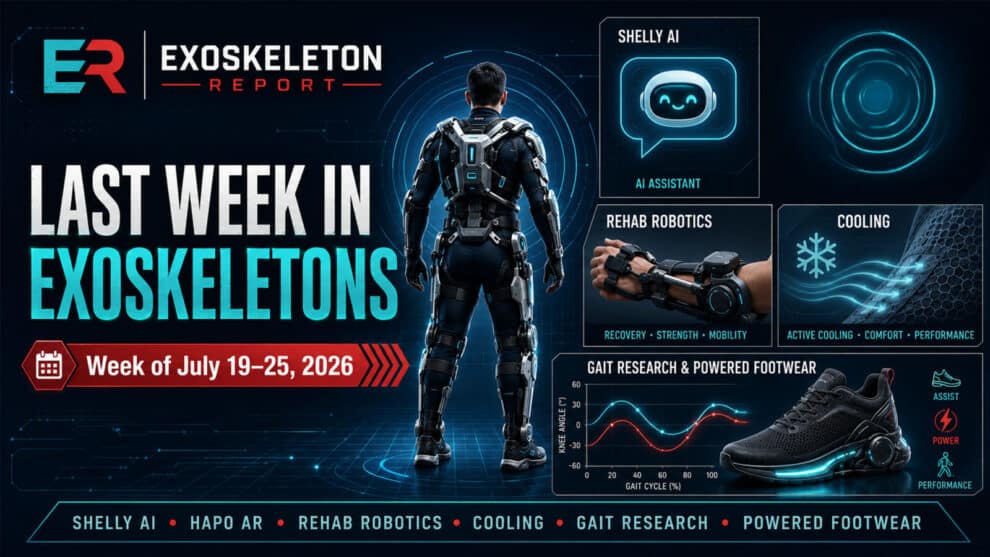
Even on vacation, the Exoskeleton Report never sleeps, and the news keeps rolling in! Wearable robotics and exoskeletons are taking more steps towards becoming a mainstream technology:
Visual Archive:
Text-Only Archive:
Become a Beta Tester for Hypershell’s New AI Sidekick, Shelly
Hypershell is inviting owners of the new X Ultra S, X Max S, and X Pro S to apply for beta access to Shelly, its new AI assistant. Designed to interact through text or voice, Shelly can help control device settings, personalize the exoskeleton’s response, and provide fitness and health insights. Selected testers will receive early access to new features and an opportunity to help shape how AI is integrated into consumer exoskeletons. Link: Hypershell.tech
Hapo Launches the Hapo AR Workstation-Mounted Arm Support
Hapo has introduced the Hapo AR, a non-wearable upper-limb support derived from the Hapo Front exoskeleton. Rather than being worn, the device attaches to a table or workstation using a clamp and combines an adjustable telescopic mast with a fiberglass spring rated for 3 kg of assistance. Designed as shared equipment for fixed workstations, the Hapo AR could support sustained or repetitive tasks such as assembly, welding, sanding, laboratory work, instrument cleaning, and desk work. Its single fabric cuff can be positioned on the forearm, around the elbow, or on the upper arm according to the task and user preference. Link – HAPO.EU
Also from Hapo:
- Hapo Previews a Single-Cuff Option for the Hapo Front – planned for September, it will give users an alternative to the current dual-interface positioned around the elbow.
- Hapo LEA App Adds Exo-LiFFT Calculations for Back-Support Exoskeletons – the new Exo-LiFFT function goes further by comparing the lower-back bending moment generated by the worker’s upper body and handled load with the assistance supplied by a Hapo exoskeleton.
OYMotion Debuts Lower-Limb Rehabilitation Exoskeleton at WAIC 2026
OYMotion unveiled a new lower-limb intelligent rehabilitation exoskeleton during the 2026 World Artificial Intelligence Conference in Shanghai. The device uses inertial sensors to detect walking intent within milliseconds and provide hip assistance intended to reduce foot dragging, support longer walks, and operate across varied outdoor terrain. The exoskeleton was introduced alongside OYMotion’s gForce Ultra myoelectric wristband and CeRelax EEG headband as part of a broader “Brain-Muscle-Machine” product ecosystem. OYmotion.com
Innophys Combines Back Assistance and Personal Cooling at an Auto-Parts Factory
Japanese automotive rubber-parts manufacturer Miwa Industry has adopted an Innophys Muscle Suit Every back-support exoskeleton together with 28 Muscle Suit COOL VEST 2 (a Peltier device) units and one AQUA VEST. The company identified repeated handling of loads weighing up to approximately 25 kilograms as a source of back strain, while mobile maintenance and transport workers could not always benefit from fixed fans or spot coolers. The deployment is especially interesting because it combines an industrial exoskeleton with wearable cooling, a growing exoskeleton-adjacent category addressing both musculoskeletal load and heat exposure. – Innophys
A PT’s Guide to Robotic Gait Training – Healing Innovation
Healing Innovations has published a clinician-oriented guide examining robotic-assisted gait training after stroke, spinal cord injury, and traumatic brain injury. The article discusses evidence that robotic training can increase safe, repeatable stepping practice and may improve gait-related outcomes when combined with conventional rehabilitation, while also acknowledging clinical guidelines that found limited benefits for some chronic, already ambulatory patients. Its most balanced conclusion is that robotics should be treated as a tool for delivering greater training volume and consistency rather than as an automatic shortcut to better outcomes. – Healing Innovation
Common gait modulation by presence of hip assistance, individual motor strategies by assistance timing
In 22 healthy adults, simply activating the hip exosuit produced broadly consistent changes regardless of the force timing: greater hip flexion and ankle dorsiflexion, along with reduced soleus muscle activity. However, the differences between timing profiles were small when averaged across the group, while each participant showed distinct and highly repeatable responses to different profiles. The practical conclusion is that a standard assistance profile can create predictable general gait changes, but optimizing the timing for performance, comfort, or efficiency will likely require individual tuning rather than relying on one universally “best” setting. – Science Direct
Using Stereoradiography to Investigate Ankle Bone Motion with a Powered Footwear System – Presented only at the World Congress of Biomechanics in Vancouver – Destan Norman – LinkedIn
Research Examines How Nike Amplify Interacts with Ankle Mechanics
University of Denver researcher Destan Norman presented new work related to the Nike Amplify powered-footwear project at the World Congress of Biomechanics in Vancouver. The study used biplanar high-speed stereoradiography to capture in-vivo ankle-bone motion during use of a powered footwear prototype, providing an unusually detailed look at how the system interacts with the body’s natural joint mechanics. Norman described it as one of the first studies of its kind, although specific findings and numerical results have not yet been released publicly.


Add Comment