

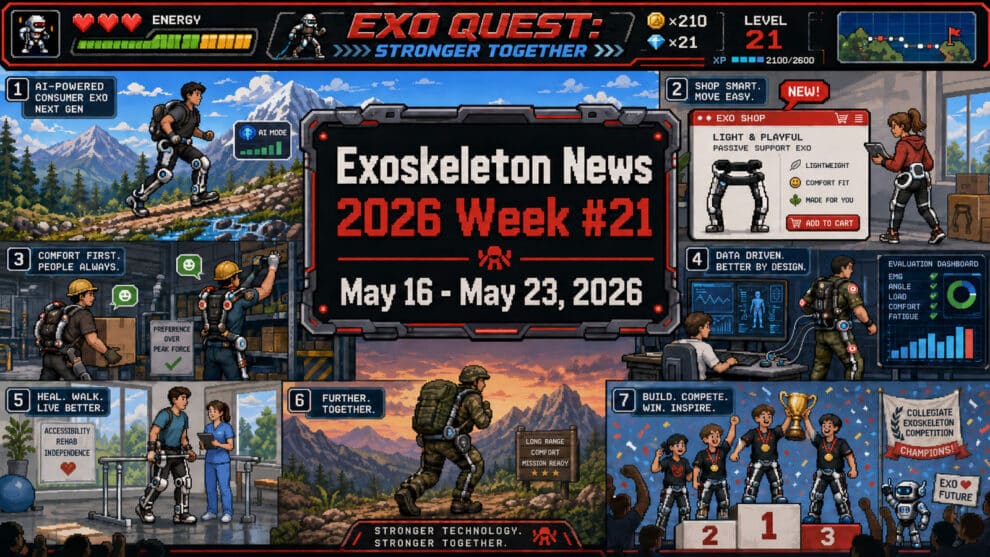
This is the text version of the newsletter. which covers another busy week for the exoskeleton and wearable robotics industry. For best results, subscribe to receive the newsletter directly in your inbox.
Hypershell Updates X Series With End-to-End AI Motion Control
Hypershell has launched the New Hypershell X Series, a refreshed lineup that includes the X Ultra S, X Max S, and X Pro S. Compared with the earlier X Series, the key change is the move from rule-based motion modeling to HyperIntuition, an end-to-end AI control system that Hypershell says responds in 0.31 seconds, 64.5% faster than the previous generation, while improving gait synchronization across varied terrain. The release also notes upgraded wearing comfort, a new-generation motor system, and a HyperLIFT field-test program exploring search-and-rescue use cases.
ArtiFusion Launches New Shoppable Website
ArtiFusion has launched a new shoppable website for its ArtiFusion Frame, a passive consumer exoskeleton/toy designed to redistribute load and reduce strain on the shoulders, lower back, knees, and ankles.
Hypershell Announces $50M Series B+ Round, Bringing Series B Financing to $120M Hypershell has announced a new $50 million Series B+ financing round co-led by Ant Group and Meituan DragonBall, with participation from Sofina and Granite Asia. The announcement follows the company’s previously reported $70 million Pre-B/B financing in late 2025, bringing its Series B-series funding total to $120 million. – link to Pandaily
These are the closing remarks for the 2026 California Labor Lab Symposium. Presented by Carisa Harris, PhD, CPE, Associate Researcher for the CA Labor Lab and Director of the Northern California Education and Research Center. – YouTube
Passive back- and arm-support exoskeletons have effects on physical demands and user perceptions in simulated manual mining tasks that are generally beneficial but are both device- and task-specific
A new Applied Ergonomics study of passive exoskeletons in simulated manual mining tasks reinforces an important real-world lesson: the device that reduces muscle activity the most is not always the one workers choose. For example, the Laevo Flex back-support exoskeleton produced larger reductions in trunk muscle activity than HeroWear, but participants preferred HeroWear because it was easier to move in, interfered less with tasks, and caused less discomfort. Similarly, the Paexo Shoulder showed stronger and more consistent shoulder-muscle reductions than EVO, yet user preference was split evenly, reflecting differences in comfort, perceived exertion, fit, and task suitability. The takeaway is that exoskeleton selection should be user-centered and task-specific – not based on biomechanics alone. – Science Direct
Upper-body exoskeleton for worker’s support in railway industry
FP3-IAM4RAIL – development of a novel upper-body active exoskeleton. – Europe’s Rail Joint Undertaking – YouTube
Bionic Power Named to the Forbes Accessibility 200 List 2026 Vancouver-based medtech company recognized for advancing mobility and independence through wearable smart orthosis technology Vancouver, British Columbia – May 19, 2026 – Bionic Power, a Canadian company developing smart orthotic technology, has been named to the Forbes Accessibility 200 List.The prestigious global list celebrates leading innovators and impact-makers advancing accessibility. The list highlights organizations whose products and technologies deliver broad, meaningful, and measurable impact across mobility, sensory, neurodivergent, digital, and experiential accessibility categories. – LinkedIn
HUROTICS has signed an MOU with the Gangwon Branch of the Korean Physical Therapy Association, taking the first step toward establishing a regional collaboration model for robotic physical therapy.
CYBERDYNE has launched rental sales in Japan for its new Medical HAL Lower Limb Type C, a successor model in the company’s wearable assistive-robotics line for gait rehabilitation. The new device is designed to make clinical use simpler and more comfortable, with one unit supporting users from 150–190 cm, enhanced AI-based walking control for smoother and less tiring assistance, and improved stability, durability, and day-to-day usability. The model has received medical device approval/certification in Japan and Europe, and in Japan it remains eligible for public medical insurance coverage for the same 10 neuromuscular and spinal cord disorders covered by previous Medical HAL models. Original press release: CYBERDYNE press release
Ten years after ExoBuddy, Centaur takes big steps – Royal Army
Ten years after the Dutch Ministry of Defence announced the ExoBuddy experiment, the system has evolved into Centaur: an 8 kg, semi-passive load-carrying exoskeleton aimed at making long movements with heavy gear easier. The article follows recent Dutch Defence trials with InteSpring, the Defence Expertise Centre Military & Equipment, and TNO research support, and frames Centaur as being at a crossroads: useful tool or essential part of operations. The next step is especially interesting: moving from manual adjustment of support and timing toward AI-enabled automatic control. It’s a good snapshot of how far military exoskeletons have come, and how much field validation is still needed before they become operational necessities.
HÉKA’s PODI Team Wins First Place at ACE 2026
Congratulations to HÉKA / Polytechnique Montréal and its PODI exoskeleton team for taking home first place at the 2026 Applied Collegiate Exoskeleton Competition (ACE). After two days of challenges at McMaster University, the team announced that PODI returned to Montréal with the first-place trophy. HÉKA is a multidisciplinary student technical society at Polytechnique Montréal focused on biomedical engineering projects, including exoskeleton development for real-world assistive applications. Learn more about the team on the HÉKA website
State of the Art Review of Wearable Exoskeletons
Free to access on Doras.DCU This report reviews three application domains, for each domain, the report describes user needs and use-cases, current system approaches (mechanics, actuation, sensing, control, safety, and usability), evidence from clinical and operational validation, and the main technology gaps and opportunities. In rehabilitation, published evidence is dominated by treadmill-based and overground lower-limb systems evaluated with standard mobility and independence outcomes.
From having only 200,000 yuan left in the account to raising 1 billion yuan in financing, he created a globally popular exoskeleton in 5 years. – eu36kr
Very good interview with the CEO of Hypershell on eu36kr with two key takeaways: admitting when a product doesn’t work isn’t all bad, and the company is moving forward with standards and standardizations efforts after issuing its call to action at the end of last year for stakeholders across the sector to join this effort (https://exoskeletonreport.com/2025/12/hypershell-publishes-c…)
ExoJobs, Events and More!
Visual Version of the Newsletter:
Special thanks to all of our Patreon supporters!!!


Add Comment