

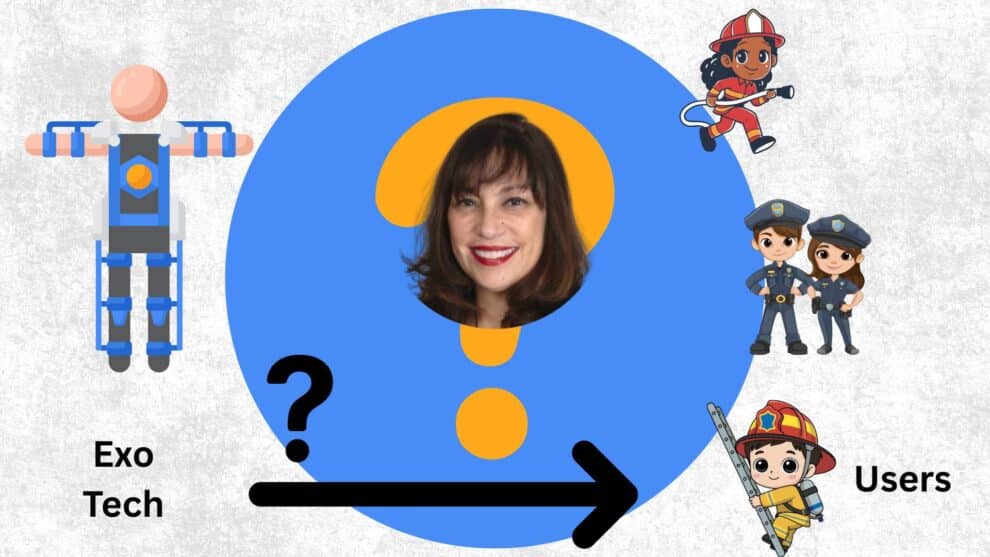
Guest author Rita Vazquez-Torres draws on her decades of experience to explain why successful pilots and capable hardware are still far from standard issue for soldiers, firefighters, law-enforcement officers, and other frontline responders.
Those of us who live within the exoskeletons/wearable tech world to help others get through their physically demanding workloads can easily understand the value of these technologies. HOWEVER, I just don’t see, for the next 5-10 years, a scenario where these communities (mostly Fire or Law Enforcement) will adopt exotech as part of their kit. I would not expect widespread operational adoption in structural firefighting, for example. That doesn’t mean there won’t be pilots or evaluations, but pilots are very different from institutional acceptance.
Stay with me on this one.
Culture. Public services (such as the fire service) are exceptionally conservative (for good reasons)
Fire departments don’t simply buy equipment because it improves performance. Every piece of equipment must answer a compelling overriding question:
“Will this get a firefighter killed?”
Unlike manufacturing or logistics, where a failed exoskeleton may reduce productivity, a failure inside an IDLH (Immediately Dangerous to Life or Health) environment can be catastrophic (this applies to Law Enforcement, Search and Rescue, Military, or any other uniformed service member). This will translate to a very high burden of proof for the developer. Most developers I know do not want to take the risk of answering this with 100% certainty.
In the case of structural firefighting, an exoskeleton must demonstrate that it:
- never interferes with SCBA
- never catches on debris
- doesn’t increase heat stress
- doesn’t reduce mobility during mayday situations
- survives extreme heat
- works while crawling, climbing, dragging victims, breaching walls, and ladder work
- can be donned quickly
- doesn’t complicate emergency doffing
That’s an enormous engineering challenge. I have seen many products that can address one or two. But not all. Not an easy problem to solve.
Procurement practices are not trivial obstacles. But aren’t the only obstacles
For responders, understanding the procurement process is CRITICAL. Who cares if it works and checks all the blocks, if you can’t sell it? And in the case of the USA, you can’t overcome the Berry Amendment/other regulatory requirements. Manufacturing matters. AND, unlike the military, there is no single customer.
Instead, there are thousands of customers:
- volunteer departments
- municipal departments
- county agencies
- airport fire departments
- industrial brigades
- federal agencies
Each has its own:
- budget
- standards
- politics
- purchasing cycles
- risk tolerance
Selling one department does not create a national market. Which also answers why it is so difficult to create a national or international market and trade. Too many special interests involved
The ecosystem matters
It isn’t simply about technology. Have I mentioned the politics of science? And the relationship between politics, policy and science? Add in an ecosystem. For example, Fire PPE manufacturers have decades of relationships with:
- departments
- unions
- testing laboratories
- certification bodies
- standards committees
- distributors
That isn’t a conspiracy (although I will contend that there are strong power plays and deep-rooted fiefdoms that are very politically connected). It’s how mature industries function.
An exoskeleton company isn’t competing only against another device. It’s competing against an established ecosystem that already works well enough. To add complexity to the mix, for the most part, exoskeleton companies are not part of that established ecosystem. I can’t say for sure who is trying to become partnered with or embedded into the fold, but I can’t say I have seen anyone making much progress in that arena (would be GREAT to see!)
Engineers often design to address engineering problems (they think they have the human factor nailed. They don’t always do. Close but no cigar).
This is something I’ve seen repeatedly across wearable robotics.
Many systems optimize for:
- torque output
- actuator efficiency
- battery life
- kinematics
A responder, firefighter, or service member asks different questions:
“Can I crawl through a collapsed basement? Confined spaces?”
“Can I climb three flights carrying a charged hose?”
“Can I fit through a window?”
“Can I throw a ladder?”
Those are human-centered design questions.
If the answer to any is “not really,” adoption stalls regardless of how elegant engineering is. And this is not just an issue for the fire community, but other communities as well.
Culture is probably the biggest barrier
Firefighters place enormous value on competence, toughness, and trust.
New equipment is often judged socially before it’s judged scientifically. This is human nature!
A firefighter, warfighter, search and rescue, coast guard, may ask:
“Is this helping me, or slowing me down?”
If it slows them even slightly during one drill, its reputation may be damaged for years.
Technology acceptance in emergency services is rarely linear.
Where do I think exos have a better chance?
More promising applications include:
- Consumer Markets
- USAR logistics
- Equipment transport
- Training academies
- Rehabilitation after injury
- Repetitive station tasks
- Airport rescue operations
- Logistics at incident staging areas
Those applications may have lower consequences if something goes wrong.
What could change the equation?
I think adoption requires several shifts occurring together:
- Systems that are designed to understand the apparel market and how protective clothing and athletic clothing systems are designed, manufactured, and sold.
- In some instances, passive or quasi-passive systems that are lightweight and don’t rely heavily on electronics OR don’t require the swapping of parts (bands, cables) to fit and refit.
- Integration into PPE rather than appearing as a separate robotic frame (boy, this is a tall order).
- Demonstrated reductions in musculoskeletal injuries over multiple years (increasing the number of wearers – I think this is underway).
- Endorsement by influential members from sports, medicine, fire departments, law enforcement communities and respected instructors—not just manufacturers or academics.
- A clear return on investment through fewer injuries, less lost work time, and lower workers’ compensation costs (this is getting better, but we aren’t there yet).
- Development driven by multi-disciplined teams and not primarily by engineers, or heavily reliant on one discipline such as biomechanists, ergonomists, etc.
- Learning the critical difference between “user” and “consumer”. While letting go of the overly abused reliance on trying to speak for the “user”.
A very different frustration
Over the years, I have never said that the “technology doesn’t work.” I just have been firming that the technology readiness level and the market readiness level are out of sync, and for the most part, developers get “caught up in their own heads” and are out of touch with what makes a market happen and how consumers… consume.
Those are very different problems.
An exoskeleton can be technically impressive and still have no viable market because:
- the user doesn’t want it,
- the purchasing system can’t support it,
- standards don’t accommodate it,
- or the operational concept hasn’t matured.
History is full of technologies that were “right” but arrived before the surrounding ecosystem was ready.
My outlook
I am not saying that the fire, military, and public service communities will never embrace exoskeletons. They have all eventually adopted innovations such as thermal imaging cameras, lighter SCBAs, and new PPE materials once they demonstrated clear operational value without compromising safety. And once the apparel industry has found a profitable margin. Exotech has not found an ecosystem where it fits in (puns intended!). While the world of exoskeleton technology continues to expand, picking the ecosystem that will work for the product and getting them onto the bodies of many people with sustained over-time acceptance, use, and satisfaction is wildly positive for the community at large!
As for the responder and service ecosystem, I think the timeline continues to be longer than many developers and investors expect (and hope for). Unless there is a fundamental adjustment of developer mindset and understanding that a particular market is an ecosystem of moving parts. And, unless exoskeletons become almost invisible to the user – comfortable, rugged, affordable, seamlessly integrated into PPE, and supported by compelling injury-reduction data, practical and affordable, they are likely to remain niche tools rather than standard issue for the frontline. That conclusion isn’t because of a single obstacle like procurement or culture; it’s because technical, operational, economic, and institutional barriers reinforce one another.
 About the author: Rita Vazquez-Torres (LinkedIn) is a technology and policy strategist whose career has encompassed soldier systems, responder PPE, government research and development, technology transition, standards, and exoskeleton adoption. She served as director of the National Protection Center at the U.S. Army’s Natick Soldier Center, where she worked on adapting military technologies for law enforcement and other first-responder applications. Her professional profile includes involvement in Robotics for Human Assist/Augmentation and the HULC military exoskeleton program beginning in 2009–2010. More recently, she is the CEO and senior technology strategist of New Stone Soup VT LLC and a founding partner of the ASTM Exo Technology Center of Excellence (link).

Add Comment