

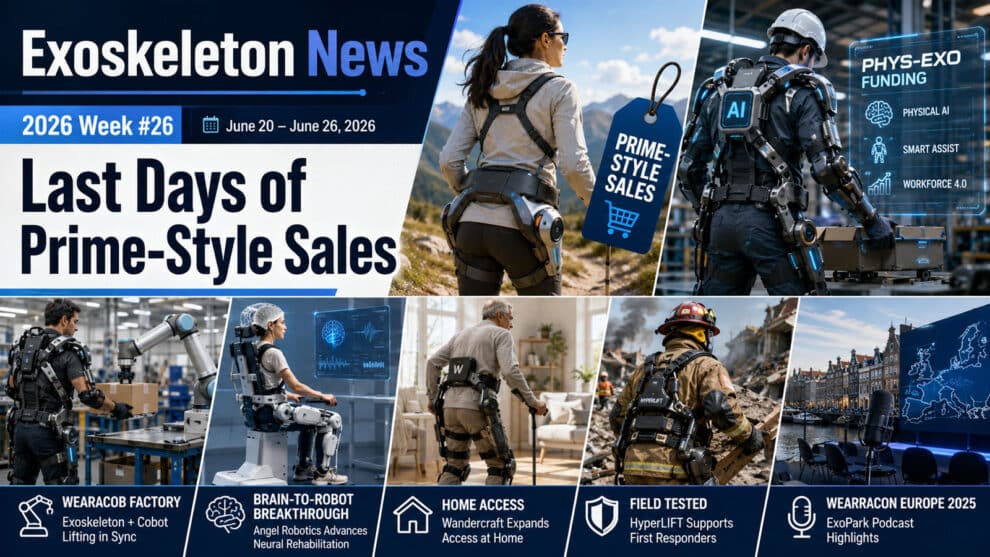
Welcome to the weekly archive copy of the Exoskeleton Report newsletter. This archive copy covers the final hours of Prime-style sales on consumer exos. There are also new studies on how occupational wearables can interact with cobots, new haptic-feedback for wearable robotics, podcast announcements, and much more:
Visual Archive:
Text Only Version:
Your 2026 Guide to Prime Day-Style Consumer Exoskeleton Sales – Exoskeleton Report
Your guide to Prime Day-Style Consumer Exoskeleton Deals in 2026 from Hyperhsell, DNSYS, Crimson Dynamics / MECLAYER, Ascentiz, YRobot, MeBotX, and ArtiFusion…. read more on ExR
Full Adventure Days 2026 by Hypershell Sales Ends June 30
If you have been waiting to buy a Hypershell X Series powered hip exoskeleton, this coming week will have the best sales of their products, ever! This is not about selling “cheap exos” it is about the field maturing and consumer devices joining Prime Day type of sales… read more on ExR or go directly to Hypershell.tech.
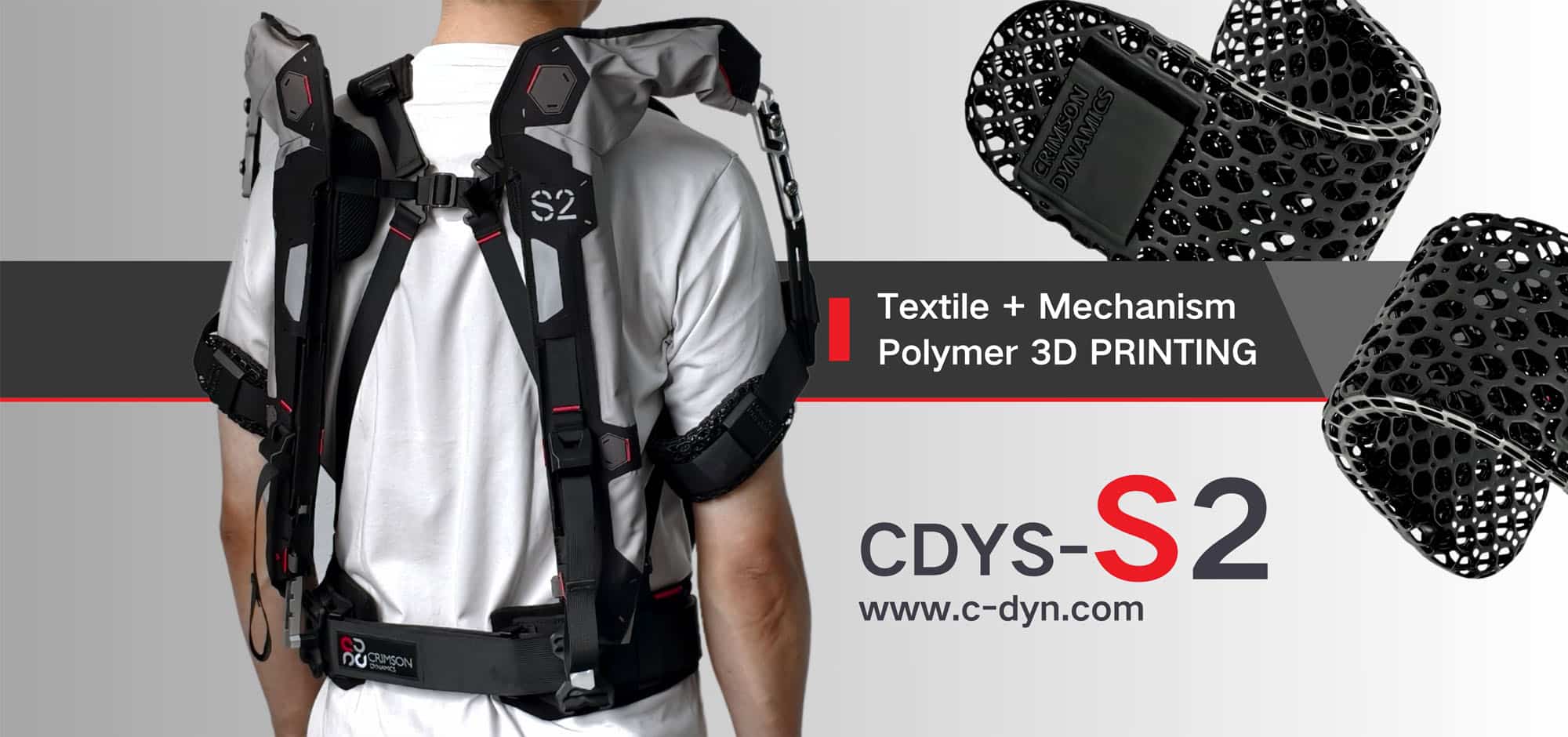
Crimson Dynamics / MecLayer: exoskeleton know-how moving into performance gear
Introducing MecLayer, the consumer wing for wearable performance gear built from Crimson Dynamics’ exoskeleton experience. Its first product is the K1s Advanced Jumper Knee Strap coming summer 2026, and in observance of Prime Day, you can get a 20% coupon by subscribing. Check out the full details on Crimson Dynamics’ site.
PHYS-EXO Selected for EIC Pathfinder Challenge Funding
PHYS-EXO, a new project focused on physical embodied intelligence for next-generation smart exoskeletons, has been selected for funding under the European Innovation Council Pathfinder Challenge, “Accelerating Physical AI: Embodied Intelligence for the Next Frontier of AI-Powered Robotics.” Chosen from among 425 proposals, the project will advance research in Physical AI, 3D environment reconstruction, semantic reasoning, and intelligent control for exoskeleton systems. IDSIA USI-SUPSI is also seeking a Postdoctoral Researcher to join the project in Lugano, Switzerland.
Link: Read more on LinkedIn
Episode 29: WearRAcon Europe 2025, Big Booths, Big Energy, and ExoPark at A+A
In this episode, Bobby Marinov from Exoskeleton Report and Dr. Tom Sugar from the Wearable Robotics Association recap their November trip to Germany for WearRAcon Europe 2025, A+A Düsseldorf, ExoPark, and the ExoWorkAthlon. They discuss the scale of the world’s leading safety trade fair, the growing momentum behind occupational exoskeletons, standout presentations from the conference, hands-on demonstrations, emerging evaluation tools, and the energy around the exoskeleton industry as it continues moving toward wider workplace adoption: links, transcript and more on the ExR website.
Exoskeleton-Cobot System Cuts Factory Lifting Strain by Up to 65%
Researchers at the Technical University of Munich have developed WearaCob, a system that pairs an upper-body exoskeleton with a collaborative robotic arm to make factory lifting tasks safer and less physically demanding. The cobot weighs objects and wirelessly shares load information with the exoskeleton, which adjusts support for the worker’s arms and can reduce muscular effort by up to 65%. The system also supports easy “programming by demonstration,” allowing workers to teach the robot new tasks without writing code.
Link: Read more on Tech Xplore
ExR’s Perspective: Fraunhofer IPA has previously worked on two-person lift where the exoskeletons communicate with each other. This is a positive step forward in integrating exoskeletons with the workplace, rather than thinking of them in a vacuum.
A research team led by Professors Kyoungchul Kong and Jung Kim of KAIST’s Department of Mechanical Engineering, together with Angel Robotics Co., Ltd., has begun developing a bidirectional Brain-to-Robot technology
KAIST researchers have launched an ambitious bidirectional “Brain-to-Robot” project that aims to let people control an exoskeleton with brain signals while also sending touch and force sensations from the robot back to the brain. Led by mechanical engineering professors Kyoungchul Kong and Jung Kim in partnership with Angel Robotics, the project will run from April 2026 through December 2032 and focuses on restoring movement and sensation for people with quadriplegia. The team says the system could mark a major step toward assistive robots that not only move with a user’s intent, but also help them feel the world again.
Read More on https://www.eurekalert.org/news-releases/1133495
Wandercraft Partners with NSM to Expand Access to Home-Use Exoskeleton Technology
Wandercraft has named National Seating & Mobility as the exclusive complex rehabilitation technology distribution partner for Eve™, its self-balancing personal exoskeleton designed for home use. Pending FDA clearance, the partnership will leverage NSM’s network of 180+ locations to support evaluation, education, access, and delivery for eligible individuals with spinal cord injuries and other severe mobility impairments. Eve is designed to bring upright mobility beyond rehabilitation settings and into everyday home life, supporting hands-free standing and walking with the assistance of a trained companion.
Read more on National Seating & Mobility: https://www.nsm-seating.com/press-release/wandercraft-names-…
Neural stimulation and exoskeletons improve hand function following neurological injuries
“Researchers at the Medical University of Vienna, in collaboration with ETH Zurich, the Technical University of Munich and Medical Faculty Belgrade, have developed a wearable neurorobotic system that combines electrical neurostimulation with hand exoskeletons. In a clinical trial involving 14 patients with hand impairments caused by neurological injury, the technology supported finger mobility, tactile perception and grip control. The results demonstrate the potential of personalized assistive systems for people living with the consequences of spinal cord or brain injury.” – MedUni Wien YouTube
ExR’s Perspective: I have gotten to wear the ETH Zurich exo-glove, but not with the added feedback.
Podcast: Brain-computer interface controls exoskeleton
Advancements in science and technology impact the well-being of the American people. U.S. National Science Foundation-supported professor Payam Heydari [UC Irvine] discusses a breakthrough brain-computer interface that controls a robotic exoskeleton, technology that could transform the lives of people living with spinal cord injuries. – Watch on NSF.Gov
Hypershell pushes AI exoskeletons into search-and-rescue with HyperLIFT field tests
Hypershell appears to be broadening its consumer/outdoor exoskeleton story into real-world emergency-response use cases. HyperLIFT is a 2026 field-testing initiative to explore wearable exoskeletons for physically demanding search-and-rescue work, including plans to supply devices to more than 50 search-and-rescue organizations and showcase the technology in extreme environments such as Everest.
Find out more on Hypershell.Tech
There is no text-only version of the job listings or upcoming events. Special thanks to all our Patreon supporters, and I look forward to reconnecting next week!





Add Comment