

Exoskeletons are entering normal retail behavior. For years, wearable robotics has lived in a strange space between medical devices, industrial equipment, trade-show prototypes, and futuristic promise. Exoskeletons were something you saw at CES, in clinical studies, and inside factories. They were interesting, but they often felt like they were adjacent to normal consumer life.
Now, Hypershell is doing something very different. It is putting an outdoor exoskeleton into the rhythm of ordinary consumer technology: a countdown clock to Prime Day-style sales, early access, a limited sales window, model comparisons, product pages, checkout buttons, and seasonal retail urgency.
Because at some point, a category crosses a line. It stops being something you only read about at a robotics conference and becomes something you compare, wait for, save on, and buy during a major shopping event. This was a major shopping event named Hypershell Adventure Days!
Why is it worth paying attention?
I have watched the company evolve from a futuristic concept into a consumer-facing product sold at scale. I am one of the co-authors of the Hypershell white paper on 3rd party testing. I have recorded episodes on consumer exoskeletons [see Episode 28: Not a Sales Pitch – An Exoskeleton Engineer Puts Consumer Exos to the Test and Episode 5: Exploring Consumer Exoskeletons: Skiing, Hiking, and Fitness Applications] and on Hypershell specifically. I have made TikTok videos about Hypershell, too.
Having worn more human augmentation devices than most, I can safely say that the Hypershell is not a toy to be underestimated. If you have been waiting to buy a unit for yourself, your lab, department, or a loved one, this sale represents the best opportunity to do so.
On a personal level, I have seen how much the Hypershell Ultra helps my grandma [link to ExR on TikTok] with her fatigue and access to the outdoors. As a person with cardiovascular deficiency, she gets tired very easily. While not a medical device, every time I have had the Hypershell Ultra on her, she has been able to walk for at least twice as long and conquer hills and inclines that would otherwise be unimaginable for her. (Please don’t infer any medical claims.) I believe that getting old is not a medical condition and that these devices will be used to support graceful aging.
I think about my grandmother because she represents one of the clearest consumer exoskeleton use cases: someone who still wants to participate. The point is not to turn someone into a mountain athlete. The point is to reduce the cost of saying yes.
Yes to the longer walk.
Yes to the family outing.
Yes to the trail with a little elevation.
Yes to the trip where everyone else wants to keep moving.
Yes to staying involved rather than sitting it out.
That is the emotional center of consumer exoskeletons. The technology story is motors, sensors, torque, batteries, algorithms, and wearable ergonomics. The human story is simpler.
Hypershell leads the exoskeleton market for consumer use
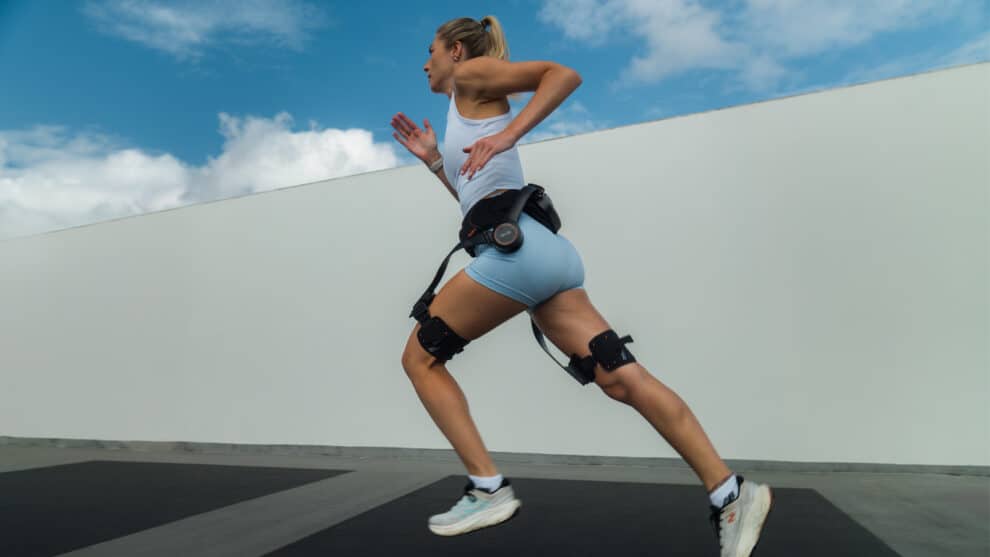
Hypershell describes the X Series as an outdoor exoskeleton that combines robotics, ergonomics, and AI into a compact wearable system for activities including outdoor use, photography, travel, sports, biking, hiking, and everyday life.
The company’s reviewer materials position the X Series around several core claims: up to 800 W peak output, up to 40% more leg strength, up to 30% less physical exertion, 30 kg load offset, 17.5 km battery range, IP54 dust and water resistance, and fast charging from 0–100% in 88 minutes.
Importantly, the company is not trying to be everything at once. These are not military, industrial, or medical devices. The current models don’t support the lower back for repetitive tasks such as lifting or stacking boxes. They can’t help with sit-to-stand. And finally, the controller knows to get out of the way… so it won’t help you jump over a puddle, but it also won’t lock up on you. This allows Hypershell to laser-focus on assisting known repetitive motions (walking, hiking, biking, stair climbing, etc…) rather than trying to boil the ocean and do everything at once.
The company is also a rare gem that is not afraid to admit when it makes a mistake and to do something about it. For example, the initial Kickstarter campaign had an overly ambitious design. Rather than releasing on schedule and creating dissatisfied customers with negative first impressions, management made the tough decision to delay the launch by more than a year and go back to the drawing board. This attitude delivers higher-quality products and makes the entire exoskeleton industry look good.
Who is this actually for?

The easy answer is hikers. Uphill trails, long approaches, backpacking, outdoor photography, uneven terrain, and fatigue management are all natural fits for a wearable assistive system. The more general answer is: anyone who is still mobile, still active, still curious, but who increasingly thinks about fatigue or wanting to walk faster.
That could be an outdoor photographer carrying gear.
It could be a traveler walking all day in a new city (especially a medieval city, a maze of stairs).
It could be someone who loves hiking but does not love climbs.
It could be a search-and-rescue volunteer (or a trail maintenance volunteer).
It could be an older adult who can walk independently but wants more endurance and confidence for longer outings.
Can this help people do more of what they already want to do?
That is why I think the outdoor exoskeleton category is worth watching. It does not have to be framed only around extremes. It does not have to be “summit faster,” “carry more weight,” or “become superhuman.” For many people, the appeal may be much more ordinary and much more powerful.
More walking.
More exploring.
More independence.
More energy left at the end.
This article was updated on Jun 24, 2026 to include the unlocked Adventure Days deals.
This article was updated on July 9, 2026 to reduce content related to the finished Prime Day Style promotion.


Add Comment