

It has been another action-packed week in the world of physical augmentation technology, this time dominated by consumer news! Below is the e-mail embedded version and the text version for easier searching & reference:
No Exoskeletons at Eastern States 100
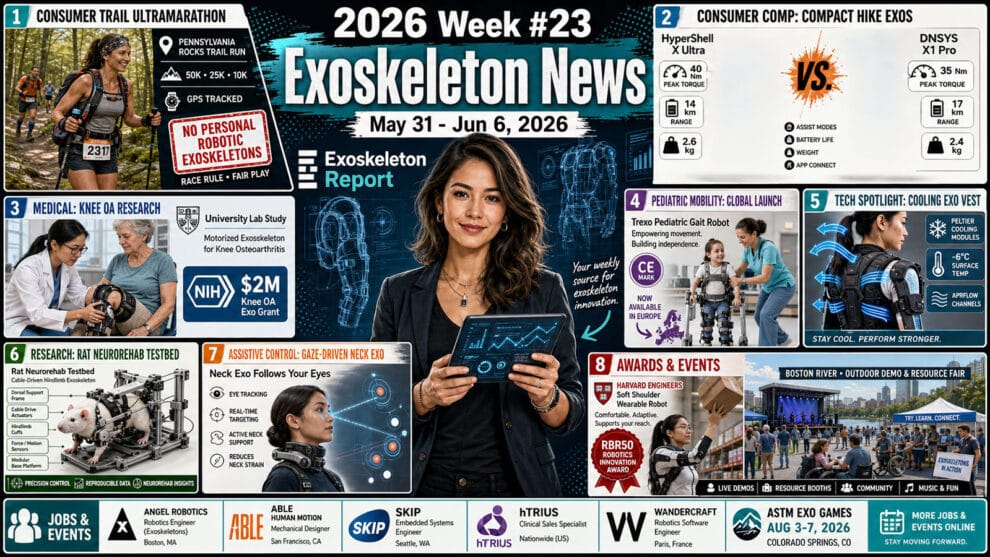
The “eastern race” is the Eastern States 100, a 103-mile single-loop trail ultramarathon through the Allegheny Plateau in north-central Pennsylvania. Its race rules allow standard aids like poles, GPS devices, sport watches, and heart-rate monitors, but draw the line at technological assistance: … “personal robotic exoskeletons” are explicitly prohibited. Link
Using an EXOSKELETON as an Amputee?!
ExR’s Perspective: Using a powered exoskeleton on top of prosthetic used to be a popular research and discussion topic. While this is not a scientific video, it is interesting to see the subject being brought up once again by the availability of consumer systems. Side note, exoskeleton systems don’t exist in a vacuum, and figuring out what they combine well with will be an entire artform on its own.
Link: Alex1Leg via YouTube
Battle of the Exoskeletons: HyperShell X Ultra vs DNSYS X1 Pro
In this video, Dariusz Tech puts two of the most exciting wearable exoskeletons head-to-head: the HyperShell X Ultra and the DNSYS X1 Pro.
ExR’s Perspective: Dr. Sugar and I did a series of videos on TikTok and one episode on our podcast where we carefully compared the exact same two models. We tried to keep it technical and diplomatic. Dariusz Tech is a little bit more straightforward, which is entertaining and curiously we are entering where anyone can pick up two exos and directly compare them head-to-head.
Link: YouTube
U-M Team Wins $2M NIH Grant to Develop Knee Exoskeletons for Arthritis Relief
A University of Michigan research team led by robotics professor Robert Gregg has secured a $2 million National Institutes of Health grant to develop motorized knee exoskeletons that could help reduce pain and improve mobility for people with knee osteoarthritis. The project builds on earlier U-M exoskeleton work using brace-based designs and lightweight motors, shifting the focus from boosting strength to reducing joint contact forces inside arthritic knees, with the long-term goal of making everyday movement easier and potentially delaying or avoiding surgery. link – news.umich.edu
CYBERDYNE has announced a strategic alliance with Silicon Valley-based Pegasus Tech Ventures and the creation of a US$60 million investment fund aimed at startups and growth companies in “HCPS Cybernics with Physical AI.” The move frames wearable robotics, AI-controlled physical systems and medical/healthcare technology as an investable ecosystem rather than a single-device category, and could help CYBERDYNE expand globally through startup partnerships, co-development and access to Pegasus’ innovation network. link
Personal Cooling Could Become the Next Exoskeleton-Adjacent Product Category
ExR’s Perspective: could exoskeletons of the future come with built-in temperature controls and how could that look like.
Tiny Rat Exoskeleton Resurfaces as a Neurorehab Robotics Testbed
Japanese researchers from Nagoya University and the University of Tsukuba have developed a miniature robotic exoskeleton for rats, designed to support the full hindlimb – hip, knee, and ankle – during quadrupedal walking. The system gives scientists a controlled way to study how robotic movement assistance could improve rehabilitation after neurological injuries such as stroke or spinal cord injury. The lightweight, cable-driven device is built to replicate natural rat gait patterns while minimizing stress on the animal, and the team says the platform could help reveal neural recovery mechanisms that inform future human exoskeleton control strategies.
A Neck Exoskeleton That Follows Your Eyes
University of Utah researchers are presenting an ICRA 2026 paper on a gaze-driven assistive neck exoskeleton aimed at people with dropped head syndrome, including conditions such as ALS. The novel idea is less about the brace hardware and more about the control system: instead of using a joystick, keyboard, or other hand control, the device tries to infer where the user wants to move their head by tracking eye gaze. No single controller was best for everyone – a strong hint that future assistive exoskeletons may need personalized control software rather than one-size-fits-all settings.
Link: Research paper on arXiv: “A Multi-Layer Sim-to-Real Framework for Gaze-Driven Assistive Neck Exoskeletons.”
Harvard’s Soft Shoulder Exoskeleton Wins RBR50 Application of the Year
Harvard researchers are getting new recognition for a soft wearable shoulder robot designed to help people with upper-limb impairment regain independence in daily tasks.
Link: “A Wearable Robot That Learns” & LinkedIn
Exoskeletons Took the Stage at “Abilities: Amplified” in Boston
The June 3 Abilities: Amplified event at Boston’s Hatch Memorial Shell brought together music, disability community-building, and hands-on assistive technology demos on the Charles River Esplanade. The free event featured live performances and a resource fair highlighting wearable robotics and mobility tech, including Harvard Biodesign Lab wearable robots, REEV’s robotic knee brace, UMass Amherst gait-assistance demos, Stride Bionics’ robotic ankle device, and Dephy’s lightweight walking exoskeletons. link
Special thanks to all of our Patreon supporters! If you enjoy this publication, please consider joining their ranks!



Add Comment