

Exoskeletons help with physical work, but they are still wearables. That means comfort, heat buildup, and user adoption are inseparable from the design problem. Exoskeletons are usually discussed in terms of assistance: reducing back strain, supporting the shoulders, improving grip, or making repetitive work less fatiguing. But every exoskeleton has to solve another, more ordinary problem. It has to be worn.
Whether rigid, soft, passive, or powered, an exoskeleton must connect to the body through straps, cuffs, sleeves, harnesses, belts, pads, textiles, or other human-machine interfaces. Those attachment points are what allow the device to transfer force to the wearer. They are also places where heat can become trapped. This challenge is compounded by rising global temperatures and the fact that many warehouses, stockrooms, and shipping and receiving departments are not climate-controlled.
Exoskeleton producers have already tried many ways to improve comfort: better straps, performance textiles, modular sizing, breathable materials, smaller frames, and faster donning and doffing. Those improvements matter. But at the end of the day, an exoskeleton is still a wearable. Like a backpack, harness, brace, vest, or close-fitting garment, it can interfere with normal heat loss.
That creates an opening for a new kind of exoskeleton-adjacent product category: personal cooling. Cooling clothing and personal thermal-management devices are becoming more visible, and some companies around the exoskeleton ecosystem have started exploring them. Perhaps there is a future where the two are combined into one product. Here is what is becoming available on the market right now:
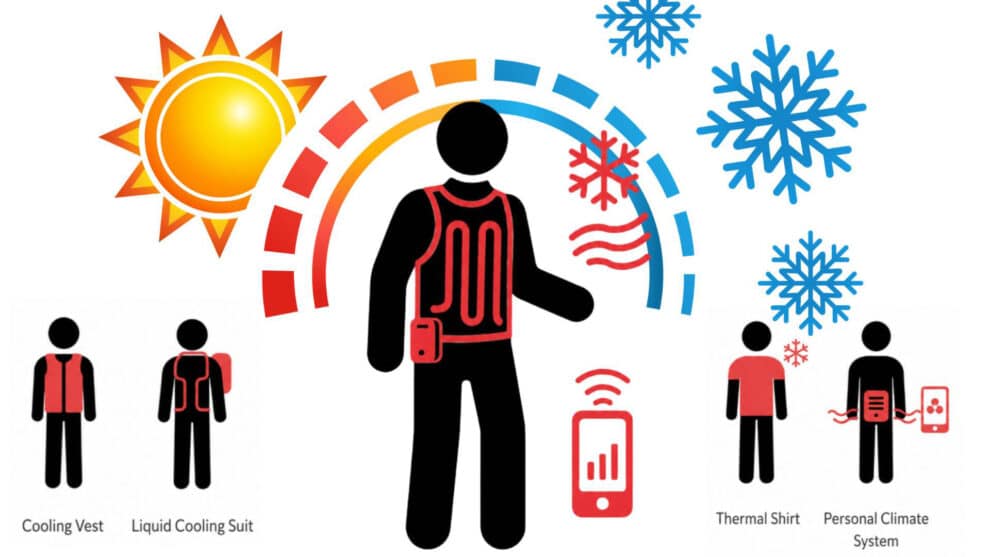
Types of Personal Cooling Clothes and Devices:
There are at least four strategies for wearable climate control that appear to be gaining traction: wearable fans, evaporative-cooling clothing, Peltier devices, and wearable mini-ACs with liquid-circulation systems.
Evaporative cooling clothing is the simplest. These garments are activated with water, then worn after excess moisture is removed. Cooling comes as retained moisture evaporates from the textile. Exo-Cool Apparel, sold through The Exoskeleton Store, describes products that are 100% textile, require no gels, refrigeration, batteries, or compressors, and can be activated by running them under cold water for a few seconds. This kind of solution is attractive because it is lightweight, quiet, and power-free, but also comes with limitations. See The Exoskeleton Store Exo-Cool Apparel for images and details.
Peltier or thermoelectric devices use electrical current to create a cold side and a hot side. The cold side can cool a body-contact area, while the hot side must be managed with airflow, heat sinks, or other heat-rejection methods. Sony’s REON POCKET line shows how consumer personal-cooling products are becoming smaller, sensor-informed, and app-controlled. Sony’s REON POCKET products are the most visible consumer-facing examples, but there are exoskeleton-adjacent ones as well. NSBT Japan describes Innophys’ COOL VEST as using Peltier and fan-based active cooling. Thermoelectric systems are appealing because they are active and controllable. Their challenge is energy use and heat dissipation.
Wearable mini-AC-style and liquid-circulation systems are more complex. They can include pumps, fans, cooling modules, mobile power supplies, and liquid channels in the garment. The Climate Control Exosuit uses a water-based cooling medium and is framed as exoskeleton-adjacent cooling clothing for industrial environments. The SEEPPO WCE Intelligent Temperature Control Clothing is described as using semiconductor thermoelectric cooling and a TPU water-circulation layer across the back, with a wearable host containing a pump, cooling system, and fan. These systems may offer stronger or more distributed cooling, but they also add weight, cost, maintenance, and integration challenges.
In summary:
- Wet-to-activate cooling garments: simple, quiet, no battery, but environment-dependent.
- Peltier / thermoelectric devices: active, controllable, compact, but power-hungry and dependent on heat rejection (from the electrical resistance and the transferred body heat).
- Mini-AC / liquid-circulation clothing: more distributed cooling, but heavier and more complex.
Why this could matter for exoskeletons
Not all exoskeleton-adjacent technology has to be mechanically assistive. Keeping a worker comfortable is still assistive, just in a different way. It does not lift a box, support a shoulder, or strengthen a grip. Instead, it may help make a wearable system more tolerable, more practical, and more likely to be used consistently. A device that reduces back strain but feels hot, bulky, or complicated may lose users. A cooling layer or module that makes the whole system more wearable could become part of the adoption story.
The integration possibilities are obvious. Some exoskeletons already have wearer-facing controls. Some cooling wearables also use buttons, apps, sensors, tags, or remote-control logic, and rather than asking a worker to manage two separate wearable systems, the interface could eventually be combined. One control could manage both mechanical assistance and thermal comfort. One app could handle fit, mode selection, cooling level, and usage data. One battery platform could power both systems, or at least coordinate charging and runtime. One sensor suite could detect activity, posture, ambient temperature, humidity, and user state, then adjust support and cooling together.
That does not mean every exoskeleton should become an air conditioner. But personal cooling gives the industry another design path. It allows exoskeleton companies to think beyond force assistance and toward the broader worker-wearable system. The next step in exoskeleton design may not be a stronger actuator or a smarter spring. It could be a cooling vest, a neck-worn thermal device, a water-activated shirt, or a liquid-circulation garment that makes wearing the exoskeleton easier in the first place.
Personal cooling will not replace exoskeletons. But it could become one of the technologies that helps them fit better into real work.
Need help understanding where the exoskeleton industry is heading? Exoskeleton Report offers consulting and advisory services for organizations evaluating wearable robotics, workplace adoption, and emerging exoskeleton-adjacent technologies.



At ASU, Konrad Rykaczewski is doing some very nice work
https://news.asu.edu/20230525-solutions-meet-andi-worlds-first-outdoor-sweating-breathing-and-walking-manikin “With the data and information collected, researchers hope to design interventions, such as cooling clothes or exoskeletons for backpacks that are designed for cooling support.”