

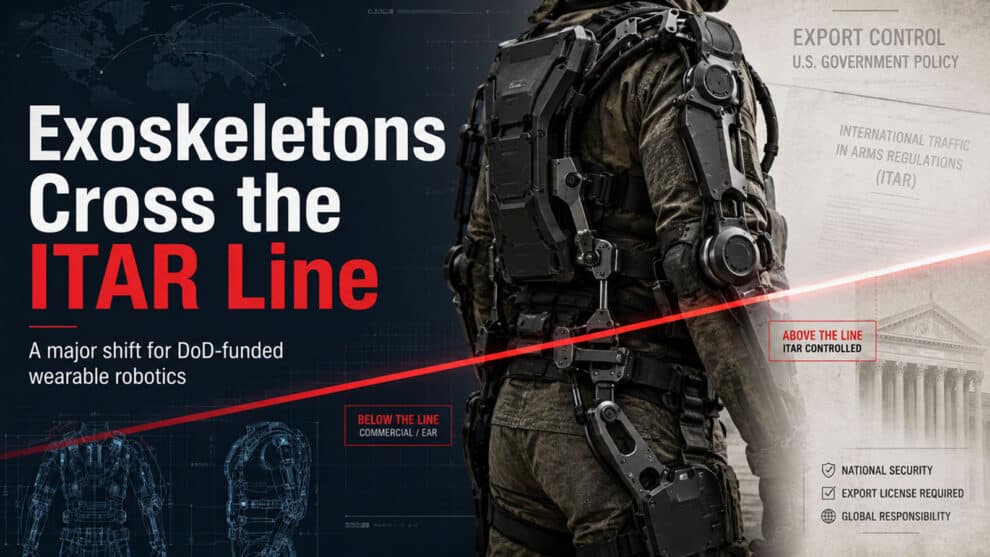
The exoskeleton industry has spent years trying to prove that wearable robotics is more than ergonomic theater. Now, in a major regulatory shift, the U.S. government has identified certain DoD-funded developmental exoskeletons as sensitive military technology.
That does not settle the commercial debate. It does, however, change the stakes. The conversation is no longer only about injury reduction, worker fatigue, ROI, or whether systems are overhyped. For companies pursuing covered DoD-funded developmental exoskeleton work under contracts or funding authorizations dated after January 20, 2026, development may now involve export-control strategies, foreign-person access controls, technical data restrictions, supplier reviews, overseas testing limits, and investor due diligence.
The change appears in USML Category X — Personal Protective Equipment under the International Traffic in Arms Regulations, or ITAR. The controlling text is not a broad ban on commercial exoskeletons. It is narrower, but still highly significant.
The current text of 22 CFR § 121.1, Category X(b) reads:
“Developmental exoskeletons funded by the U.S. Department of Defense via contract, or other funding authorization, dated after January 20, 2026; and specially designed parts, components, accessories, and attachments therefor; excluding those that are:
(1) Enumerated elsewhere on the USML;
(2) In production;
(3) Documented as subject to the EAR via a commodity jurisdiction determination (see § 120.4 of this subchapter); or
(4) Identified in the relevant DoD contract or other funding authorization as being developed for both civil and military applications.”
That language is now in the current eCFR version of the U.S. Munitions List. (current 22 [as of this publication] CFR § 121.1 / USML Category X link to ecfr.gov)
When did this happen?
The key public rulemaking appeared in the State Department’s broader rulemaking titled “International Traffic in Arms Regulations: U.S. Munitions List Targeted Revisions.” The interim final rule was published in the Federal Register on January 17, 2025, as 90 FR 5594, Document Number 2025-01313, Public Notice 12441, RIN 1400-AF42. The rule listed an effective date of September 15, 2025, and a comment due date of March 18, 2025. (January 17, 2025, interim final rule link to federalregister.gov)
In that January rule, the State Department gave the reason plainly: “Developmental exoskeletons have been identified as a technology warranting ITAR control due to the critical military advantage they provide.”
The final rule was published on August 27, 2025, as 90 FR 41778, Document Number 2025-16382, Public Notice 12744. It adopted the interim final rule with changes and kept the September 15, 2025, effective date. (August 27, 2025, final rule link to federalregister.gov)
In other words, the rule became effective on September 15, 2025, but the exoskeleton entry is drafted to apply prospectively to covered DoD contracts or funding authorizations dated after January 20, 2026.
This is not “all exoskeletons are ITAR”
The rule does not say every warehouse, rehabilitation, construction, logistics, medical, or passive exoskeleton is now a defense article. The trigger is more specific: developmental exoskeletons funded by the U.S. Department of Defense through a contract or other funding authorization dated after January 20, 2026, plus specially designed parts, components, accessories, and attachments therefor.
The exclusions also matter. Category X(b) does not automatically cover every exoskeleton connected to the military. It does not capture items already enumerated elsewhere on the United States Munitions List (USML), items in production, items documented as subject to the Export Administration Regulations (EAR) through a commodity jurisdiction determination, or items identified in the relevant DoD contract or funding authorization as being developed for both civil and military applications. In the first case, the item may still be ITAR-controlled elsewhere; it is simply not being newly captured by Category X(b). (22 CFR § 121.1 / USML Category X(b) link – Code of Federal Regulations)
Why is this a major industry signal?
Now the U.S. government is signaling that certain developmental exoskeletons are considered sensitive enough to be included on the U.S. Munitions List when they are funded by DoD after the cutoff date. The rule does not spell out every military use case, but a reasonable inference is that the government sees potential military advantage in human augmentation, load carriage, endurance, soldier performance, and wearable robotics. It does not validate every commercial claim. But it does say that this technology family is no longer being treated as merely speculative.
The compliance impact could be bigger than the hardware
ITAR not only affects physical devices. USML Category X also controls technical data and defense services directly related to the defense articles in that category. The eCFR text for Category X(e) states that technical data and defense services directly related to the Category X defense articles described in paragraphs (a) through (d) are controlled. That matters for exoskeleton teams because “technical data” can include information required for design, development, production, assembly, operation, repair, testing, maintenance, or modification of defense articles. That does not mean every marketing deck or general product description is controlled technical data; ITAR’s technical-data definition excludes basic marketing information on function or purpose and general system descriptions. But engineering-level design, development, production, testing, repair, maintenance, or modification information can fall into a very different category. In practical terms, companies may need to consider export controls before they consider international demos, foreign-person engineering access, overseas trials, offshore contractors, shared CAD repositories, investor due diligence, supplier documentation, cloud collaboration, or university research teams, depending on the facts and classification.
Bottom line
Part of the exoskeleton industry just crossed a regulatory line. The debate over commercial usefulness is not over. Passive supports, powered suits, medical devices, and military human-augmentation systems are not all in the same category. But the U.S. government has now formally identified certain DoD-funded developmental exoskeletons as sensitive military technology. That changes the conversation from “are exoskeletons real?” to “which exoskeleton programs may now involve controlled defense articles, technical data, or defense services?”





Add Comment