

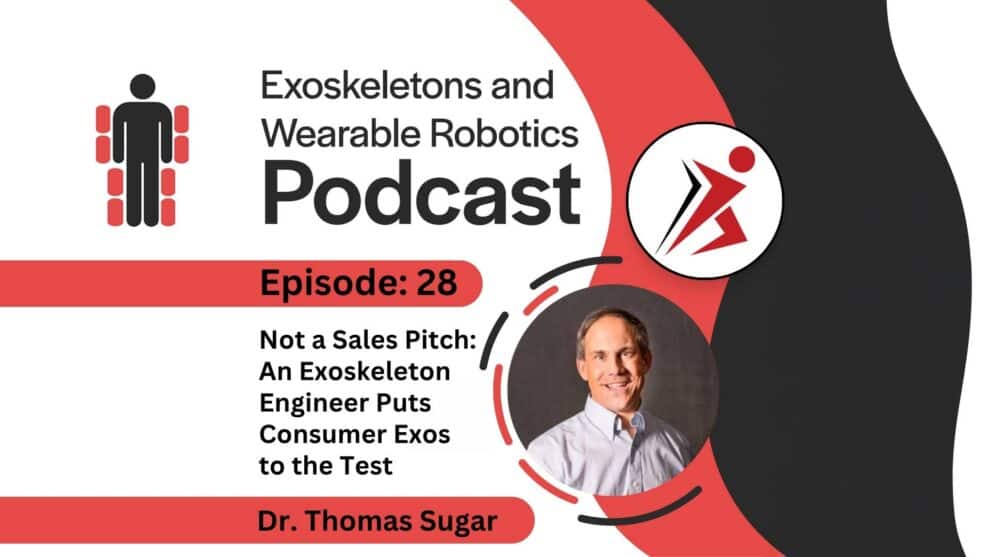
Powered exoskeletons for less than $1,000: are they toys, gimmicks, the real deal, or something in between? In this episode, I sit down with Dr. Tom Sugar after a day and a half of hands-on testing with several consumer hip exoskeletons, including the Hypershell base model, the Dnsys Pro, and the Hypershell Ultra. What makes this conversation different is that Tom is not just reacting as a first-time user; he is a wearable robotics researcher and engineer who has built multiple powered exoskeletons and powered prosthetic systems himself (with over 25 years of hands-on experience). Together, we talk through what it was like to put these devices on, acclimate to them over thousands of steps, test them on ramps, stairs, an incline treadmill, and a bike, and compare their real-world feel against Tom’s own engineering experience. My hope is that listeners come away with a more grounded answer to the question: what can consumer exoskeletons actually do today, where do they still fall short, and are they becoming something like “e-bikes for your legs” – not a replacement for movement, but a way to help more people walk farther, climb more, stay active, and explore what wearable robotics can become.
YouTube:
Topic Markers: 00:00 Intro and why this test is different 01:59 Fast onboarding and first impressions 04:01 Acclimation and the 7,000-step outdoor walk 06:23 Incline treadmill, heart-rate checks, and cycling tests 10:37 Tom’s engineering perspective on consumer exoskeletons 16:47 Fit, feel, features, limitations, and best use cases 31:12 “E-bikes for your legs,” 2026 predictions, and wrap-up
Alternatively, you can listen to the episode here or on any major audio distribution platform.
Summary Transcript:
Bobby Marinov is joined by Dr. Tom Sugar, following Tom’s visit, to try several consumer hip exoskeletons in person. Tom had about a day and a half of hands-on testing with three devices: the Hypershell base model, the Dnsys Pro, and the Hypershell Ultra. The episode emphasizes that this was not a company sales pitch or a polished product demo, but an informal field test with Bobby and an experienced wearable robotics researcher who has personally built powered exoskeletons and prosthetic systems. Tom’s overall reaction was positive: he was impressed by the comfort, fit, ease of use, quietness, and cost-effectiveness of the devices.
One of the first things that stood out was how quickly the devices could be used. Within about 15 minutes of arriving, Tom had gone through the basic onboarding process, fitted the device, downloaded the app, watched the tutorial, and started walking. Different assistance modes, force levels, and automatic activity recognition were put through the paces. Tom noted that donning and doffing became quick after the initial fitting, and he was surprised by how accessible the devices felt compared to many research-grade exoskeletons.
The discussion then moves into the importance of acclimation. Tom’s first impression was that the devices lifted his leg a bit too much during the swing phase, especially when trying them briefly indoors. But after walking outside, climbing ramps, and completing roughly 7,000 steps, he began to settle into the rhythm of the exoskeleton. Bobby and Tom both describe this as something the nervous system must learn through experience, rather than something a user can fully understand from videos or manuals. By the end of the walk, Tom was casually talking while wearing the device, increasing the assistance level, jogging, and feeling more natural in the system.
The conversation moved on to the second day of testing in a more controlled setting at a workout facility. They used an incline treadmill with steeper grades, and Tom found that higher levels of assistance were more useful as the incline increased. In quick A/B-style tests, they observed noticeable differences in heart rate when the device was turned on versus off, although they clearly state that this was not a scientific study. They also tested cycling on a Peloton-style bike, where Tom felt the device’s benefits, both helping to lift the leg and pushing through the power phase. Throughout the testing, Tom compared the commercial devices to systems he had built in the past, including hip exoskeletons for running, walking, pushing, stairs, and load assistance.
The episode closes by discussing what these consumer exoskeletons are good for, their limits, and where the market might go next. Tom and Bobby agree that the devices are especially promising for hiking, inclines, stairs, cycling, older adults who want to keep walking, people with weaker legs, and users who want help staying active without fully replacing their own effort. They also clarify that these systems are not meant for squat lifting, getting out of a chair in the traditional two-leg-assist sense, dancing, or complex side-to-side movements. Tom frames them as something like “e-bikes for your legs”: not removing exercise, but helping people go farther, climb more, and stay active. They end by predicting that consumer exoskeletons could become a major market, with future developments likely expanding into knee, ankle, and possibly lower-back support devices.
Special thanks to you, our Patreon supporters!

Add Comment