

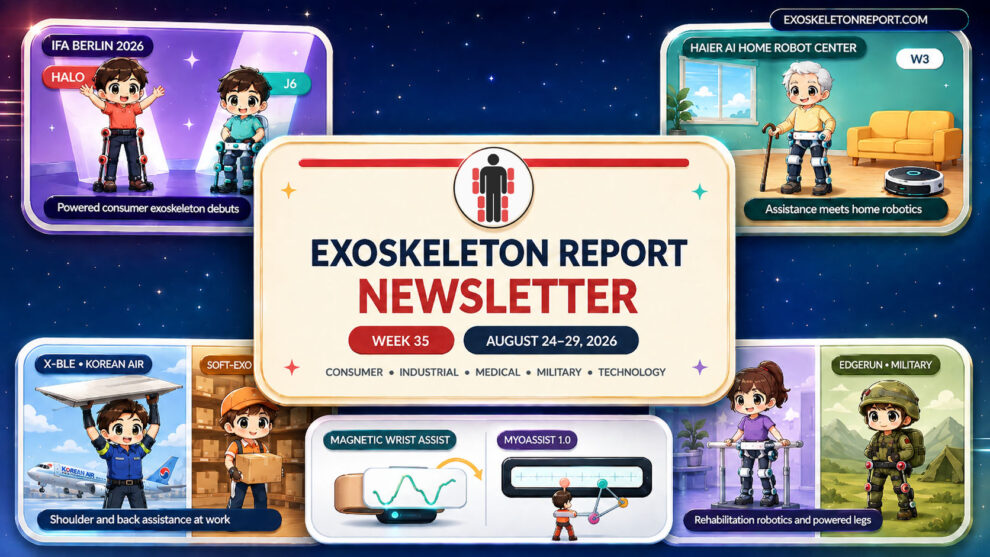
Another action-packed week is now behind us, marked by a spike in activity in consumer and military exoskeletons! It is thrilling to see so many developments in the wearable robotics industry each week (a decade ago, one couldn’t even dream of this volume of news, stories, and job openings). However, it is also a double-edged sword: What is repeated or repackaged information? What is a news development? How does one keep track of it all? Rather than hoarding information, I hope this weekly newsletter helps everyone and brings us together as a community!
Visual Archive:
Text-Only Archive: Week 35: August 24 – 29, 2026
Hypershell to Debut Powered Hip-Knee Exoskeleton – Hypershell Halo at IFA 2026, more information expected in September – PRNewswire
VIGX π6 is Coming to IFA Berlin 2026 | A New Look for Exoskeletons
ExR’s Perspective: Shown, but not demoed at CES 2026, this compact and promising exo is getting closer to being released.
Ascentiz Seeks Developers and Makers for BodyOS Early Builder Program
As mentioned a few weeks back, Ascentiz has opened an Early Builder Program for developers, researchers, students, makers, mechanical designers, and open-source contributors interested in building around its BodyOS modular exoskeleton platform. The company is initially emphasizing third-party attachments and mechanical integrations (including accessory mounts, protective structures, etc…) Selected applicants may be considered for early hardware and SDK access, product-feedback sessions, developer events, and potential grants, collaborations, or project showcases. – Ascentiz
Hypershell Expands Try-On Access Through Owner Host Program
Hypershell has published details of a free Host Program that connects prospective users with existing Hypershell X owners for conversations and, where available, an in-person try-on. Hosts are currently listed across the United States, United Kingdom, France, Germany, Switzerland, the Netherlands, Slovenia, Thailand and other locations. – Hypershell
Haier Opens AI Home Robot Experience Center in Qingdao
Haier has opened what local media describes as China’s first AI home robot experience center in Qingdao, where visitors can try a range of domestic robots in realistic household settings. The showcase includes the W3 powered mobility exoskeleton, reported to weigh 1.75 kg and use dual motors, sensor fusion, and AI-based gait prediction to assist with walking, squatting, and sitting, as well as robots for laundry, floor cleaning, cooking, household monitoring, and fall detection. The center aims to move home robotics beyond online demonstrations by allowing consumers to assess products in person. – Global Village Space
X-BLE MAKES IT POSSIBLE | The X-BLE Shoulder Experience at Korean Air – YouTube
Promotional video for the X-ble Shoulder passive exoskeleton at the Korean Air Airframe Division site.
[Case study] The assist suit “Muscle Suit Soft-Light2” was introduced to the mail room of the Yazaki Parts Manufacturing Center to reduce the burden of internal logistics work in the indirect department.
Yazaki Parts introduced the Innophys Muscle Suit Soft-Light2 in a manufacturing-center mailroom where employees spend about five hours a day unloading, sorting and moving items weighing 5g to up to approximately 30 kg. Innophys reports that a March – April evaluation found reduced perceived lower-back strain and fatigue without disrupting movement through the mailroom’s limited space. – Innophys
Shenzhen MileBot Robotics has announced a strategic financing round worth nearly RMB 100 million from CSC Capital.
The company says it has achieved profitability, that its 2025 business grew by nearly 200%, and that overseas sales represented more than one-third of revenue, although it disclosed no absolute revenue or profit figures. MileBot manufactures rigid lower-limb rehabilitation exoskeletons whose joints use compliant, series-elastic actuators designed for force control, impact absorption, and some backdrivability. MileBot says the new capital will support product development, commercial expansion, and future exploration of brain–computer-interface integration. – EU36Kr
ICORR 2027 Publishes Call for Papers and Submission Deadlines
The 20th International Conference on Rehabilitation Robotics will take place May 31–June 4, 2027, in Lausanne, Switzerland, as part of RehabWeek. Invited topics include wearable robotics and orthotics, assistive and therapeutic robotics, clinical adoption, human-machine interfaces and evaluation methods. – ICORR
Edgerun: The 10 lb Military Exoskeleton – New Military Exoskeleton Company – YouTube
Edgerun Industries is part of Y Combinator’s Summer 2026 batch and aims to build powered legs for soldiers with the goal to add torque to every step under combat load, so a soldier travels farther, carries more, and arrives ready to fight. – https://www.edgerun.com/
Geometry-Informed Magnetic Sensing for Real-Time Control of a Soft Wrist-Assistive Device, published in IEEE Transactions on Instrumentation and Measurement.
Federico Masiero and colleagues have demonstrated a soft wrist-assistive device controlled through magnetic tracking. A small permanent magnet embedded in the moving wristband is monitored by magnetometers in the cuff, allowing a geometry-informed algorithm to estimate forearm pronation and supination without relying on an IMU for joint-angle tracking. – IEEE Explorer
MyoAssist 1.0 Launches Open-Source Virtual Testbed for Assistive Devices
The NeuMove Lab at Northeastern University has released MyoAssist 1.0, an open-source framework for simulating physical interaction between musculoskeletal human models and exoskeletons, prostheses, and other assistive devices. Built within MyoSuite using the MuJoCo physics engine, the release includes 15 modeled devices and assistive environments – covering ankle and hip exoskeletons, powered and passive prosthetic legs, a back exosuit, a manual wheelchair, and a bimanual prosthetic system – alongside human models containing up to 416 muscles. Researchers can combine supported human, device, and terrain components, then develop and compare controllers using reinforcement learning or structured controller optimization through a shared evaluation pipeline. The project is intended to reduce duplicated simulation work, improve reproducibility, and make it easier for researchers and device developers to contribute new models. The accompanying study is currently available as a bioRxiv preprint. – https://myoassist.neumove.org/modeling/devices/catalog
Scientific Reports Opens Exoskeleton Research Collection
Nature Portfolio’s Scientific Reports is accepting submissions for a dedicated “Exoskeleton” Collection focused on real-world research into the design, use and advancement of wearable robotic systems. The collection spans applications ranging from restoring mobility for people with physical impairments to improving strength and endurance in industrial and occupational environments, bringing together work in robotics, sensing and mechanical design. Original research papers will be considered by Scientific Reports, while narrative reviews may be submitted to the sister journal Scientific Reviews. The guest editors are Shaoping Bai of Aalborg University and Emilio Trigili of the Sant’Anna School of Advanced Studies, and the submission deadline is May 27, 2027, with accepted papers published on a rolling basis. – Nature
Special thanks to all of our Patreon subscribers:




Add Comment