

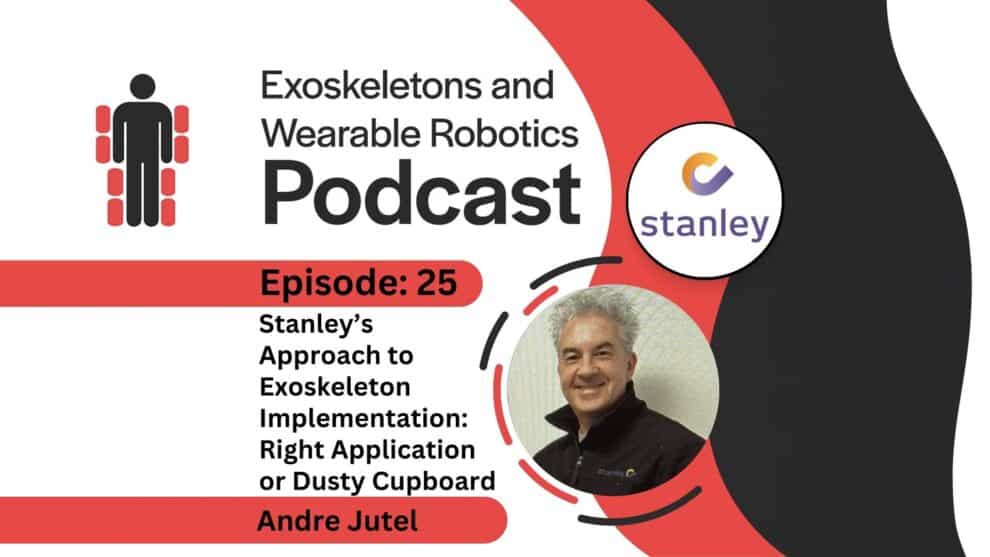
Welcome to episode 25 of the Exoskeletons and Wearable Robotics podcast, and this one is a doozy! Tom and I have changed gears and are focusing on the implementation and integration of occupational exoskeletons for the entire hour with episode guest Andre Jutel, from Stanley Handling Ltd.
Andre has worked for an exoskeleton producer before becoming a full-time division head. He accurately understands the importance of education, communication, setting expectations, and matching the correct device and solution to the ergonomic concern at a job site.
YouTube:
As usual, you can view the full 1h+ entry on YouTube, listen to it on more than a dozen of the major audio streaming platforms, or take advantage of the embedded link right here!
0:00 Episode 25 kickoff: implementor’s perspective (Stanley Handling) 1:38 Meet Andre Jutel: how he got into exoskeletons + what Stanley does differently 10:54 WearHealth + “warehouse app”: matching the right exo to the right use case 25:45 Real-world impact story: “the surgeon who kept operating” (lung transplant) 38:07 Why people resist exoskeletons (and why PPE gets accepted) — change management 47:24 Education & ROI: turning “I don’t want this” into informed adoption (standards matter) 1:03:00 Implementers vs. resellers: why deployments fail (aka the “dusty cupboard” problem) 1:15:33 Wrap-up + community call-to-action
For more, see:
- Exoskeleton technology used in world’s first double lung transplant at Harefield Hospital https://stanleyhandling.co.uk/exoskel…
- Stanley Handling: https://stanleyhandling.co.uk
- Wearable Robotics: https://wearablerobotics.com
Embeded:
Alternatively, you can catch the episode right here:
Streaming:
If you just want to listen to the episode without being on the website, the entire podcast is available on these streaming platforms:
YouTube, Apple Podcasts, Spotify, Amazon Music, Podcast Index, Overcast, iHeartRadio, Podcast Addict, Castro, Castbox, Podchaser, Pocket Casts, Deezer, Listen Notes, Player FM, Goodpods, TrueFans
Transcript Summary:
And of course, for those who would prefer to do some reading, the summary of the episode transcript is below:
A recurring theme is education versus sci-fi expectations. Andre tells a story about someone calling to borrow an exoskeleton as a movie prop, expecting something like RoboCop, only to realize occupational exoskeletons are practical, task-specific tools that don’t resemble Hollywood fantasies.
From there, the discussion turns to how Stanley positions itself: not tied to a single manufacturer, but acting as a solutions provider that matches the right device to the job and site. Andre emphasizes the need to combine subjective feedback with objective measurement so clients can make decisions based on evidence, not sales opinions.
Andre explains how their evaluation and selection approach is structured around clear work “use cases,” which he groups into three broad movement buckets: floor-to-waist lifting, waist-and-out-in-front tasks, and waist-and-above/overhead work; because it’s rare for one exoskeleton to do all three well.
They also dig into real deployment constraints that are often overlooked in marketing: things like battery restrictions (including hazardous environments), food or high-sanitization contexts, and tight spaces, factors that can immediately rule out certain exoskeleton categories.
One of the strongest proof-of-value moments is Andre’s account of being contacted by a cardiothoracic surgeon seeking help to extend his career. After trialing a device, the surgeon reports completing a double lung transplant while wearing an exoskeleton, highlighting that the right support can matter even in high-stakes precision work.
A major barrier discussed is human resistance to change, even when benefits exist. Andre argues education has to be honest: exoskeletons can be hot, uncomfortable at first, and people will joke about them. He compares adoption to other accepted safety norms, using safety shoes as an analogy to explain why protecting backs and shoulders should be taken seriously.
Cost and liability are part of the implementation argument. Andre contrasts the price of a passive exoskeleton with the total cost of even a “minor” back injury: time off, medical visits, insurance and claims, plus the longer-tail legal exposure that may arise later.
The episode closes on a broader note: more education and fewer gimmicks are needed, and while robotics will continue to advance, it may take years to fully replace people. In the meantime, the messiest and most physically risky tasks tend to remain with humans; making practical wearable assistance and better implementation support more important, not less.
Sadly, there are only so many hours in the day and here are some of the topics that we didn’t get to discuss in this episode:
- How to talk to management
- How to talk to upper management
- How to explain return on investment (ROI)
- How to talk about an exoskeleton in the context of the stock market and a 1–2 year life cycle (in terms of companies)
- What to do when you have a contract or a subcontractor (especially when they “don’t have the defenses / don’t have people looking out for them”)
As always, thank you for listening & special thanks to our Patreon members for supporting the podcast!
Add Comment