

YouTube video version:
Newsletter Version:
Text Only Version:
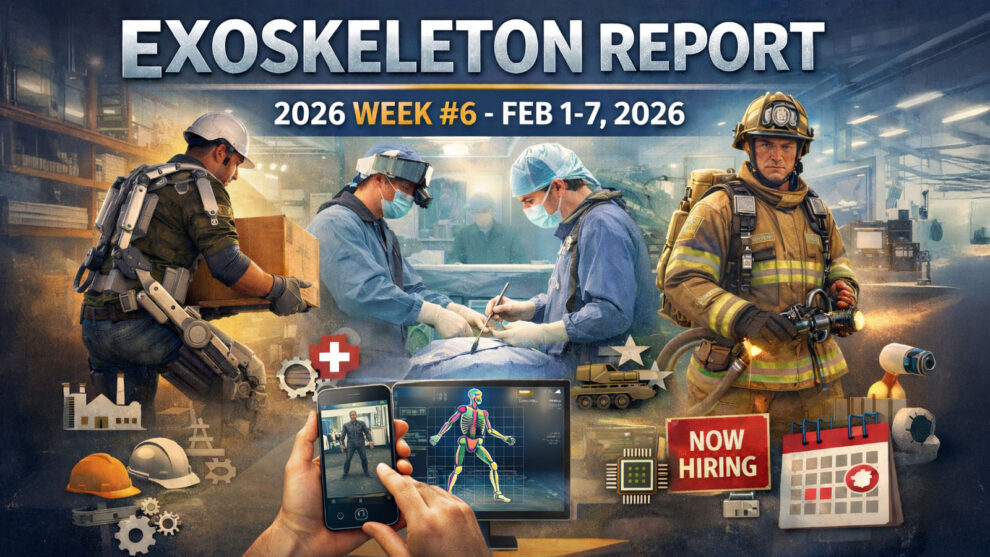
Japan’s Assist Suit Association just launched a new “Assist Suit Concierge” consultation desk to help organizations figure out which assist suit fits their work tasks and pain points—before spending time (or budget) on demos and procurement. The service is positioned as neutral (association staff) and can guide you through selection/comparison criteria, budget considerations, and next steps, including connecting you to relevant manufacturers or arranging trial experiences. It also supports requests for talks/lectures, including by association staff and certified physical therapists.
Who it’s for: company/organization/government stakeholders. Cost: free. How it works: apply via the dedicated form, then coordinate scheduling and (if needed) a short pre-survey before an online consult (e.g., Zoom).
Evaluation of a markerless motion capture to measure 3D joint kinematics during occupational lifting tasks using mobile devices
OpenCap gets a lifting upgrade. OpenCap (the smartphone-based, markerless motion capture system) was originally trained mostly on athletic/locomotion-type movements, so its joint-angle estimates can get pretty rough when you use it for workplace lifting. This paper retrained OpenCap’s “marker augmentation” AI on a large dataset of manual lifting trials, so it could better handle lifting-specific motion and occlusions (especially in the upper body and trunk). The result: average 3D joint-angle error dropped from about 15° to ~9.5° (≈37% lower), with the biggest accuracy gains in upper-body joints and trunk kinematics. They also showed you can do this with two smartphones (a third camera didn’t meaningfully improve accuracy), supporting the idea that phone-based 3D kinematics could become practical for field ergonomics and lifting risk assessment.
Use of an Intraoperative Head, Neck, and Back Support Exoskeleton on Surgeons’ Pain and Posture
A Feb 2026 Annals of Surgery field study (12 surgeons, 48 open procedures) found that the passive NekSpine intraoperative exoskeleton significantly reduced surgeons’ neck discomfort and cut time spent in extreme-risk neck/torso postures, with minimal workflow disruption and strong willingness to reuse (22/24 cases). Objective IMU data showed ~4.8° less average neck flexion (33.4°→28.6°). Workload ratings for mental/physical demand rose slightly—suggesting a learning curve—but overall usability was favorable, positioning neck-support exoskeletons as a practical intervention for long, flexion-heavy open surgeries.
Efficacy of Wearable Exoskeleton (Angel Legs M20) for Gait Recovery in Patients With Stroke: A Multicenter Randomized Controlled Trial
The exoskeleton didn’t improve walking independence more than standard therapy, but it was associated with a modest additional gain in lower-limb strength (Motricity Index).
German Bionic’s powered exoskeletons are currently being evaluated in real-world workflows as part of the ‘ExoFire’ project with the Berlin Fire Department and Charité – Universitätsmedizin Berlin. Results are expected in early 2026.
Hunting the Lost Pieces of Hardiman: The World’s First Powered Exoskeleton
What happened to the world’s first full-body powered exoskeleton? In this episode, Matt and I uncover the wild history of Hardiman, GE’s ambitious 1960s project that aimed to amplify human strength dramatically…
Episode 281 of EHS On Tap, Dr. Karl Zelik, Co-founder and Chief Scientific Officer of HeroWear, talks about a new study on the use of exoskeletons in the workplace.
Advancing Exoskeleton Adoption Through Safety and Standards with Matthew Dickinson
“…Rather than focusing on hype or headlines, Matthew brings us into the less-visible (but critically important) work happening around safety certification, standards, and user-centered design…”
Systematic Evaluation of Hip Exoskeleton Assistance Parameters for Enhancing Gait Stability During Ground Slip Perturbations
A new arXiv preprint from Maria Tagliaferri and Inseung Kang (CMU) tested whether a bilateral hip exoskeleton can improve reactive stability during unexpected forward slips. In 8 healthy adults, they systematically varied hip-torque magnitude and duration and found that even a simple hip-extension-only torque “burst” can improve reactive stability—if the timing/duration are tuned well, while energy-optimized controllers may be the wrong shape for stability tasks. They also saw large person-to-person differences in the “best” settings, reinforcing the need for personalized, stability-first control (their stability-optimal parameters reduced whole-body angular momentum (WBAM) range by ~25.7% vs an energy-optimized controller).
Real-Time Estimation of User Adaptation During Hip Exosuit-Assisted Walking Using Wearable Inertial Measurement Unit Data and Long Short-Term Memory Modeling
A new Biomimetics paper proposes a practical way to track “user adaptation” to a hip exosuit in real time using only thigh-mounted Internal Measurement Units (IMUs) and gait consistency as a proxy for whether the user has learned to take advantage of assistive features, rather than directly estimating metabolic energy use.
Special thanks to all our Patreon supporters, and apologies for the error in the EHS Leader’s podcast descriptor field.



Add Comment