

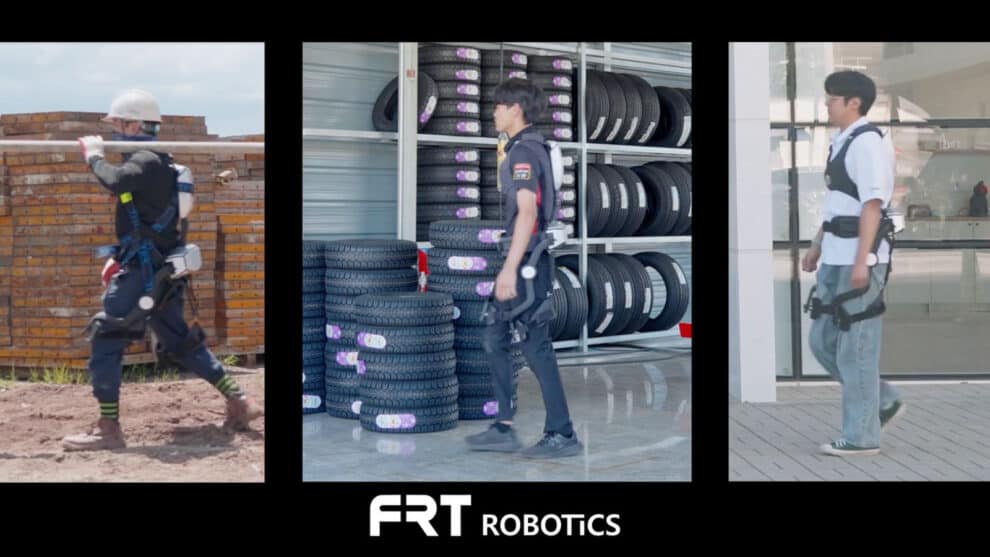
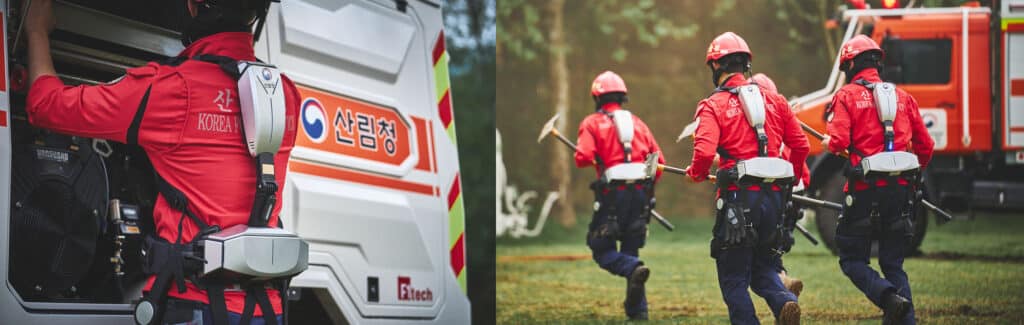
FRT Robotics is a Korean exoskeleton company that develops and supplies wearable robots designed for real-world use in industrial and disaster safety environments. Beyond logistics, construction, and eldercare, the company has also supplied its equipment to public-sector organizations, including the Korea Forest Service and the National Fire Agency. In these settings, its wearable robots are deployed as operational tools to reduce physical strain during high-intensity disaster response activities, including wildfire suppression, firefighting, rescue, and emergency medical operations.
What sets FRT Robotics apart is that its wearable robots have progressed beyond pilot demonstrations and are now in continuous, on-site operation in public-sector environments. As of 2025, the company’s flagship model, StepUp 4.0, reached annual production and sales of approximately 1,000 units. Among these, 150 units are currently in use by the National Fire Agency and 206 by the Korea Forest Service, which actively deploy them in wildfire suppression operations. The company has registered its products as Innovative Products with the Public Procurement Service of Korea and continues to refine its models based on feedback accumulated through real-world field deployment.
In parallel, FRT Robotics has conducted proof-of-concept (PoC) deployments with more than 50 private-sector companies across construction, logistics, and manufacturing, demonstrating the scalability of wearable robots across diverse industrial settings.
FRT Robotics prioritizes field practicality over peak performance. Rather than pursuing complex automation algorithms, the company emphasizes intuitive operation and predictability, placing user trust and safety at the center of its design philosophy. CEO Jaeho Jang explains, “Trust comes from consistency – when a user moves, the system must respond in the same way every time,” underscoring predictability as the most critical design principle for safety-critical equipment.
Supporting Humans, Not Replacing Them: Enhancing the Sustainability of Labor
The core value of industrial wearable robots lies not in automation but in enhancing the sustainability of human labor. Repetitive heavy lifting and prolonged material handling have long been identified as leading causes of industrial injuries and productivity loss. Wearable robots are emerging as a practical solution that redistributes physical load, reduces fatigue accumulation, and enables skilled workers to remain in the field longer.
This philosophy is embodied in StepUp Neo, FRT Robotics’ new product launched in 2026. Through extensive field research, the company identified the lower back and shoulders as the most commonly affected areas among industrial workers. StepUp Neo was therefore developed as a passive system that selectively supports these regions to help prevent chronic musculoskeletal disorders caused by repetitive bending and overhead tasks.
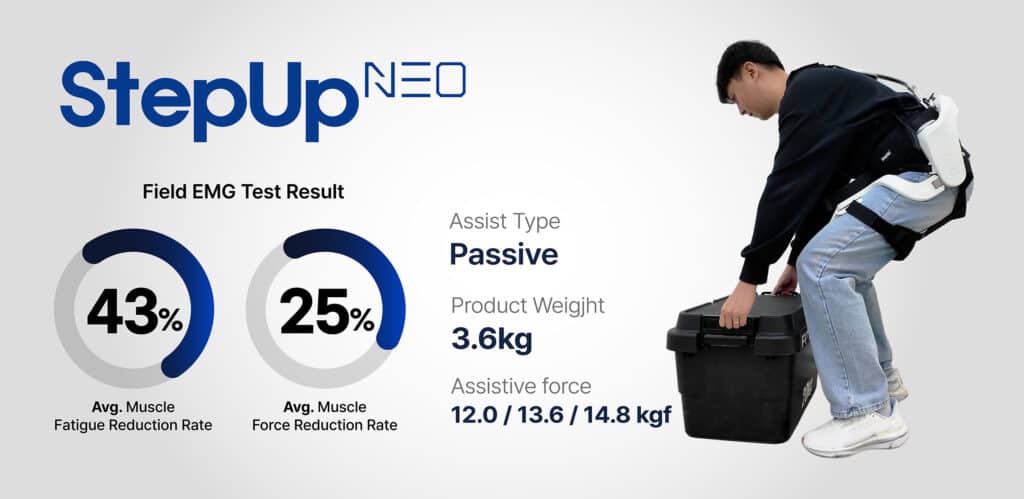
StepUp Neo is an industrial wearable robot engineered to provide selective assistance to the lower back and shoulders during repetitive, load-intensive work. It is intended for use across a wide range of high-intensity work environments, including construction, logistics, manufacturing, eldercare, agriculture, maintenance, and disaster response. The system is also designed to be easy for female workers to use, broadening accessibility across the workforce.
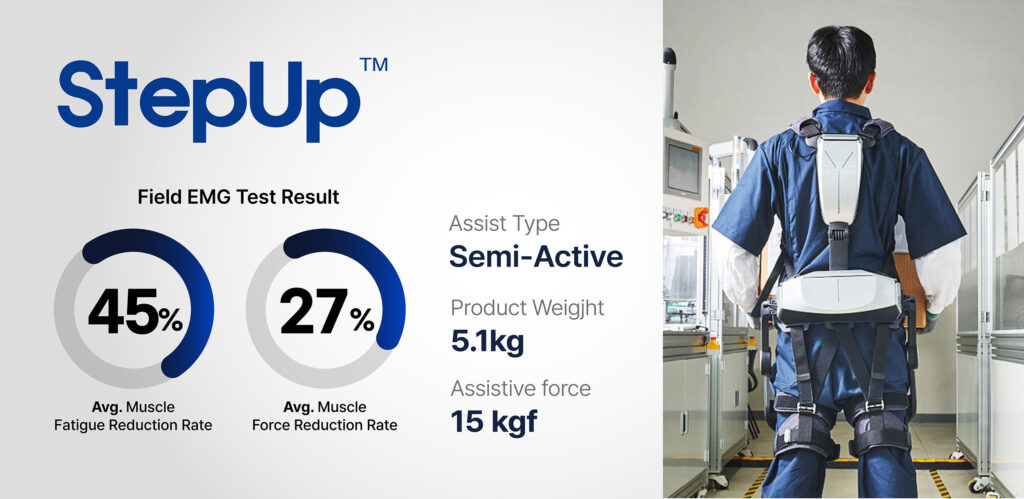
In simulated cargo-handling tests that replicated real-world working conditions, StepUp Neo demonstrated a reduction in average muscle fatigue by up to 43% and a decrease in muscle activation levels by approximately 25% when worn. These results confirm the system’s effectiveness in mitigating physical strain during repetitive lifting and overhead work, thereby reducing fatigue accumulation and the risk of musculoskeletal injuries.
Such performance does not stem from raw power output, but from a design approach that prioritizes safety and long-term usability. StepUp Neo features a modular mechanical architecture that enables controlled assistance by body region. Its ergonomic exoskeletal design allows natural movement without restricting the wearer, while integrated motion-responsive mechanical control mechanisms ensure consistent assistance aligned with posture changes and work rhythms. This approach minimizes excessive assistance and prevents unexpected system responses during extended use.
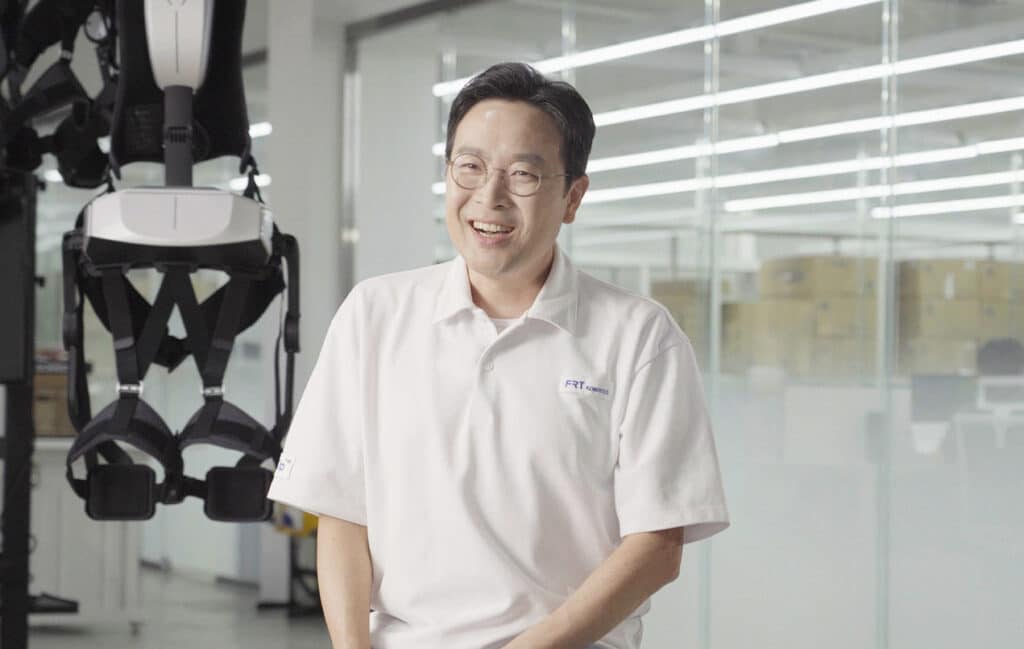
“Initially, we believed that providing more force was the key,” says CEO Jang. “But in real-world environments, we realized that preventing injuries and enabling people to work longer matters far more than simply becoming stronger.” StepUp Neo is positioned not as a replacement for automation systems, but as a safety infrastructure that complements human capabilities and supports sustainable labor. This evolution reflects a broader shift in industrial wearable robots -from powerful machines to technologies that work alongside people.
From Exoskeletons to Physical AI: Scaling Through Data
FRT Robotics’ business model extends beyond product sales and is built on a structural strategy that leverages field data accumulation to advance next-generation robotic intelligence. The company defines exoskeletons not as finished products, but as physical interfaces for capturing human motion and task execution in industrial environments. Similar to how large-scale deployment enabled data accumulation in the electric vehicle industry, FRT Robotics aims to secure Physical AI data by scaling the adoption of wearable robots across industrial sites.
Data generated in high-intensity environments – such as repetitive lifting, load transport, disaster response, and military logistics – represents a critical learning asset that captures how humans actually work under physical load. This data will form the foundation for future human–robot collaboration, including humanoid robotics.
This vision is reflected in the company’s product portfolio strategy. Rather than focusing on a single model tailored to a specific industry, FRT Robotics has built a multi-layered lineup that includes industrial worker exoskeletons, public-sector disaster and safety models, and defense-oriented and special-purpose equipment. Beyond revenue diversification, this approach is designed to broaden the scope of motion, load, and fatigue data collected across diverse working environments.
The company’s product evolution follows a recurring cycle of technological validation, field deployment, and generational advancement. Beginning with the early Hyper series in 2015, FRT Robotics transitioned to large-scale deployment in industrial and public-sector environments with the StepUp series from 2019 onward. In 2025, these accumulated field experiences culminated in the release of the Neo model. Looking ahead, the company plans to expand into upper-body exoskeletons and systems that support locomotion during load transport, ultimately evolving wearable robots into full-body physical interfaces.
At the center of this roadmap is Powered Neo, currently under development, which integrates powered actuation for both lifting assistance and load-bearing locomotion. While the existing StepUp Neo focuses on passive lower-back protection and assistance during repetitive industrial tasks, Powered Neo incorporates motors to extend assistance to walking under load, including material transport, slope traversal, and sustained movement with heavy payloads.
Powered Neo is equipped with additional IMU (Inertial Measurement Unit) sensors and encoders to recognize user movement patterns, enabling AI-driven learning architectures. The system continuously collects and analyzes motion, load, and environmental data, which will be further developed into Physical AI technologies.
FRT Robotics’ growth trajectory reflects the effectiveness of this structural strategy. Early-stage operations focused on technology development and limited pilot revenue, but growth accelerated rapidly after large-scale public procurement and sustained industrial deployment. The company likens the current phase of wearable robot adoption to the early expansion of electric vehicles, with a long-term vision centered on building a collaborative ecosystem where humans and humanoid robots coexist and work together.
If the widespread adoption of exoskeletons represents the electric-vehicle moment, then the vision beyond it is a future society where humans and robots work side by side. By transforming countless instances of human movement under industrial load into the foundation of future robotic intelligence, FRT Robotics is establishing a new benchmark for the next generation of the robotics industry.

Company Info.
Email: marketing@frtrobotics.com
Korea Office: 2/3F, 170 Dosan-daero, Gangnam-gu, Seoul
U.S. Branch: 3003 North 1st Street #221, San Jose, CA 95134
Web Info.






Add Comment