

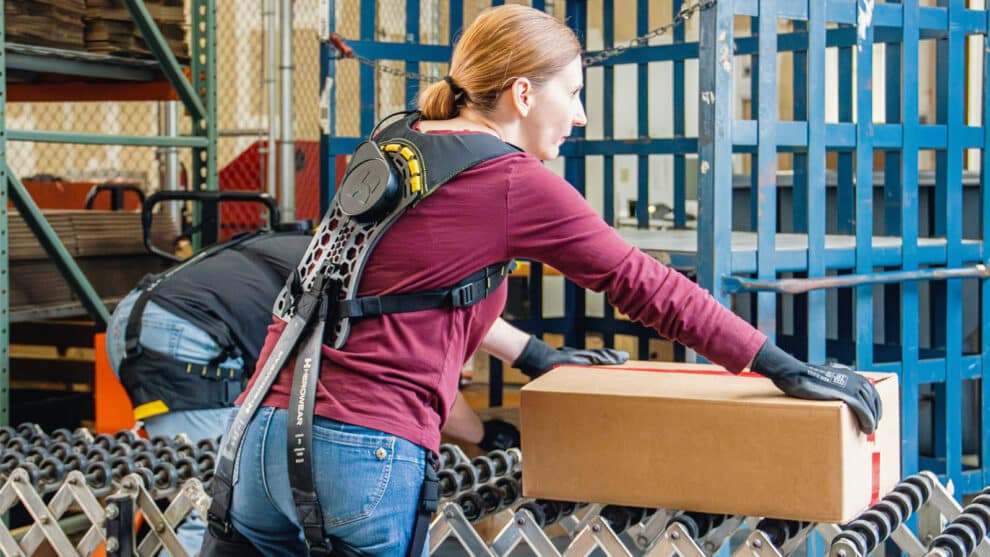
One of the biggest adoption blockers for occupational exoskeletons isn’t the hardware or its cost, but the fear of the unknown.
Safety leaders and frontline workers tend to ask the same, very reasonable questions: What happens after months of use? Are we just shifting injuries from the low back to the knees, hips, or shoulders? Are we turning workers into test subjects for a shiny new technology? As HeroWear’s Dr. Karl Zelik put it in a recent post, the industry has plenty of demos and first impressions, but far less public data on what sustained, real-world use looks like over time.
This is why HeroWear’s newly published, multi-site “industry study” around its Apex 2 back-assist exosuit is worth attention. It’s not a controlled clinical trial, and it doesn’t magically solve all longitudinal research gaps, but 311,000+ work hours across five distribution centers is far from “nothing.” Actually, the newly published data is closer to a “longitudinal industry study using a natural experiment design.”
What Is HeroWear Reporting:
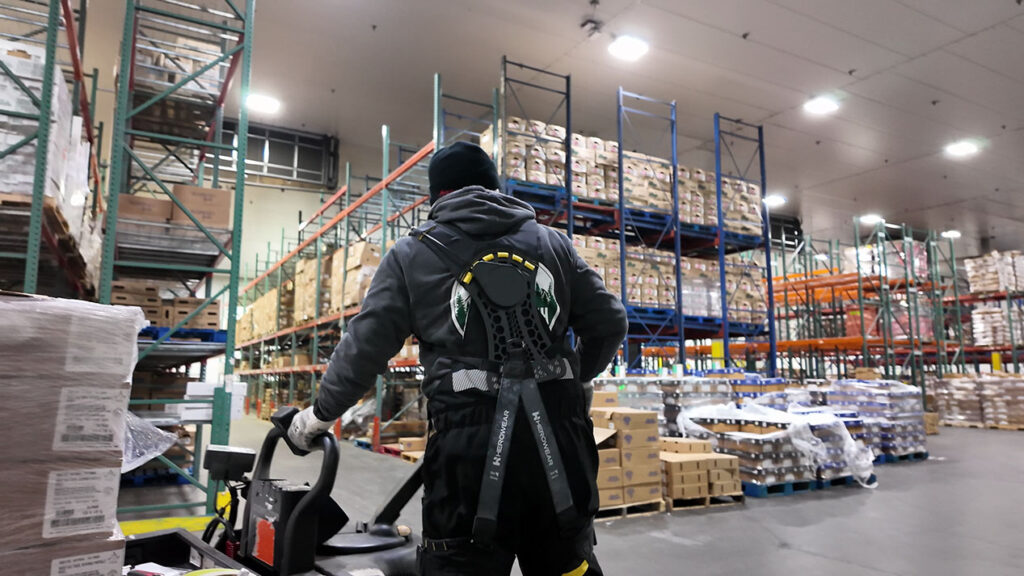
HeroWear says five distribution centers tracked injury outcomes over 8–23 months of sustained use, totaling 311,000 work hours, which they frame as roughly the equivalent of 155 full-time workers wearing exosuits regularly for a year, with measured results and observations:
-
Improved Safety: 62% reduction in total strain & sprain injury rate, from 10.2% historically to 3.8% (per 100 workers per year) after exosuits were deployed.
-
Fewer Injuries: Injuries shifted from about one every 20,000 work hours historically to fewer than one every 50,000 work hours, and none of the post-deployment injuries were back injuries.
-
Critically: no evidence that risk was transferred elsewhere in the body, addressing the common concern that back-assist devices might simply “move the problem.”
The communication emphasized that the team looked beyond the lower back and tracked total strain/sprain injuries across the body, specifically to test the “risk transfer” fear.
Why this matters to adoption: nobody wants to be the experiment
In real workplaces, innovation competes with day-to-day reality: injury risk, production pressure, turnover, tight margins, and a workforce that’s understandably skeptical of anything that feels too new. In the extreme case, slowing down a car production line can cost the company one vehicle every two minutes.
HeroWear’s materials describe how these distribution centers didn’t jump straight to exosuits. They explored other ergonomic interventions first, weighing cost, practicality, likelihood of worker acceptance, and evidence of efficacy, then moved to exos only after exhausting other options. That’s exactly how adoption typically works when safety teams are being responsible.
They also highlight an under-discussed success factor: implementation. These sites piloted multiple exos, rejected some as bulky/uncomfortable/too complex, and leaned heavily on worker input to build buy-in. HeroWear notes that onboarding support and workflow integration are key to sustained acceptance, because without real, sustained use, “long-term data” never materializes.
A quick reality check: what this study is and isn’t:
What it IS
-
A longitudinal (long-term) industry injury study — in research/industry shorthand, “longitudinal” and “long-term” are commonly used interchangeably.
-
Longitudinal data from real deployments (multi-site, months of use, lots of cumulative hours) used to evaluate injury outcomes over time.
-
A longitudinal study using a natural experiment design (observational “before vs after” in real operations, not lab-controlled).
-
Potentially one of the largest long-term industry datasets in the exoskeleton space, especially if narrowed to publicly shared injury-rate outcomes tied to a specific exosuit deployment.
What it ISN’T
-
Not a longitudinal RCT (randomized controlled trial), no random assignment, no blinded control group, and therefore not the “highest level” causal evidence.
-
Not a controlled cohort study with rich individual-level tracking (e.g., standardized repeated measurements per person, detailed covariates, precise exposure-time per worker).
-
Not guaranteed to generalize to all exoskeletons or all use cases, even if the results are strong, they’re evidence for this device + this context + this implementation approach.
So no, this doesn’t prove Apex 2 is solely responsible for every improvement in a strict cause-and-effect sense. But it does add a meaningful datapoint that the field badly needs: sustained deployments, across multiple sites, with a focus on both injury reduction and unintended consequences.
Exoskeleton Report Takeaway
The exoskeleton industry has no shortage of marketing, prototypes, and flashy demos. What it needs are more success stories. More transparent, sustained, real-world reporting that directly addresses the opportunities and fears that guide wearable tech adoption.
The 311,000 work hours across five distribution centers, with reduced total strain/sprain injury rates and no detected increase in injuries elsewhere, is exactly the type of evidence that helps safety teams, ergonomists, and workers move from uncertainty to informed decisions regarding this promising technology.
Find Out More:
-
Press release (Jan 21, 2026): “Distribution Centers Using Exoskeletons Cut Total Strain and Sprain Injury Rate by 62%, New Long-Term Data Shows” (Business Wire), LINK
- Strains and Sprains Case Study, How Warehouse Workers Reduced Strain and Sprain Injuries, LINK
All images courtesy of HeroWear.

Add Comment