

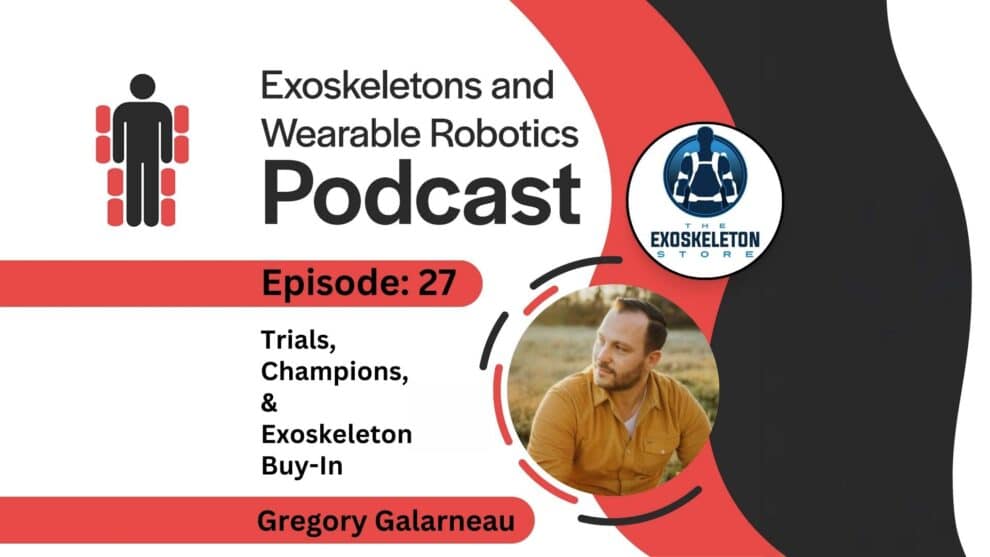
In Episode 27 of the Exoskeletons and Wearable Robotics Podcast, we sit down with Gregory Galarneau of The Exoskeleton Store for a grounded discussion on what occupational exoskeleton adoption actually looks like in the field. Rather than staying at the level of theory, this episode digs into how Gregory entered the space through industrial automation, why he saw exoskeletons as a practical answer for tasks that could not easily be automated, and how The Exoskeleton Store grew into a major North American distributor focused on matching real workplace problems with real wearable solutions.
The conversation then moves into the realities of implementation: why exoskeletons often need a “try before you buy” approach, how worker feedback can make or break adoption, and why success depends on much more than just a product spec sheet. Gregory shares lessons from customer trials, the personal nature of body-worn technology, and the differences between top-down deployments and demand driven by real worker need. By the end, the episode becomes something close to a field report on the current occupational exoskeleton market, including where adoption is working, where it stalls, and what trends may shape the next phase of growth.
Thank you to all of my Patreon supporters for making this possible. Your support is both financial and moral, and it helps me continue producing podcast episodes, transcripts, and independent coverage of exoskeletons and wearable robotics. I really do appreciate it, and I hope that if you enjoy this content, you would consider becoming a Patreon supporter as well: https://www.patreon.com/ExoskeletonReport/membership
YouTube Version:
Main Topics: 00:00 Introduction to Episode 27 and Gregory Galarneau of The Exoskeleton Store 02:23 How Gregory Galarneau got into occupational exoskeletons from industrial automation 04:46 The first customer story that changed the mission of The Exoskeleton Store 08:30 Why exoskeletons need to be tried before they are bought 13:05 Why exoskeleton implementation is different from traditional automation 16:37 A successful exoskeleton rollout: trial, buy-in, and safety award 24:54 Cautionary tales: why some exoskeleton projects fail 28:32 Hunting elephants vs. helping small businesses adopt exoskeletons 32:54 Culture, Japan and Europe, and why North America may be adopting more slowly 55:39 Where the industrial exoskeleton market is heading in the next 5 to 10 years.
Streaming:
If you prefer to listen to this episode, it is already available on all major audio platforms: Apple Podcasts, Spotify, Amazon Music, Podcast Index, Overcast, iHeartRadio, Podcast Addict, Castro, Castbox, Podchaser, Pocket Casts, Deezer, Listen Notes, Player FM, Goodpods, TrueFans
For more on The Exoskeleton Store:
Visit: https://www.theexoskeletonstore.com
Summarized Transcript:
Episode 27 centers on a practical, market-facing conversation with Gregory Galarneau, founder of The Exoskeleton Store, which Bobby introduces as the largest distributor of exoskeleton technology in North America. Rather than focusing on theory or lab testing, the discussion is framed as a look at what is actually happening in the field: how customers discover exoskeletons, what makes them adopt them, and why some projects succeed while others stall.
Gregory explains that his path into exoskeletons came through roughly two decades in industrial automation and robotics, especially in warehousing, manufacturing, and food processing. In that world, he repeatedly saw tasks that were too manual and repetitive to automate because of cost or space constraints. When he later encountered exoskeletons inside a manufacturing setting, he immediately saw them as a practical way to support workers where full automation was not realistic.
A major early theme is that Gregory did not enter the industry from hype, but from frustration and curiosity. He says it was difficult to understand the market, compare products, interpret specifications, and even imagine what published support values would feel like in real life. That experience pushed him to research the market more seriously and ultimately build a business that could help customers make sense of the options.
The emotional turning point in the episode is Gregory’s story about his first customer, a property-maintenance business owner with severe shoulder problems. That customer had exhausted surgical options and was effectively down to either selling his business or relying on painkillers. Gregory sent him an upper-body exoskeleton on a trial basis, and after two weeks, the customer told him it had changed his life by letting him work above chest level again without immediately being sidelined by pain. Gregory connects that experience to his own father’s back injury and says this was the moment that shaped the company’s mission.
From there, the discussion shifts into how The Exoskeleton Store approaches the market. Gregory emphasizes that they do not try to sell just any device; they want products with time on the market, credible data, and a clear fit for specific body areas and tasks. One of his key points is that there is no single exoskeleton that does everything well, so success depends on matching the right suit to the right use case rather than forcing one product into every situation.
A large portion of the podcast is about implementation. Gregory strongly argues for a “try before you buy” model, because many buyers cannot translate research papers or torque numbers into real-world expectations. He describes a process that starts with a virtual discovery meeting and, when possible, task videos; then, for many customers, on-site visits where multiple devices are tried side by side. The goal is to let workers experience different systems directly and decide what actually fits their tasks and comfort preferences.
Another important theme is that exoskeleton adoption is deeply personal because these devices are worn on the body. Gregory uses a clothing analogy: some people adapt easily, some tolerate it but dislike aspects of the fit or feel, and some simply reject it outright. He says this is one of the biggest differences between exoskeleton implementation and traditional automation projects, because the people wearing the equipment have to provide qualitative feedback about comfort, heat, and whether they would actually use it every day.
When asked what kinds of customers adopt exoskeletons most successfully, Gregory says the strongest pull often comes from real need: workers trying to offset pain, fatigue, or repetitive strain. He contrasts that with top-down mandates, where a company simply tells employees to wear a device because management thinks it is a good idea. In his view, the best projects are usually driven by genuine demand from the work itself, while the hardest cases include both younger workers who feel invincible and older workers who may need help most but are reluctant to change late in their careers.
The podcast also offers a concrete example of a successful rollout. Gregory describes a company that ran a two-month trial with the right decision-makers involved and with a strong internal champion in human resources. After seeing real value, the company expanded use of the suits, later received a safety-related award, and even began using exoskeletons as training devices to help protect new hires while their bodies adjusted to physical work. That example leads into a broader discussion of stakeholder alignment, KPIs, and project management, with Gregory arguing that exoskeleton projects succeed when they clearly show value, align with business goals, and communicate outcomes to everyone involved.
On the cautionary side, Gregory says many failed projects come from poor intent or poor buy-in. Sometimes companies invite vendors in for demonstrations without any serious plan to implement the technology, which wastes time and disappoints workers who briefly see real benefit. Other failures happen when exoskeletons are pushed onto teams without involving stakeholders or without giving workers a voice. Since these are body-worn devices, people’s feelings about comfort, identity, and control matter much more than in many other industrial technology rollouts.
One of the most interesting market insights in the episode is Gregory’s argument that the industry may have spent too much time “hunting elephants,” meaning chasing massive enterprise orders from very large companies. Based on his experience with more than 250 customers, he says the more promising current market is often smaller, family-like businesses with 50 employees or fewer. In those firms, owners and managers are closer to workers’ day-to-day fatigue and pain, approvals are simpler, and there is often more genuine willingness to adopt a helpful solution.
The episode closes on the idea that exoskeleton adoption is not just about product performance, but about company culture, project champions, and broader market forces. Gregory notes that in other regions, aging workforces, insurance structures, subsidies, or stronger safety incentives may push adoption faster. In North America, he suggests that the technology is still not widely known and that better marketing and a clearer understanding of its real-world value may be needed before adoption accelerates. Bobby closes by describing the conversation as a “mini market report” on occupational exoskeletons based not on theory, but on what companies in the field are actually doing.
This podcast is brought to you with the generous support of our Patreon members!
If you love this content, consider becoming a supporter as well!

Add Comment