

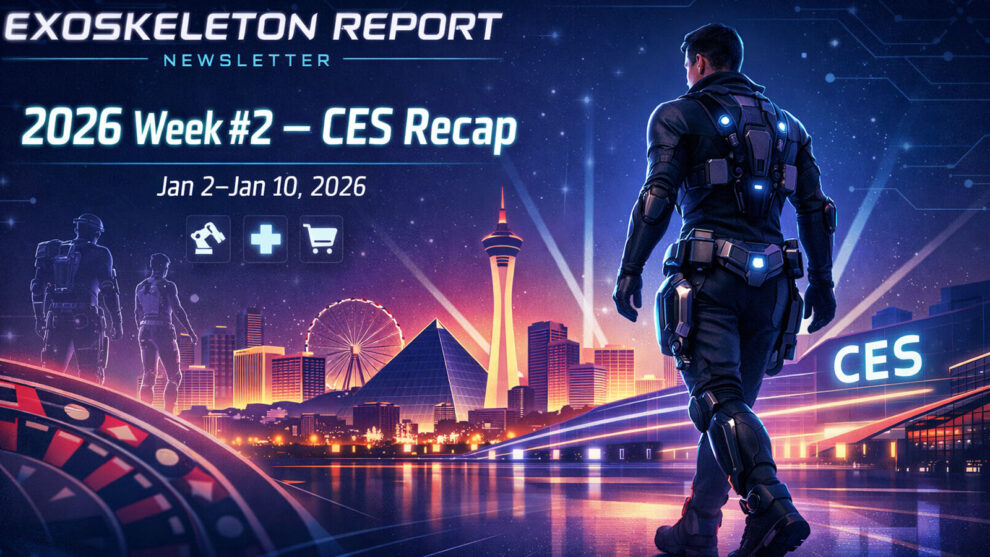
The second week of 2026 was dominated by CES 2026 Las Vegas, which saw no less than 21 Exoskeleton Producers vying for the attention of media, influencers, and investors. Without a doubt, interest in human augmentation is increasing.
Text Only Version:
Even though I have been to 20+ exoskeleton-related conferences or meetings, this year was the very first time I had the opportunity (thanks to Hypershell) to attend CES in Las Vegas! This newsletter will be a mix of news + what I saw at the trade fair.
Being a Consumer Electronics Show, I didn’t expect to see too many occupational ONLY exoskeleton booths last week.
– I didn’t have time to get up close, but it seemed that Hyndai had their shoulder support exoskeleton and two-screen simulators similar to the ones at A+A ExoPark Düsseldorf.
– The Turkish HQ company Ocalis was also at CES with its full line of exoskeletons, and its display area was diagonally from Agade’s.
– Finally, I had the pleasure of trying out the WithForce back support exoskeleton from South Korea… essentially a spring device, with heat-activated shortening filament and a lever arm at the back.
Unfortunately, I didn’t have time to visit the German Bionic booth. Now I really have to go and update the catalog to include all of the devices I have seen!
There were very few medical devices at CES (or at least I wasn’t in that section… this event was spread out across multiple buildings and locations all over town), but Cosmo Robotics (ExoAtlet) had a very large and well-organized booth. I was finally able to see their Bambini and other exoskeletons up close (including a shoulder-hip support occupational prototype). I plan to edit and release videos of all the booths on my TikTok channel over time. Fourier had a booth, but it was only for their humanoid robot (no exos). (KAIST didn’t have an exo with them either.)
Consumer exoskeletons were the star of the consumer electronics show (who would have guessed). It was physically impossible to stop and talk to everyone in just one day, but I did my best. In chronological order, I saw the booths for:
1. Hypershell – Hypershel Ultra – hip
2. ULS – (normally an occupational exo developer, they had both an occupational and their consumer hip device, Viatrix)
3. Mebotx Intelligent Technology (Suzhou) – Xtand – single motor for the hips, one motor each for the knees
4. VIGS (Kenqing, aka Luban) has their single-motor powered hip exo for people to try, and their occupational exos were just displayed on posters.
5. YRobot – POWRKNEE
6. Dephy – SideKick – significantly changed from two years ago, it now has a magnetic shoe clip, a lever arm to move it away from the shin, and actuates behind the leg rather than to the side.
7. Sumbu Innovations – Sumbu S3 – hip exoskeleton
8. ATDev – sit-in place knee exo
9. Dnsys – X1 (hip), Z1 (knee)
10. Ascentiz – modular hip only and/or knee, shoulder
11. SKIP – Mo/Go – knee
12. WIRobotics – WIM – single motor hip
13. Heimgear – hip exo (they have other models and use cases on their website)
Unfortunately, there just wasn’t enough time to cover all the ground and try out every demo, but at least I physically made it to 18 exoskeleton booths in one day!
How to choose Powered Exoskeleton? Watch This Video! VIGX vs HYPERSHELL : Detailed Comparison
Personal Take: Easily the best and most detailed exoskeleton comparison video of all time. Is this what the Exoskeleton Report should be doing in the future?
MaRS Capital Program: 1:1 Support for Seed & Series A Fundraising (Canada)
A program helping high-potential Canadian startups raise seed and Series A rounds faster, with stronger strategy, narrative, and investor connections, and experience working with exoskeleton programs.
German Bionic received an inaugural “Lara Lewington Health Tech Award” at CES 2026 (a new award launched by BBC/ITV tech journalist Lara Lewington to spotlight human-centered health tech).
💡 I asked ChatGPT to analyze all the CES 2026 exoskeleton media coverage from the past week and summarize the good, the bad & the ugly—what’s being emphasized & what’s completely missing from the conversation.
Here were the insights (and I largely agreed):
🟢 The Good: Exoskeletons feel “real” now
CES coverage frames exoskeletons less like sci-fi or future tech & more like wearable tools: lighter, modular, faster to put on & usable outside the lab or clinic. The narrative has clearly shifted from “someday” to “this is almost normal gear.” That’s progress.
🟢 Broader use cases are finally visible
We’re seeing consumer, medical & industrial exos discussed side-by-side. Fatigue reduction, endurance & mobility support are described in human terms—not just specs. That’s an important evolution for societal awareness of exos.
🟡 The Bad: Lots of (device-centric) claims, very little validation
Most CES articles repeat headline features—weight, battery life, assist force, “AI-powered” adaptability—but rarely include independent data or human-centered outcomes.
“AI” is often shorthand for “trust us—the exo feels natural and moves with you.” However, these claims are rarely backed by clear validation & when metrics are presented, they tend to be gadget-centric rather than human- or outcome-focused.
🟡 Long-term impacts are barely mentioned
There’s almost no discussion of long-term use, comfort, safety, adherence, or sustained real-world impact. What happens after months of use? Are people still wearing these devices months or years later? CES coverage is overwhelmingly first-impression–driven (“this is so cool!”). Power, performance & AI buzzwords are celebrated, while true user experience & long-term societal impact are largely absent from the conversation.
🔴 The Ugly: Societal impact is implied, not demonstrated
CES coverage suggests exos could transform mobility, work & aging—but offers little evidence of real-world outcomes:
• independence improvements
• physical activity impacts
• quality-of-life metrics
• productivity changes
• injury reduction
• real UX
Nor is there much discussion of access, reimbursement, or workforce deployment at scale…
Heartfelt thanks to our paid Patreon subscribers:
- Corporate Tier: Humotech, Auxivo, HeroWear, Digity, Hypershell, Proteso, Crimson Dynamics
- V.I.P: Volker Bartenbach, Rita Vazquez-Torres, MinMar
- Main Tier: SupperEssence, Karl Zelik, George Woodland, Stefano Toxiri, Sebastien Stassin, Diego Arbea




Add Comment