

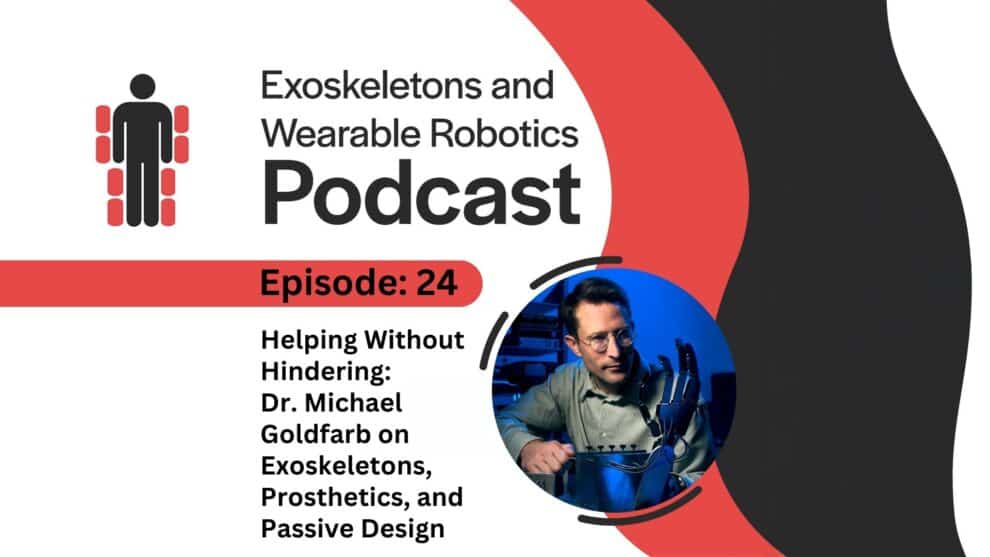
What happens when you have a conversation between two research engineers with 55+ years of experience in powered prosthetics, orthotics, and exoskeletons!? In Episode 24 of the Exoskeletons and Wearable Robotics podcast, we’re joined by Dr. Michael Goldfarb, the H. Fort Flowers Professor of Mechanical Engineering at Vanderbilt University with additional appointments in electrical engineering, computer science, and physical medicine and rehabilitation, and director of the Center for Intelligent Mechatronics.
Dr. Goldfarb’s 30+ years of work focus on wearable robotics and assistive technologies, including powered lower-limb prostheses, multigrasp hand prostheses, and the Indego exoskeleton, one of the first commercially available powered exoskeletons designed to help people with spinal cord injury and other mobility impairments stand and walk. In this episode, Dr. Goldfarb talks with us about the evolution of prosthetics, orthotics, and exoskeletons, what it really takes for devices to “help without hindering,” and where he sees the future of wearable robotics heading.
YouTube version:
Major Timestamps: 00:00:00 — Intro & Patreon Shout-Outs Episode welcome, Who Dr. Michael Goldfarb is, and VIP Patreon acknowledgements. 00:01:09 — Early Robotic Ankles: “Were You Really One of the First?” Asking Michael to react to the claim that he was among the first to make a successful robotic ankle. 00:02:25 — How Did You Get Into This Field? “Can you tell us about your work? What got you interested in this field?” 00:04:23 — Prosthetics, Orthotics, and Exoskeletons: Where’s the Line? Host asks how he sees the boundary between prosthetics, orthotics, medical exoskeletons, and augmentation of able-bodied users. 00:05:24 — Helping Impaired vs Enhancing Healthy Users Discussion around why the “performance bar” is different for people with disabilities vs healthy users. 00:10:29 — Naming the Field: What Do We Call These Devices? Conversation about terminology in an emerging technology field (exoskeletons, wearable robots, etc.). 00:20:29 — Where Is the Real Value Add? Question about when it’s worth adding an exoskeleton vs when existing solutions are already good enough. 00:25:44 — Swing Phase, Stumbling, and Not Getting in the Way Host asks about risks when swing assistance is high at the wrong time and how to avoid tripping users. 00:28:15 — Do Users Feel the Help? Awareness of Assistance Story of a user asking “what was that?” and discussion about whether assistance should be noticeable or invisible. 00:30:35 — Why Haven’t Powered Exoskeletons Taken Off Yet? “We expected to see tons of powered systems by now—what’s holding them back? Marketing, aesthetics, use-case fit?” 00:40:20 — Can Machine Learning Solve Exo–Human Coordination? Asking about the prospects of using machine learning to coordinate exoskeleton actions with user intent. 00:50:33 — Understanding Human Intent “How can I do that—how can I understand what the human wants?” in the context of exo control architectures. 00:57:51 — Outro 🔗
Learn more:
Dr. Michael Goldfarb: H. Fort Flowers Professor of Mechanical Engineering Director, Center for Intelligent Mechatronics – https://www.vanderbilt.edu/vise/visep…
If YouTube is not your favorite way to listen to a podcast, you can access the episode below or at virtually any audio platform.
AI summary of the transcript below, too:
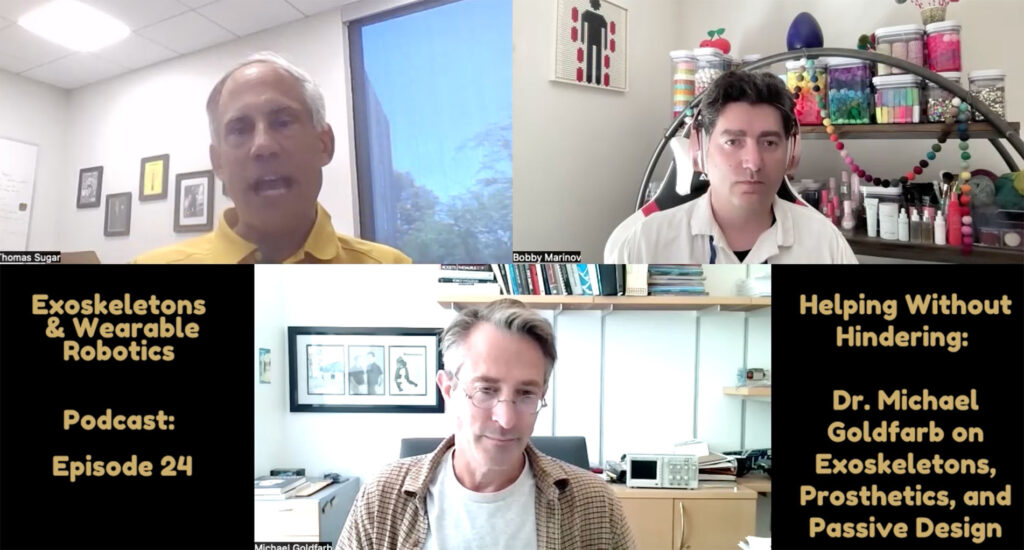
The conversation begins with a warm introduction to Episode 24 of the Exoskeletons and Wearable Robotics podcast and an overview of the guest’s background: a mechanical engineering professor from Vanderbilt University who directs a major research center, earned a PhD at MIT, helped pioneer powered robotic ankles, and played a leading role in developing the Indego exoskeleton, which later became part of Ekso Bionics.
The discussion then shifts to the guest’s long-standing interest in enhancing human movement, starting in high school with work in a VA prosthetics lab. The conversation follows a continuous thread through undergraduate and graduate projects involving upper-limb prostheses, compliant prosthetic feet, prosthetic knees, and ultimately early hybrid exoskeletons, all driven by a desire to improve mobility and functionality for people with physical disabilities.
From there, the conversation shifts to a conceptual discussion of impairment versus augmentation. The guest explains how designing for people with disabilities differs from improving already high-performing, healthy bodies, noting that it is easier to make a noticeable improvement when there is significant impairment, but also easier to disrupt the finely tuned coordination of able-bodied movement if assistance is poorly applied.
Another topic is terminology and semantics: exoskeletons versus orthoses and where medical devices fit in. The guest reflects on earlier use of the term “powered orthosis” for devices like Indego and explains that, functionally, powered orthoses and powered exoskeletons can be essentially the same. The discussion highlights that terms are often chosen based on the audience— “exoskeleton” for technical communities and “orthotic” for medical professionals—and that this is mainly a language and search/patent issue rather than a strict technical boundary.
The discussion shifted to the role of passive devices and the idea of “powered on passive.” Examples such as ankle-foot orthoses, carbon fiber prosthetic ankles, and traditional hydraulic knee prostheses show how much can be accomplished with clever passive mechanics. This introduces the concept that devices should primarily function very well passively, with added power used strategically to improve, not replace, good passive design.
The next topic covers how exoskeletons and prosthetic technologies are evaluated, especially relating to everyday activities. Examples include competitions and challenges that go beyond basic lab walking, such as carrying soup from a counter to a table or navigating a simulated apartment, along with Japanese mobility challenges that imitate real home tasks. The guest sees value in this shift toward realistic usage scenarios but stresses that tasks should match how a device is truly intended to be used.
Accessibility and real-world situations where legged mobility devices can be helpful are also part of the conversation. Typical scenarios are described where exoskeletons could provide upright, weight-bearing movement for health benefits, help access places that are difficult to reach in a wheelchair (like stadium seating or historic districts with stairs and cobblestones), and support social participation by allowing users to interact at eye level during walks, gatherings, and shopping trips.
Where could walking-assist exos see the most use? The discussion then shifts to global differences in built environments, comparing the relatively accessible infrastructure in the United States with the challenges of older European cities and very ancient architecture. This leads to a reflection on how exoskeletons are not meant to replace wheelchairs entirely but can greatly expand access and participation for people with spinal cord injuries and other significant mobility impairments, especially in environments where wheeled devices have difficulties.
This episode ends with a retrospective of the guest’s portfolio: powered ankles and knees, hand devices, and semi-active systems that control elements like clutches, highlighting especially significant projects. Throughout the discussion, themes of user intent, coordination, and the fine balance between mechanical simplicity and powered assistance are emphasized as key principles shaping the future of exoskeletons and wearable robotics.
Thank you to all Patreon supporters for your continuing commitment to popularizing exoskeleton technology via the Exoskeleton Report!

Add Comment